New data proves two-thirds of marketers can't define basic principles. It's time to stop trusting 'vibes' and start using marketing science.
The Professionalism of Guessing
Imagine, if you will, a surgeon leaning over your open chest, scalpel in hand, turning to the nurse and asking, "So, what exactly is a 'heart' again? Is it more of a vibe or a physical organ?" You’d be off that table faster than a junior planner fleeing a 5 PM Friday brief. And yet, in the hallowed, glass-walled halls of marketing, we’ve spent the last decade treating our discipline like a collective improv session where the rules are made up and the budgets don’t matter. Well, the data is in, and it turns out the audience is starting to notice we don't know our lines.
Mark Ritson recently dropped a knowledge bomb that should have sent every CMO in the country into a cold sweat. According to research conducted with Ipsos, a staggering two-thirds of British marketers would fail a basic undergraduate marketing test. We aren't talking about naming the obscure sub-theories of 1970s consumer psychology; we are talking about the bedrock. The stuff that keeps the lights on. The stuff that prevents us from setting millions of pounds on fire in the name of 'brand awareness' without knowing how that awareness actually converts to cash.
The Dunning-Kruger Department
The most delicious - and by delicious, I mean terrifying - part of the study is the overconfidence. Among those who failed the quiz, 83% still rated themselves as "above average" at marketing. We are the only profession that has managed to turn ignorance into a competitive sport. It’s the Dunning-Kruger effect in a designer hoodie. We’ve replaced actual knowledge with a vocabulary consisting entirely of words like 'synergy', 'disruption', and 'authenticity', while completely ignoring the laws of how brands actually grow.
"Marketing is the only profession where you can be a 'Senior Strategic Lead' without being able to explain how a budget actually affects market share."
If you find yourself in that 83% who feels personally attacked right now, let’s do a quick pulse check. Can you explain The Law Of Excess Share Of Voice? Or are you still trying to convince the CFO that your 'organic viral strategy' is going to replace a paid media budget? Because spoiler alert: it won't. The science says that if your share of voice isn't higher than your market share, you aren't growing. You're just managing a very expensive decline.
The Vocabulary of the Uninformed
Why does this happen? Because we’ve decided that 'formal training' is for people who aren't creative enough to have 'instincts'. We treat marketing like it’s an art form that can’t be measured, rather than a social science with repeatable outcomes. When Ritson asked about The Growth By Penetration Law, only 53% of marketers could define it. This is the equivalent of a pilot not knowing what 'lift' is. If you don't understand that brands grow by reaching more light buyers rather than squeezing more blood from the 'loyalist' stone, you aren't doing strategy. You're doing wishful thinking.
Let’s look at the gap between what we think we know and what the evidence actually tells us:
Marketing Concept | The "Vibe" Interpretation | The Evidence-Based Reality |
|---|---|---|
Brand Loyalty | If we love them, they will stay forever. | Double Jeopardy Law: Loyalty is a function of size. |
Targeting | Find a 24-year-old vegan who likes jazz. | Reach Beats Precision: Growth comes from the masses. |
Differentiation | We are the only brand that cares about 'joy'. | The Distinctiveness Law: Being recognized is better than being 'different'. |
Memory | People will remember our deep brand purpose. | The Law Of Memory Building: Consistency builds mental structures. |
Decision Making | Consumers weigh their options rationally. | The Autopilot Law: Most choices are unconscious and easy. |
The High Cost of Being Uneducated
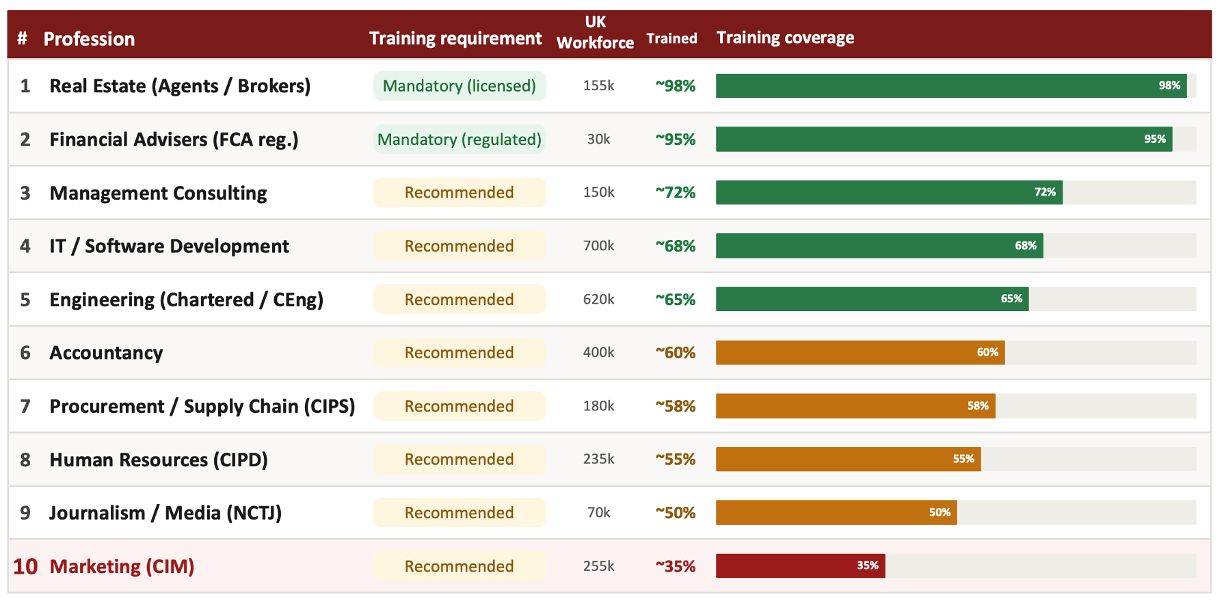
This isn't just about winning at pub quizzes or making Ritson happy. There is a direct correlation between knowing the rules and having a career that doesn't end in a 'restructuring' every eighteen months. Trained marketers are 15% more likely to get their budgets approved. Why? Because when you speak the language of The Law Of Profit And Market Share, the CFO stops looking at you like you’re a child asking for more glitter for their macaroni art. You become a person who understands how money makes more money.
We have a massive library of 61 Marketing Laws on this platform for a reason. It’s not to give you something to read while you wait for your oat milk latte. It’s to give you the ammunition to stop 'guessing' and start 'knowing'. When you understand Distinctive Assets Law, you stop changing the logo every time a new creative director walks through the door. You realize that your brand's font, color, and jingle are more important than your latest 'brand manifesto' video that nobody watched past the three-second mark.
How to Stop Being a Statistic
So, how do we fix the 66% failure rate? We stop pretending that 'learning on the job' from someone who also doesn't know what STP stands for is a valid education. We need to treat marketing like the profession it claims to be. Here is a short Q&A for the self-aware marketer:
Question: Is my 'gut feeling' a valid substitute for marketing science?
Answer: Only if your gut has been reading Ehrenberg-Bass for the last twenty years. Otherwise, your gut is just yesterday's lunch masquerading as insight.
Question: Can I be creative if I follow these 'laws'?
Answer: Constraints are the mother of creativity. Knowing that you need to build Mental Availability doesn't tell you *how* to be interesting, it just tells you *what* the ad needs to achieve. It stops you from being 'critically acclaimed' but commercially invisible.
Question: Where do I even start?
Answer: Start by admitting you might not know as much as you think. Then, dive into the evidence. Stop looking for the 'new' thing and start mastering the 'true' things.
The Professional Path Forward
The marketing industry loves to talk about 'disruption', but the most disruptive thing you can do in 2024 is actually be competent. While everyone else is chasing the latest AI-generated-crypto-metaverse-fever-dream, you could be the one in the room who actually understands how to drive penetration. You could be the one who knows that Physical Availability is just as important as a flashy TV spot.
Don't be part of the two-thirds. Don't be the marketer who thinks 'penetration' is something that only happens in a lab. Use the tools at your disposal. Read the laws. Watch the real-world campaigns that actually worked and understand *why* they worked. Because at the end of the day, marketing is too expensive - and too much fun - to be left to guesswork.