Tom Roach is the marketing world’s favorite bridge-builder. We dive into his latest frameworks for ending the brand vs. performance civil war.

The Great Marketing Civil War is Over (If You Want It)
For the last decade, marketing departments have looked like a bad divorce. On one side of the hallway, you have the Brand team - people who wear expensive glasses, talk about 'emotional resonance,' and spend six months arguing over the exact shade of cerulean for a 60-second TV spot. On the other side, you have the Performance team - data-crunching hermits living in a cave of spreadsheets, obsessed with 'last-click attribution' and 'efficient scaling,' treating humans like Pavlovian dogs who only respond to 10% off coupons.
Then comes Tom Roach and finally somebody looking at both worlds without prejudice!
Roach, currently the VP of Effectiveness at Jellyfish and a veteran of creative powerhouses like BBH and adam&eveDDB, has spent his career politely pointing out that this separation is, quite frankly, a suicide note for growth. In a recent session with David Tilman, Roach laid out a series of frameworks that finally stop the bickering. It’s called 'Bothism,' and if you aren’t practicing it, you’re likely staring at a very expensive ceiling.
The Existential Dread of the Performance Plateau
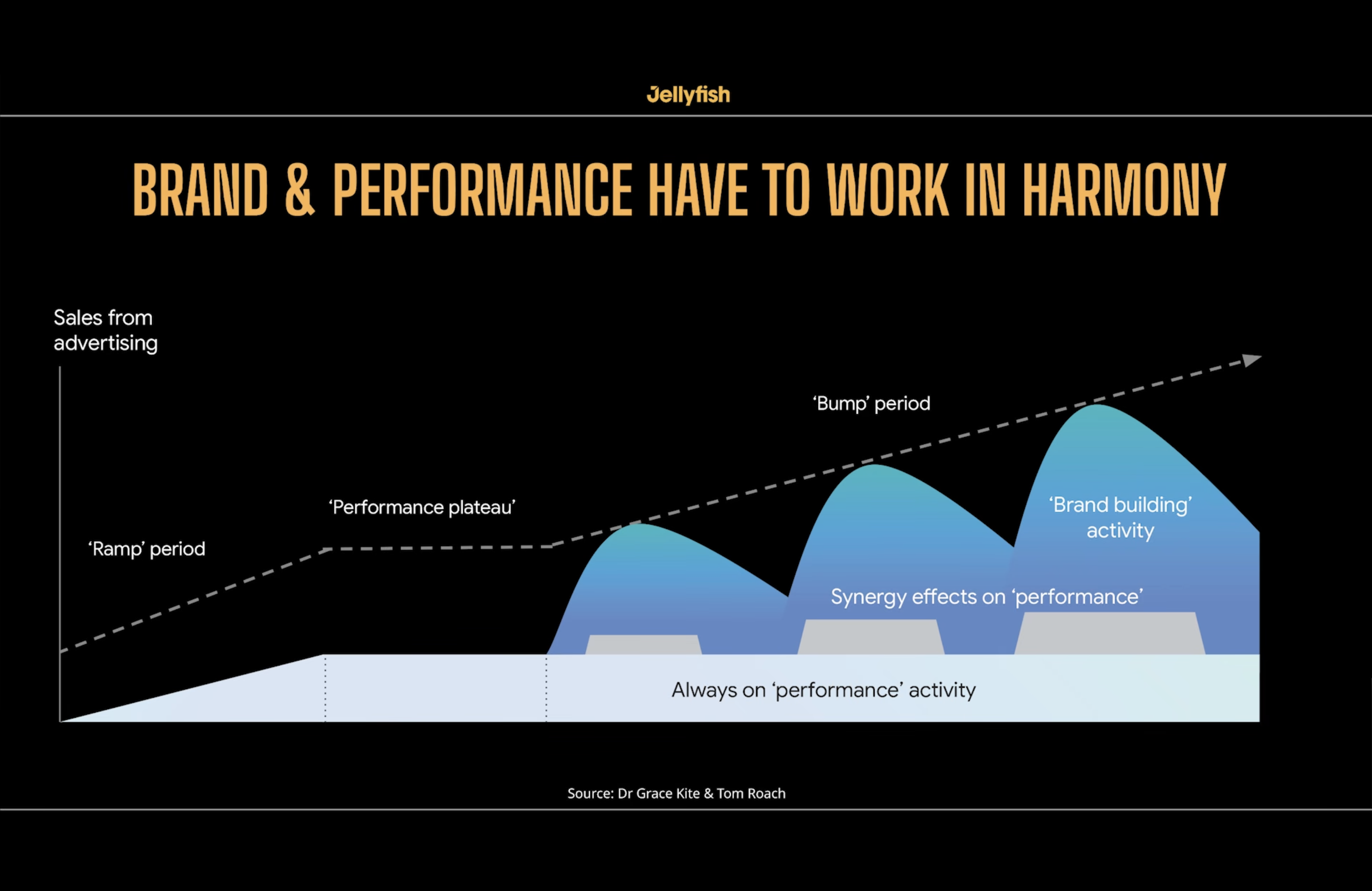
Digital-first brands usually start with a bang. They find a niche, pour money into Meta and Google, and watch the sales climb. It feels like magic until it doesn't. Suddenly, the customer acquisition cost (CPA) starts creeping up. You double the budget, but the sales stay flat. You’ve hit what Roach and Dr. Grace Kite call the Performance Plateau.
This happens because performance marketing is essentially 'harvesting' existing demand. You are picking the low-hanging fruit. Eventually, you run out of fruit. If you haven't been planting new trees (building a brand), you’re finished. This is where The Law Of The Long And Short becomes painfully real. Performance marketing captures the 'now,' but brand investment builds the 'next.'
The 'Triple Whammy' of Unified Marketing
Investment Type | Primary Function | The Unified Result |
|---|---|---|
Brand Building | Creates mental availability and future demand | Lowers long-term CPA and increases price elasticity |
Performance Marketing | Captures existing demand and directs to sale | Provides immediate cash flow and data signals |
Unified 'Bothism' | Synergistic execution across all touchpoints | The 'Triple Whammy': Growth, Base Sales, and Efficiency |
The Funnel is Dead. Long Live the 'Messy' Reality.
Roach is a vocal critic of the traditional 100-year-old linear funnel. You know the one: Awareness -> Consideration -> Conversion. It’s a neat little diagram that bears absolutely no resemblance to how actual humans shop. People don't 'consider' brands in a vacuum; they inhabit a 'messy middle' of triggers and memories.
Roach proposes a modified, more realistic model of how we actually move people:
Building (The Top): This isn't just 'awareness' (which is often a vanity metric). It’s about building Mental Availability. You want your brand to be the first thing that pops into a head when a Category Entry Point is triggered.
Nudging (The Middle): Forget 'consideration.' This stage is about refreshing memories. It’s the digital equivalent of a tap on the shoulder. You’re reinforcing the associations you built in the first stage.
Directing (The Bottom): Roach argues that the bottom of the funnel - including Search - is often just navigational. You aren't 'converting' a neutral person; you are simply pointing someone who has already decided to buy toward the checkout counter.
"Search is a navigational tool for brands people already know. If they don't know you, they aren't searching for you. They're searching for your category, and you're just bidding on a lottery."
Lots of Littles: The Creative Fragmentation Strategy
In the old days, you made one 'Big' TV ad and called it a day. Now, a brand might need a million assets a year to feed the TikTok and Meta algorithms. This is what Roach calls 'Lots of Littles.'
The trick isn't to make one big thing and chop it up. It’s to ensure that every 'little' piece of content - no matter how small - carries the Distinctive Assets of the brand. Whether it’s a 6-second bumper or a Reddit comment, it needs to look, feel, and sound like you. When you align these 'littles,' you get a synergy effect. Research suggests this synergy can account for 30–40% of overall effectiveness. You aren't just running ads; you're building a Brand Myth through a thousand tiny interactions.
The New Audience: Share of Model (AI)
Perhaps the most forward-thinking part of Roach’s discussion involves 'Share of Model.' We used to obsess over Share of Voice. Then we realized Share of Search was a better predictor of market share. Now, we have to worry about what Large Language Models (LLMs) think of us.
If a consumer asks ChatGPT, "What's the best mountain bike for a beginner?", and your brand isn't in the response, you don't exist in that moment of 'Directing.' Marketers now have two audiences: humans and AI agents. This leads to GEO (Generative Engine Optimization). You need to be an authoritative voice in the data these models are trained on - which means being active in the places AI 'reads,' like Reddit and high-authority industry publications.
How to Apply the Roach Doctrine
If you're tired of hitting the plateau, it's time to stop treating your marketing like a binary choice. Here is how to start 'Selfstorming' your way out of the performance trap:
Audit your silos: If your brand and performance teams don't share a Slack channel or a KPI, fix it today. They are two halves of the same engine.
Identify your Category Entry Points: Use our Category Entry Points (CEP) tool to find the 'when' and 'where' people actually think of your product.
Kill the rational bias: Remember The Law Of Emotion Over Reason. Performance ads can be rational, but your brand building needs to make them feel something, or they won't remember you when the 'nudging' starts.
Build a Utility: Sometimes the best way to bridge the gap is to Build an Utility, Not an Ad. Look at how BVG turned a shoe into a transit pass. That is bothism in its purest form.
Tom Roach’s brilliance lies in his refusal to accept that the 'new economy' requires us to throw out the old rules. The tools change - from TV spots to LLM training data - but the human brain remains the same stubborn, emotional, shortcut-seeking machine it’s always been. Stop choosing sides. Choose growth.
Here's the podcast: