New data from the industry-first 'Brand Reset' study proves that chasing cheap impressions is a one-way ticket to the marketing doom loop. Here is the science.

The Great Performance Hangover
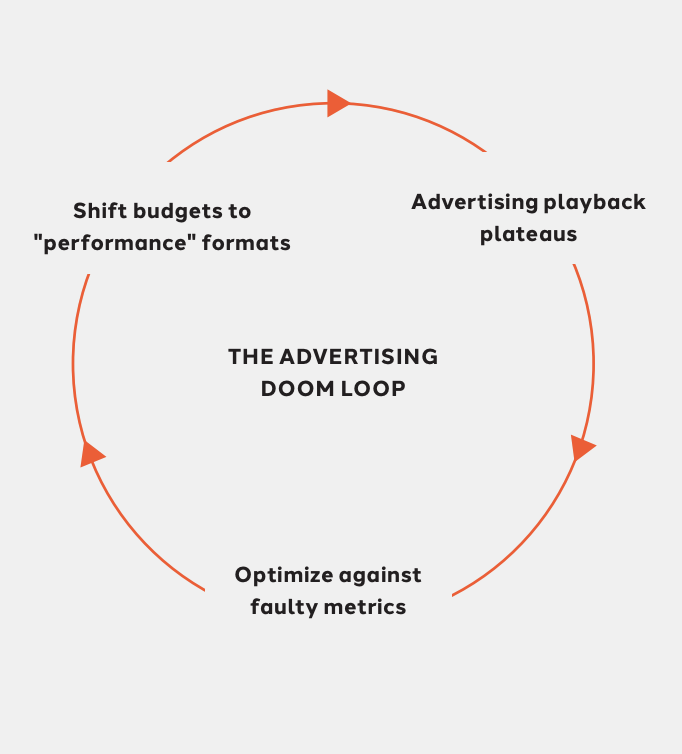
If you have spent the last five years obsessing over cost-per-click (CPC) and short-term attribution, I have some news that might make your CFO’s eye twitch: you’ve been chasing a ghost. While we were all busy high-fiving over 'efficient' digital spends, we accidentally entered what the industry is calling the Doom Loop. It is a cycle where we optimize for clicks, watch our creative effectiveness plateau, and then shift even more budget into performance formats to 'fix' the problem. Spoiler alert: it doesn't work.
According to the groundbreaking Brand Reset study by dentsu, in partnership with Kantar and Lumen, the era of solely focusing on short-term results is officially over. We are finally seeing the quantifiable link between attention, brand equity, and long-term sales. It turns out that The Law Of Being Ignored is the most expensive line item in your budget.
Attention is Not Just a Vanity Metric
For years, we treated attention as a 'nice-to-have'—a fluffy metric for the artsy folks in the creative department. The Brand Reset study, which analyzed over 40,000 video exposures, proves that attention is actually the engine of The Law Of Brand Compounding. Without attention, there is no memory building. Without memory building, there is no mental availability. And without mental availability, you’re just a commodity waiting for a price war you’ll eventually lose.
"Marketers intuitively recognize that brand building captures attention, but storytelling often falls short in front of CFOs where performance-driven investments feel like a safer bet." — Will Swayne, dentsu
The 5 Actionable Insights from the Brand Reset Study
The study breaks down the data into five critical shifts that should change how you plan your next campaign. If you are still using the 2018 playbook, you are essentially bringing a knife to a gunfight—and the knife is blunt.
Insight | The Old Assumption | The New Reality |
|---|---|---|
Long-term Reach | Only Linear TV builds brands long-term. | Digital video (including short-form) delivers multi-year brand effects. |
The CTV Powerhouse | Connected TV is just 'web video' on a big screen. | CTV builds brands on par with Linear TV, upending the old hierarchy. |
Voluntary Attention | Forced (non-skippable) views are always better. | Second-for-second, voluntary attention works harder than forced views. |
The 20-Second Cap | More attention is always better. | After 20 seconds, attention delivers diminishing returns for brand impact. |
The Sales Link | Attention only drives 'awareness'. | Attention is now directly linked to both brand equity and long-term sales. |
Why Forced Attention is a False Prophet
We’ve all been guilty of buying non-skippable pre-roll because it guarantees a 'view.' But the data shows that when people choose to watch an ad, the quality of that exposure is significantly higher. Forced attention often creates irritation, which—let's be honest—is the opposite of the 'warm and fuzzy' brand equity we're aiming for.
Creative Strategy: Quality over Quantity
To win in the Algorithmic Era, your creative needs to do more than just exist; it needs to earn its keep. You aren't just looking for eyeballs; you are looking for active attention.
Elicit Emotion: Emotional advertising outperforms rational ads every single time. Reference The Law Of Emotion Over Reason if your client asks for more bullet points in the VO.
Align with the Algorithm: Creative production must match platform requirements. A TV cut-down rarely works on TikTok.
Think Beyond the Campaign: Brand building is a marathon, not a sprint. Stop looking at 90-day windows and start looking at 3-year horizons.
The CFO Conversation: Proving the ROI
The most significant part of this study is the quantifiable framework it provides. We can finally stop talking about 'brand love' and start talking about 'predictable, sustained financial performance.' By linking attention to brand equity shifts, we can prove that skipping the brand-building phase is actually a Short-Term ROI Bias trap.
If you want to see how the big players are doing it, check out our Data as Playwright playlist. These are brands that didn't just look at spreadsheets; they turned data into drama. They used attention not as a metric to be bought cheaply, but as a resource to be invested wisely.
Planning for the 'Reset'
How do you apply this tomorrow? Start by auditing your media mix. Are you over-indexed on forced, low-quality impressions? Are you ignoring CTV because 'it's too expensive'? The Brand Reset suggests that the 'expensive' media might actually be the most efficient when you factor in the multi-year brand effects.
Common Questions for Strategists:
Q: Does this mean we stop doing performance marketing?
A: Absolutely not. But you need to balance it. Think of the 60/40 Law. Performance harvests demand; brand building creates it. You can't harvest what you haven't grown.
Q: Is short-form video actually good for brand building?
A: Yes, the study confirms it. Short-form digital video delivers long-term effects that were previously thought to be exclusive to TV. The 'doom scrolling' audience is actually building memories—if your creative is good enough to stop the thumb.
"The era of solely focusing on short-term results through cheap clicks is over." — The Brand Reset Study
Final Thoughts: Don't Be a Commodity
The Brand Reset is a wake-up call for an industry that has become addicted to the sugar hit of the last-click attribution. It’s time to reclaim the power of storytelling and the science of attention. If you’re struggling to find the right angle for your next campaign, use our Creative Session tool to bridge the gap between marketing science and 'unhinged' creative ideas. Because at the end of the day, being noticed matters more than being 'efficiently' ignored.