Clash Royale: Copycats Welcome
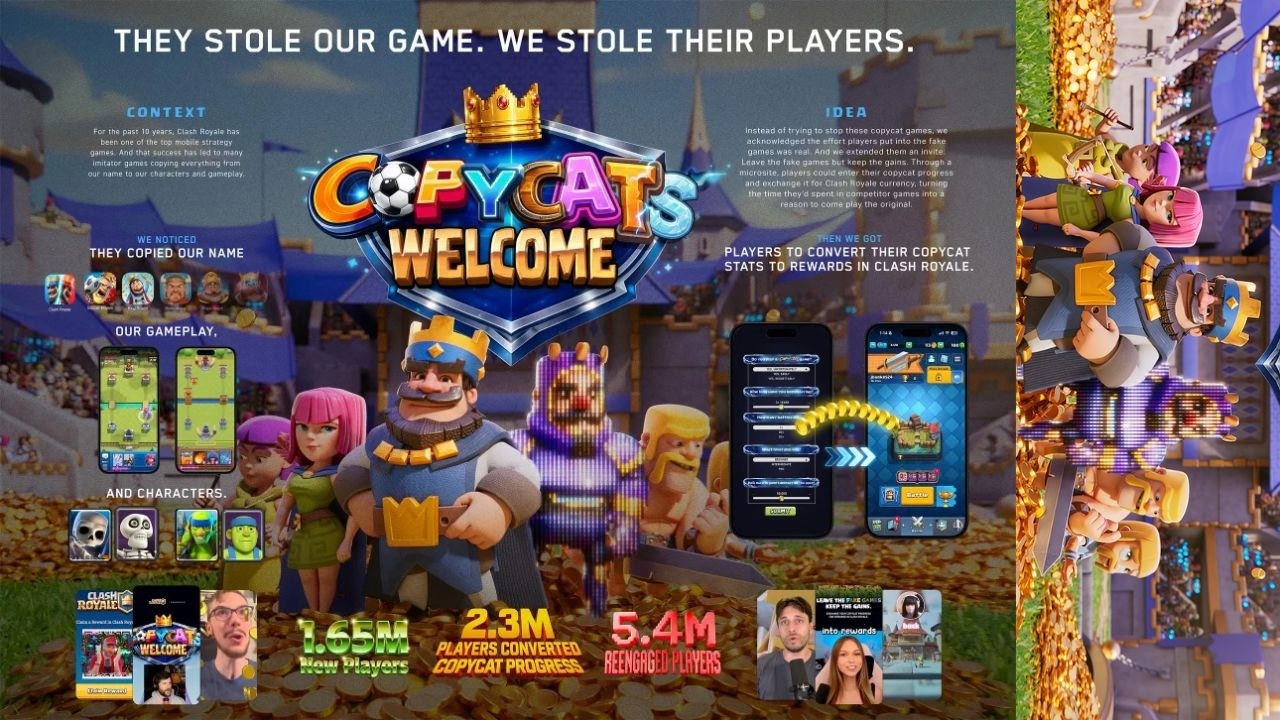
Clash Royale tasked DAVID New York with addressing the proliferation of low-quality game clones that were siphoning off their player base. The client needed a strategy to reclaim these players without resorting to costly, adversarial legal battles. The objective was to incentivize migration back to the original game by acknowledging the time players spent elsewhere and offering a seamless, rewarding transition.
Creative Idea
The brand invited players of knock-off games to trade their progress for real rewards.
Clash Royale turned the annoyance of mobile game clones into a player acquisition engine by inviting users of knock-off games to 'trade in' their progress for rewards, effectively weaponizing the competition's own user base against them.
Weaponizing The Competition To Reclaim Millions
A Masterclass In Player Amnesty
The campaign achieved immediate, massive scale, welcoming 1.65 million new players back to the game within days of launch. By treating the gaming ecosystem as a shared pool rather than a battlefield, the brand successfully converted 2.3 million players who transferred their progress from knock-off titles. This rapid velocity saw over 2.3 million players utilize the progress-swap engine in just the first 5 days, proving that acknowledging a user's history is a more effective retention tool than litigation.
Inside The Glitchy Multiverse
The production process, led by Believe TV in Santiago, focused on creating a visual language that felt intentionally "off." The animated spot follows the original Clash Royale characters as they are pulled into a series of distorted, low-quality worlds—parodies of real-world clones like Bash Royale and Space Royale. To maintain the authentic feel of a budget mobile clone, the sound design by Sonic Union utilized specific, jarring audio cues that mimic the cluttered, ad-heavy interfaces typical of these imitators.
The Honor System Strategy
A surprising detail of the campaign was the reliance on an honor system for the progress-swap. Rather than requiring complex data verification or backend integration with rival games, the team launched a dedicated microsite, copycatswelcome.com. Players simply answered a few self-reported questions about their time in clone games to claim their rewards, which included up to 50,000 Gold, 200 Common Wild Cards, and a 3-star Lucky Magic Chest. This frictionless approach prioritized user experience over technical gatekeeping, turning a potential legal headache into a massive, community-driven acquisition engine.
Creative Strategy Deconstructed
Company
As the original market leader, the brand possessed the authority and game assets to offer genuine value to returning players.
Category
Mobile gaming companies typically rely on aggressive legal action or cease-and-desist orders to combat intellectual property theft by clone developers.
Customer
Players felt frustrated by low-quality clones but were reluctant to lose the time and progress they had already invested.
Culture
The rise of 'amnesty' marketing and the growing consumer appreciation for brands that acknowledge and respect user effort.
Company
As the original market leader, the brand possessed the authority and game assets to offer genuine value to returning players.
Category
Mobile gaming companies typically rely on aggressive legal action or cease-and-desist orders to combat intellectual property theft by clone developers.
Strategy:
Convert competitive threats into a growth pipeline by validating the user's previous investment of time.
Customer
Players felt frustrated by low-quality clones but were reluctant to lose the time and progress they had already invested.
Culture
The rise of 'amnesty' marketing and the growing consumer appreciation for brands that acknowledge and respect user effort.
Strategy:
Convert competitive threats into a growth pipeline by validating the user's previous investment of time.
Strategy Technique
Turn Weakness Into Strength
Instead of fighting clones with legal threats, the brand treated them as a source of new players. This transformed a frustrating IP issue into a massive, positive acquisition strategy that respected the player's time.
Explore Technique
Creative Technique
Make a Parody
The campaign parodies the low-quality aesthetic of mobile game clones to highlight the superiority of the original. By mocking these knock-offs, it creates a clear visual distinction that validates the player's choice to return.
Explore Technique
Craft Breakdown
This campaign stands out for its exceptional 3D animation and art direction, which brilliantly contrast the high-quality look of the official game with the cheap, humorous designs of its knock-offs.
The character animations are fluid and expressive, capturing the distinct personalities of the Clash Royale cast.
The visual contrast between the polished official game and the poorly designed knock-offs is executed with great humor and detail.
“The synergy between the high-quality animation and the clever art direction makes the parody of knock-off games highly effective and entertaining.”