2025NescaféConsumer GoodsCase video
Nescafé: Decaf Billboards
NESCAFÉ® needed to reinforce the sleep-friendly benefit of its decaf coffee in Panama City. The client faced a challenge where traditional advertising was seen as intrusive, particularly due to light pollution in high-density residential areas. Ogilvy was tasked with finding a way to communicate the product's value while addressing the city's growing frustration with digital billboards, aiming to build brand affinity through a positive, civic-minded intervention.
Creative Idea
The brand turned intrusive digital billboards into dimmers to help residents sleep better.
To prove that NESCAFÉ® Decaf won't keep people awake, the brand transformed digital billboards in Panama City into city dimmers. By displaying dark, soothing coffee visuals at night, they reduced light pollution and provided residents with a peaceful, restful environment.
Dimming Panama City's Sky to Guarantee Restful Nights
Visual Pollution Disrupting Panama City's Sleep
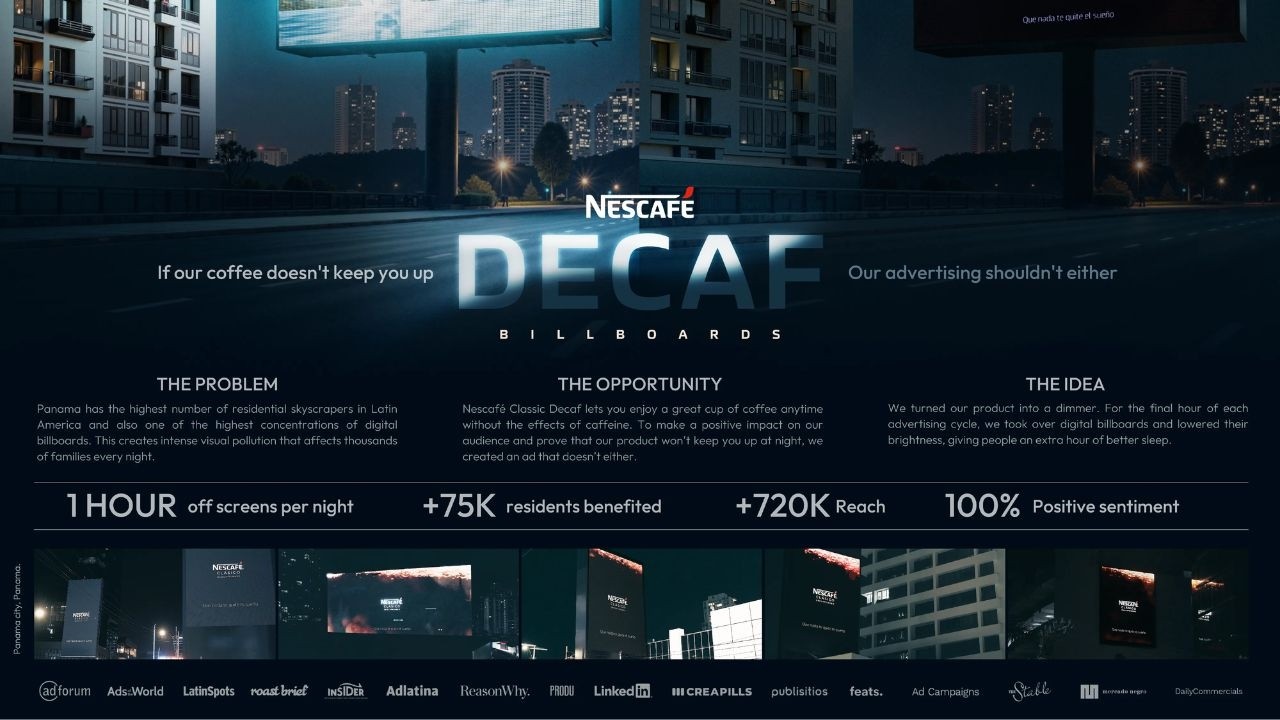
Panama has the highest concentration of skyscrapers in Latin America, and Panama City is filled with an ultra-high concentration of bright digital billboards. As a result, families living in high-density residential skyscrapers face intense artificial light at night that disrupts their sleep.
Nescafé Clásico Decaf offers the taste of coffee without caffeine's effects. To position the brand as a guarantor of sleep, the campaign aimed to show that the product does not disrupt rest by ensuring its advertising does not either.
Turning High-Traffic Billboards Into Urban Dimmers
The media strategy, executed with billboard owner JCDecaux, targeted high-traffic thoroughfares with dense skyscraper concentrations, specifically Avenida Central España and Calle 50. The team bought high-disruption digital slots facing residential units to dim them or turn them off earlier than usual.
For the final hour of each ad cycle, the brand took over the screens under the concept line "Let nothing take away from you a good rest." Replacing bright commercial content, the art direction used slow-motion footage of dark decaf coffee filling up the screens to serve as a visual dimmer, giving the city an extra hour of peace. Production was handled by VFX Panamá.
Perspectives on the Campaign
We turned our product into a dimmer.
If our coffee doesn't keep you awake, then our ads shouldn't either.
This initiative was born from a reality that is becoming increasingly evident: visual pollution also affects our sleep.
At Star5 and Ogilvy, we strive to create ideas that don't just communicate but actually improve people's lives.
4 Points Strategy deconstruction
This framework highlights how Nescafe aligned brand promise with media behavior to turn intrusive ad formats into proof of product benefit.
Results
The Nescafé "Decaf Billboards" campaign reached over 720,000 people and benefited more than 75,000 residents by reducing digital light pollution in high-density areas. The initiative achieved 100% positive sentiment across public comments and social media reactions.
75,000+
Residents benefited from reduced light pollution
720,000+
Total reach generated
100%
Positive sentiment across public reactions
Strategy Technique
Build an Utility, Not an Ad
The brand moved beyond traditional messaging by creating a functional solution to the urban light pollution problem. This approach proved the product's sleep-friendly benefit through direct, helpful action rather than just claiming it in an advertisement.
Explore Technique
Creative Technique
Unexpected Utility
The campaign repurposed intrusive advertising screens into a functional tool that reduced light pollution. This transformed a standard media buy into a tangible service that directly improved the nighttime quality of life for local residents.
Explore Technique
Craft Breakdown
This campaign's strength lies in media planning innovation and art direction, repurposing outdoor screens into a brand demo that solves an actual urban problem.
Strategically buying high-disruption digital billboard slots facing residential units specifically to turn them off/dim them earlier.
Visually using dark decaf coffee filling up bright digital screens to turn the screen into a literal darkness dimmer.
“The media placement strategy directly delivers the product promise through smart art direction on DOOH screens.”
Questions about Nescafé: Decaf Billboards
Who created the Nescafé Decaf Billboards campaign?
The campaign was created for Nescafé Clásico Decaf (Nestlé) by Star5 (Star5 Creative Ogilvy) alongside Ogilvy in Panama, with media execution by JCDecaux and production by VFX Panamá.
Where and when did the campaign launch?
The campaign launched in Panama City in April 2025, specifically running along Avenida Central España and Calle 50.
How did the Decaf Billboards work?
During the final hour of each advertising cycle, Nescafé bought out digital billboard slots facing residential skyscrapers and replaced bright commercial ads with slow-motion visuals of dark decaf coffee pouring, effectively dimming the screens.
What problem did the campaign aim to solve?
Panama City has a high concentration of residential skyscrapers surrounded by bright digital billboards that create light pollution and disrupt residents' sleep at night.
What were the main results of the campaign?
The campaign reached over 720,000 people, directly benefited more than 75,000 local residents by cutting down nocturnal light pollution, and earned 100% positive sentiment on social media and public comments.
Credits (8)
| CCO Ogilvy LATAM | Keka Morelle |
|---|---|
| CCO Star5 | Jorge Heilbron |
| CEO Star5 | Gabriel Barletta |
| General Creative Directors | Werner Lemke, Camilo Garzón |
| Creative Director | Danny Marmol |
| Art Directors | Leslie Neyme, Alberto Weand |
| Communication & NHW Director (Nestlé) | Kim Waigel |
| Business Executive Officer for Nescafé Brands | Susanne Cochez |
Sources (3)
- decaf billboards - Ads of the World · adsoftheworld.com
- NESCAFE Decaf Billboards - Marketing Oops! · marketingoops.com
- Star5/Ogilvy: Nescafe Clasico Decaffeinated dims Panama City's brightest billboards - The Stable · thestable.com.au