Honda sought to elevate the Accord's perception beyond mere transportation, aiming to highlight its superior engineering and reliability. The client wanted to appeal to discerning customers who valued precision and seamless functionality in their vehicles.
Creative Idea
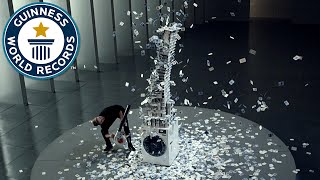
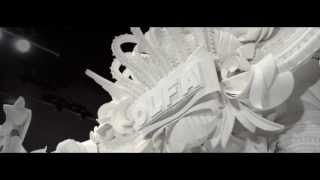
A Rube Goldberg machine built from car parts demonstrated engineering precision.
The campaign ingeniously used a mesmerizing Rube Goldberg machine built from Honda Accord parts to visually demonstrate the brand's engineering precision and the seamless functionality of its vehicles, resonating with viewers who appreciate meticulous craftsmanship and reliability.
The 606 Takes That Redefined Engineering
Two Pre-Production Accords Sacrificed
To create the two minute sequence, Honda provided two of only six hand-built pre-production Accord models in existence. The crew completely disassembled these vehicles to source the 85 individual parts used in the chain reaction. Director Antoine Bardou-Jacquet and the team at Partizan spent months in a Paris studio, where some components required placement with a precision of 1/16th of an inch. The most famous sequence - tires rolling uphill - was achieved without magnets or trickery; instead, internal copper weights were positioned so that a slight nudge shifted the center of gravity.
A Masterful Stitch in Time
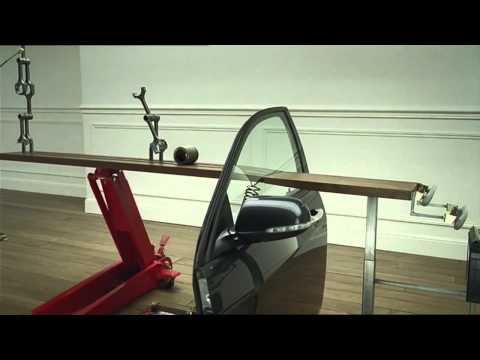 While the ad appears as one continuous shot, it is actually two takes joined at the one minute mark. The splice occurs when the exhaust pipe rolls across the floor. This was a logistical necessity because the studio was not long enough to accommodate the entire mechanical sequence. Despite the complexity, the production famously used no CGI, relying entirely on physics and mechanical timing. The final film was the result of 606 takes over several days of shooting, though many of these were partial setup tests.
The 400 Million Pound Effect
The campaign transformed Honda from a "reliable but dull" brand into a symbol of "warm, human engineering." Following the debut during the 2003 Brazilian Grand Prix, Honda UK sales surged by 28%, generating an estimated £400 million in additional revenue. Web traffic quadrupled to 55,000 visits per week, and the brand saw its dealership conversion rate jump from 19% to 22%. Even the "making-of" DVD became a cult item, with 10,000 people requesting a copy to see how the "Cog" machine functioned.
Creative Strategy Deconstructed
Company
Honda credibly delivered engineering excellence and meticulous design, showcasing its commitment to precision and reliable vehicle construction.
Category
Car advertising often focused on speed, luxury, or lifestyle, but this campaign broke norms by highlighting the intricate internal mechanics and engineering.
Customer
The audience desired vehicles that were dependable and well-engineered, appreciating the satisfaction of products that simply "work" flawlessly.
Culture
The cultural moment celebrated intricate mechanical ingenuity and the satisfying aesthetic of complex, perfectly executed chain reactions, like viral Rube Goldberg videos.
Company
Honda credibly delivered engineering excellence and meticulous design, showcasing its commitment to precision and reliable vehicle construction.
Category
Car advertising often focused on speed, luxury, or lifestyle, but this campaign broke norms by highlighting the intricate internal mechanics and engineering.
Strategy:
Visually manifest inherent product quality to reinforce trust and appreciation for meticulous engineering.
Customer
The audience desired vehicles that were dependable and well-engineered, appreciating the satisfaction of products that simply "work" flawlessly.
Culture
The cultural moment celebrated intricate mechanical ingenuity and the satisfying aesthetic of complex, perfectly executed chain reactions, like viral Rube Goldberg videos.
Strategy:
Visually manifest inherent product quality to reinforce trust and appreciation for meticulous engineering.
Strategy Technique
Dramatize the Invisible Benefit
The campaign visually amplified the often-unseen precision and interconnectedness of a car's internal components. It dramatically showcased the inherent engineering quality, turning an abstract benefit into a tangible, captivating experience.
Explore Technique
Creative Technique
Show, Don't Tell
The campaign visually demonstrated Honda's engineering precision through an intricate Rube Goldberg machine. This allowed viewers to experience the concept of seamless functionality rather than simply being told about it.
Explore Technique
Craft Breakdown
This campaign's craft is exceptional due to the meticulous design and execution of its Rube Goldberg machine, coupled with stunning cinematography and sound design that elevate it into a visual and auditory masterpiece.
The intricate Rube Goldberg machine, built entirely from Honda Accord parts, is a feat of engineering and creative design, meticulously planned and constructed to ensure every interaction works flawlessly.
The camera work is incredibly precise, utilizing smooth tracking shots and perfectly framed close-ups to capture every minute detail and transition within the complex sequence with clarity and artistry.
The sounds of the car parts are expertly recorded and mixed to create a rhythmic, almost musical score that drives the narrative and enhances the mechanical satisfaction of each interaction.
The editing seamlessly weaves together hundreds of individual actions into a continuous, flowing sequence, maintaining perfect timing and rhythm without any jarring cuts, crucial for the illusion of a single take.
“The true magic of this campaign lies in the flawless synergy between the intricate production design, the precise cinematography, and the meticulously crafted sound design, all working in concert to create a believable and mesmerizing spectacle.”