Volvo: The E.V.A. Initiative
Volvo wanted to reinforce its heritage as the world's safest car brand while addressing a specific safety gap. Forsman & Bodenfors was tasked with engaging female car buyers, who felt ignored by the industry, by highlighting Volvo's long-term commitment to protecting everyone, regardless of gender or size, and driving a global conversation about safety equity.
Creative Idea
Volvo open-sourced 40 years of crash data to expose and fix industry-wide gender bias.
Volvo addressed the "deadly truth" that cars are designed for men by open-sourcing 40 years of gender-diverse crash data, inviting competitors to use their research to make vehicles safer for everyone, reinforcing Volvo's position as the ultimate safety leader.
Forty Years of Data and a Virtual Mother Named Linda
The Deadly Truth of Male Centric Design
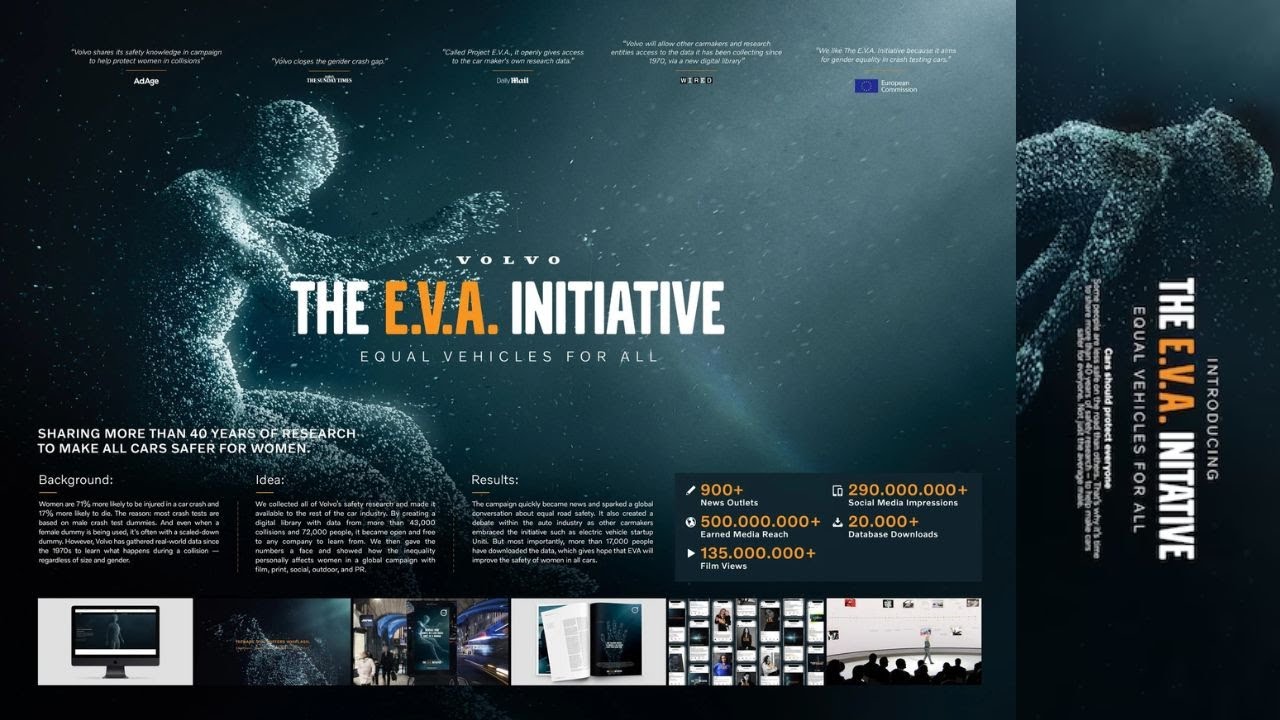
The initiative was built on a staggering data insight: women are 71% more likely to be injured and 17% more likely to die in car crashes because standard testing uses male dummies. To combat this, Volvo open - sourced 40 years of research involving 43,000 collisions and 72,000 people. While the team initially hoped for a few hundred downloads, the research was accessed over 40,000 times, with competitors like Uniti publicly adopting the data to improve their own vehicle designs.
Visualizing the Invisible Impact
Director Laerke Herthoni and Goodbye Kansas Studios opted for a radical creative choice: the main film features no actual cars. Instead, they used performance capture and CG animation to visualize how a crash impacts the human anatomy. This "stripped - down" aesthetic was paired with the haunting track "Without You" by Lapalux. The campaign also highlighted "Linda," the world’s first virtual pregnant crash test dummy developed by Volvo in 2002 to study seatbelt interactions with the womb.
Measuring Safety Equity
The campaign achieved a 317 million earned media reach and an all - time high in brand awareness at 43%. Beyond sentiment, it drove a 34% spike in web traffic and a 25% increase in car configurations. One print execution even featured a "Hand Test," where readers placed their hand on the page; if it didn't match the "average male" print, they were informed they were statistically less safe in most vehicles. This shifted the brand's narrative from selling features to advocating for "safety equity."
Creative Strategy Deconstructed
Company
Volvo possessed 40 years of real-world crash data covering men, women, and children, unlike most of the automotive industry.
Category
The automotive category traditionally relied on male-sized crash test dummies, leaving women at a significantly higher risk of injury.
Customer
Women, who influence most car purchases, felt misunderstood by an industry that prioritized male safety standards over their own.
Culture
A growing global demand for gender equality and corporate transparency made open-sourcing proprietary safety data a powerful, selfless act.
Company
Volvo possessed 40 years of real-world crash data covering men, women, and children, unlike most of the automotive industry.
Category
The automotive category traditionally relied on male-sized crash test dummies, leaving women at a significantly higher risk of injury.
Strategy:
Sacrifice proprietary assets to expose systemic industry inequality and establish moral authority through radical transparency.
Customer
Women, who influence most car purchases, felt misunderstood by an industry that prioritized male safety standards over their own.
Culture
A growing global demand for gender equality and corporate transparency made open-sourcing proprietary safety data a powerful, selfless act.
Strategy:
Sacrifice proprietary assets to expose systemic industry inequality and establish moral authority through radical transparency.
Results
The E.V.A. Initiative achieved a massive global impact, reaching over 90 million people on social media and generating an earned media reach of 317 million. The campaign film garnered over 85 million views and triggered more than 3 million engagements, resulting in a 280 million social media impression count. Most significantly, the open-source safety research was downloaded over 40,000 times, vastly exceeding the initial goal of a 'couple of hundred.' Business impact was equally strong, with a 34% increase in web traffic, a 25% increase in car configurations, and 1,000 additional business leads (a 26% increase). Brand sentiment reached an all-time high in 'Ad Awareness' at 43%, with 'Ad Liking' at 75% (surpassing the 63% benchmark). The campaign won the Cannes Lions Grand Prix for Creative Strategy and a Titanium Lion, alongside Best of Show at The One Show and multiple Grand Prix at Eurobest.
40,000+
Safety data downloads by competitors and public
317M
Earned media reach across 70 countries
+34%
Increase in website traffic
Strategy Technique
Attack a Cultural Blind Spot
The campaign called out the industry's quiet acceptance of male-centric safety standards. It transformed dry crash statistics into a moral imperative for equality, forcing a global conversation about gender-inclusive design.
Explore Technique
Creative Technique
Expose the Hidden
It revealed the shocking, invisible gender bias in automotive safety testing. By visualizing the internal impact on female bodies and sharing proprietary data, it made a hidden industry-wide failure impossible to ignore.
Explore Technique
Craft Breakdown
The campaign masterfully humanizes cold data by stripping away the product entirely, using visceral visual effects to illustrate the 'deadly truth' of gender-biased design.
Goodbye Kansas Studios used performance capture and CG to visualize internal anatomical impact without showing a single physical car.
Transformed 40 years of complex crash data into an accessible digital library and interactive print ads like the 'Hand Test'.
Strategically timed with the 60th anniversary of the seatbelt patent gift to position Volvo as a selfless industry leader.
The haunting track 'Without You' by Lapalux provided a somber, urgent emotional layer to the technical subject matter.
“The magic lies in the contrast between the clinical transparency of the open-source data and the haunting, artistic visualization of the human body's vulnerability.”