Inakadate Village: Rice Code
Inakadate Village, working with Hakuhodo, faced significant rural decline and a lack of tourism. They sought to attract visitors and revitalize their local economy by leveraging their agricultural heritage. The client aimed to create a unique attraction that would put the village on the map and generate sustainable economic growth among domestic and international tourists.
Creative Idea
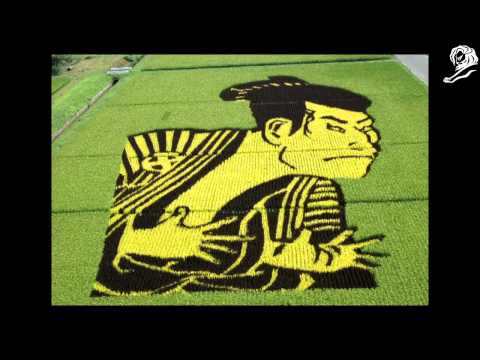
They turned rice paddies into giant, intricate art installations using different colored rice.
Inakadate Village transformed traditional rice paddies into spectacular, large-scale art installations using different colored rice varieties, captivating audiences and drawing tourists to revitalize the local economy by turning agricultural land into a unique, living gallery.
Turning Ancient Soil Into A Digital Storefront
Anamorphic Math and Seven Colors
To ensure the art appeared perfectly proportioned from the 22-meter-high observation tower, Hakuhodo utilized precise CAD modeling to create anamorphic designs. This corrected a famous 2003 "failure" where a Mona Lisa mural appeared "pregnant" due to poor perspective. The final 2014 execution used seven colors of rice derived from 13 different strains, including ancient purple and yellow varieties. Every year, approximately 1,300 local volunteers plant these seedlings by hand to bring the digital blueprints to life.
The Invention of Rice Code
The technical breakthrough was a custom image-recognition technology developed by Technical Director Hirochika Matsuo. Unlike standard QR codes that require high-contrast geometry, this tech allowed smartphones to recognize organic, low-contrast patterns in the fields from a distance. This effectively turned the "ground" into what the agency called "the men's most primitive outdoor media." By scanning the living art, visitors were linked directly to an e-commerce site to purchase the specific rice they were standing over.
Saving a Village From Debt
The campaign’s impact was so profound that the government built a dedicated Tanbo Art Station to manage the influx of 251,320 visitors - roughly 30 times the village population. Beyond the massive PR boost from a visit by the Emperor and Empress of Japan, the project delivered tangible economic recovery. By 2019, the village’s $30 million debt was reduced to roughly one-third of its 2009 level, proving that "Rice Code" was a functional utility rather than just a visual stunt.
Creative Strategy Deconstructed
Company
Inakadate Village possessed vast rice paddies and a strong community spirit, seeking innovative ways to revitalize its rural economy.
Category
Rural villages typically faced economic decline and struggled to attract visitors, often relying solely on traditional, un-differentiated agricultural output.
Customer
Audiences desired unique, visually engaging experiences that offered cultural immersion and a connection to authentic local traditions.
Culture
A cultural appetite for unique, Instagrammable travel destinations and a growing appreciation for community-led artistic and sustainable initiatives.
Company
Inakadate Village possessed vast rice paddies and a strong community spirit, seeking innovative ways to revitalize its rural economy.
Category
Rural villages typically faced economic decline and struggled to attract visitors, often relying solely on traditional, un-differentiated agricultural output.
Strategy:
Transform overlooked local assets into captivating cultural attractions to drive economic and social revitalization.
Customer
Audiences desired unique, visually engaging experiences that offered cultural immersion and a connection to authentic local traditions.
Culture
A cultural appetite for unique, Instagrammable travel destinations and a growing appreciation for community-led artistic and sustainable initiatives.
Strategy:
Transform overlooked local assets into captivating cultural attractions to drive economic and social revitalization.
Results
The Rice-Code project achieved significant outcomes: it generated massive media exposure both online and offline, leading to a substantial increase in visitors. Visitor numbers surged by 30 times the population of the village (which was 8,000), resulting in 251,320 visitors. Sales "jumped dramatically" (specific percentage not given). The success was so impactful that the government built a special train station called "rice art station" for the visitors.
251,320
visitors
30x
increase in visitors (relative to village population)
dramatically
sales increase
Strategy Technique
Build an Utility, Not an Ad
The campaign created a tangible attraction - the rice paddy art itself - which served as a direct utility for tourism. This art became the product, drawing visitors and generating economic benefit for the village.
Explore Technique
Creative Technique
Use Art
The campaign literally used rice paddies as a massive, living canvas to create intricate art. This transformed a traditional agricultural landscape into a captivating visual spectacle, attracting global attention.
Explore Technique
Craft Breakdown
This campaign's craft is exceptional in its ability to transform a traditional agricultural landscape into a dynamic, interactive art installation and a direct-to-consumer sales channel, showcasing a brilliant blend of physical creativity and digital innovation.
The campaign created a unique, large-scale, and visually stunning interactive experience by turning entire rice fields into works of art, drawing visitors and fostering engagement.
The intricate designs and precise execution of the rice field art, utilizing different rice strains for color and texture, demonstrate a remarkable artistic vision and mastery over a living medium.
The development of the 'Rice-Code' app, seamlessly linking the physical rice art (and its reproductions) to an e-commerce platform via image recognition, was an innovative technological solution.
The strategic use of this unique physical installation to generate massive earned media, both online and offline, and drive widespread awareness and engagement was highly effective.
“The campaign's true magic lies in the synergistic combination of monumental physical art with cutting-edge digital technology to create a new selling place and revitalize a struggling community.”