Wavio: See Sound
Wavio, a Deaf-owned startup, partnered with FCB Area 23 to address the lack of situational awareness for the Deaf community. Existing assistive devices were too limited, only detecting single sounds like smoke alarms. They needed a scalable solution to help the 9 million Deaf households in the US identify various household noises, improving safety and independence through a sophisticated yet simple smart home system.
Creative Idea
Trained a smart home AI using millions of YouTube clips to visualize household sounds.
Wavio created the first smart home hearing system for the Deaf by training an AI on two million YouTube clips, transforming the world's largest video library into a data source that identifies 75 life-saving household sounds in real-time.
Turning Billions of YouTube Clips into a Hearing School
The YouTube Hack for AI Training
The production team faced a massive hurdle: no database existed for diverse, labeled household sounds. To solve this, Area 23 and Wavio "hacked" the problem by leveraging the Google Audio Set. They utilized 2 million human - labeled 10 - second sound clips from YouTube, effectively turning viral videos into a training ground for machine learning. This unconventional data source allowed the AI to distinguish between 75 unique sounds, such as the specific difference between a microwave beep and a crying infant.
Engineering Situational Awareness
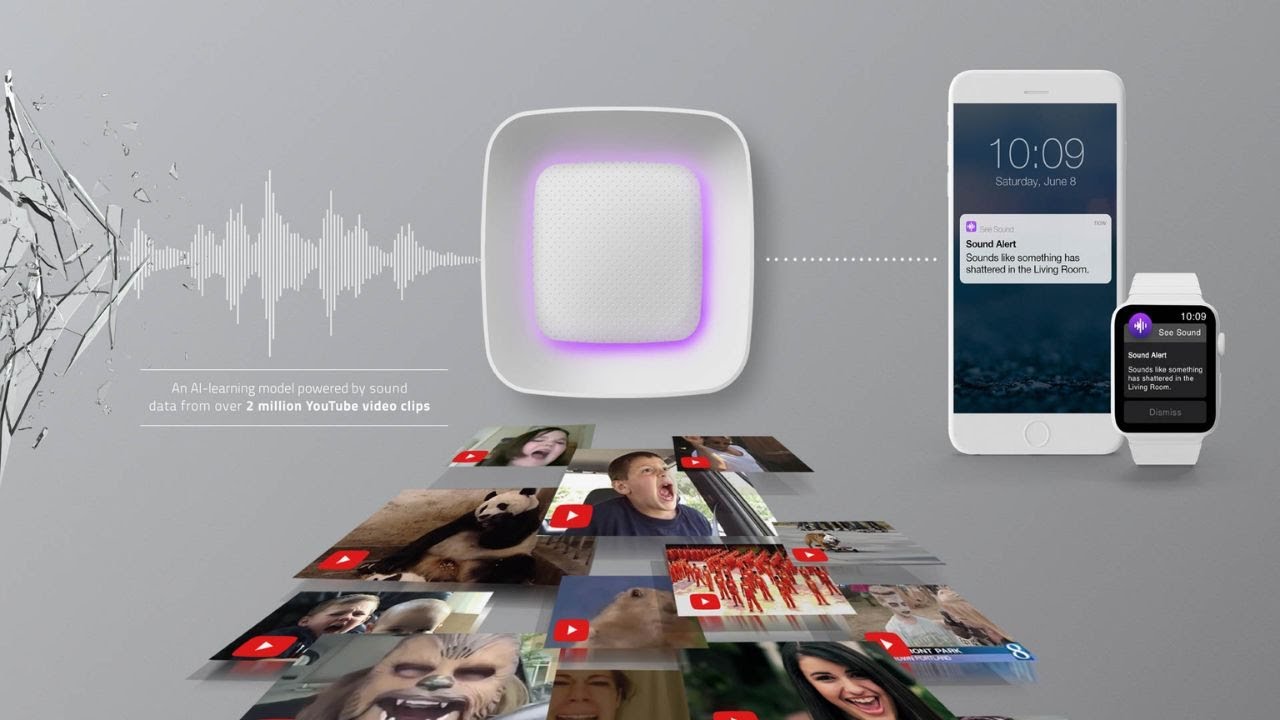 The hardware was engineered as a mesh network of microphones that triangulate sound locations within a home. Because the target audience relies on visual cues, the UI transforms audio data into visual volume spikes and text notifications. This shift from "sound amplification" to "sound interpretation" provides what CEO Greyson Watkins calls "situational awareness." The project was deeply personal for Watkins, who founded the company after a tragic incident where he was unable to hear a young girl get injured in another room.
Scaling for the ADA
With over $160,000 invested in R&D over four years, the team achieved a technical accuracy of 0.360 mean average precision, outperforming Google’s own baseline. Beyond the tech, the campaign functioned as a political petition. By lobbying the US government to include the device under the Americans with Disabilities Act (ADA), the brand aimed to unlock government - subsidized distribution. If successful, Wavio forecasted a market penetration of 50% of Deaf homes, potentially reaching 4.5 million units across the United States.
Creative Strategy Deconstructed
Company
A Deaf-owned startup with the vision to provide situational awareness through sound interpretation rather than just amplification.
Category
Assistive devices were limited to single-use alerts or amplification, failing to distinguish between complex, everyday household sounds.
Customer
Deaf individuals who felt vulnerable and disconnected in their own homes due to a lack of environmental sound data.
Culture
The explosion of user-generated video content provided an unprecedented, labeled dataset to train sophisticated machine-learning models.
Company
A Deaf-owned startup with the vision to provide situational awareness through sound interpretation rather than just amplification.
Category
Assistive devices were limited to single-use alerts or amplification, failing to distinguish between complex, everyday household sounds.
Strategy:
Repurpose massive existing datasets to solve accessibility gaps through real-time environmental interpretation.
Customer
Deaf individuals who felt vulnerable and disconnected in their own homes due to a lack of environmental sound data.
Culture
The explosion of user-generated video content provided an unprecedented, labeled dataset to train sophisticated machine-learning models.
Strategy:
Repurpose massive existing datasets to solve accessibility gaps through real-time environmental interpretation.
Results
The campaign highlights the development of a database containing 2 million analyzed and categorized videos. The machine-learning model was trained on these clips to identify 75 distinct household sounds. The video notes there are 9 million deaf households in the US that could benefit from this technology. The system achieved high accuracy ratings through its extensive data training.
2M
videos analyzed for AI training
75
distinct household sounds identified
9M
potential household reach in US
Strategy Technique
Build an Utility, Not an Ad
Instead of just raising awareness about the Deaf community's struggles, Wavio built a functional tool. This shifted the brand from a communicator to a provider of essential situational awareness.
Explore Technique
Creative Technique
Technology
The campaign centers on a technological breakthrough - using machine learning to solve a data scarcity problem. By repurposing YouTube's audio, it turned complex AI into a simple, life-saving home utility.
Explore Technique
Craft Breakdown
The campaign excels through its innovative use of existing big data to solve a human problem, combined with a clean, intuitive product design.
The use of machine learning trained on millions of YouTube videos to categorize sound is a brilliant application of existing data.
The physical product and the mobile UI are minimalist and unobtrusive, fitting perfectly into a modern home environment.