2025PumaTravel, Leisure, Retail & RestaurantsCase video
Puma: Marseille C'est Nous
Puma and Olympique de Marseille asked WAY Agency to deepen the club's bond with Marseille's diverse multicultural fans ahead of the 2025 Africa Cup of Nations. The goal was to authentically honor the city's major African diasporas, strengthen community pride, and drive retail engagement without relying on traditional commercial sponsorships or mainstream celebrity players.
Creative Idea
Seven African diaspora jerseys physically aligned to assemble Olympique de Marseille's crest.
Ahead of AFCON 2025, Puma and OM designed seven dual-identity jerseys for Marseille's African diasporas. Stripped of commercial sponsors and featuring laundry-line pattern motifs, the jerseys physically connected side-by-side to assemble the club's iconic crest.
The Dual-Identity Kit Assembling Marseille's Crest
A Masterclass in Local Production
To honor the authentic pulse of the territory, Puma and WAY Agency bypassed traditional commercial infrastructure. The limited-edition jerseys were manufactured in France to prioritize local craftsmanship.
Lead photographer Izudin Yusuf, an artist of Comorian heritage, captured the imagery using real neighborhood street settings, local courtyards, and iconic city landmarks rather than studio environments. The creative direction was led by Tareet, a Marseille fashion designer of Senegalese origin, who developed the visual themes.
Laundry Motifs and Dialects
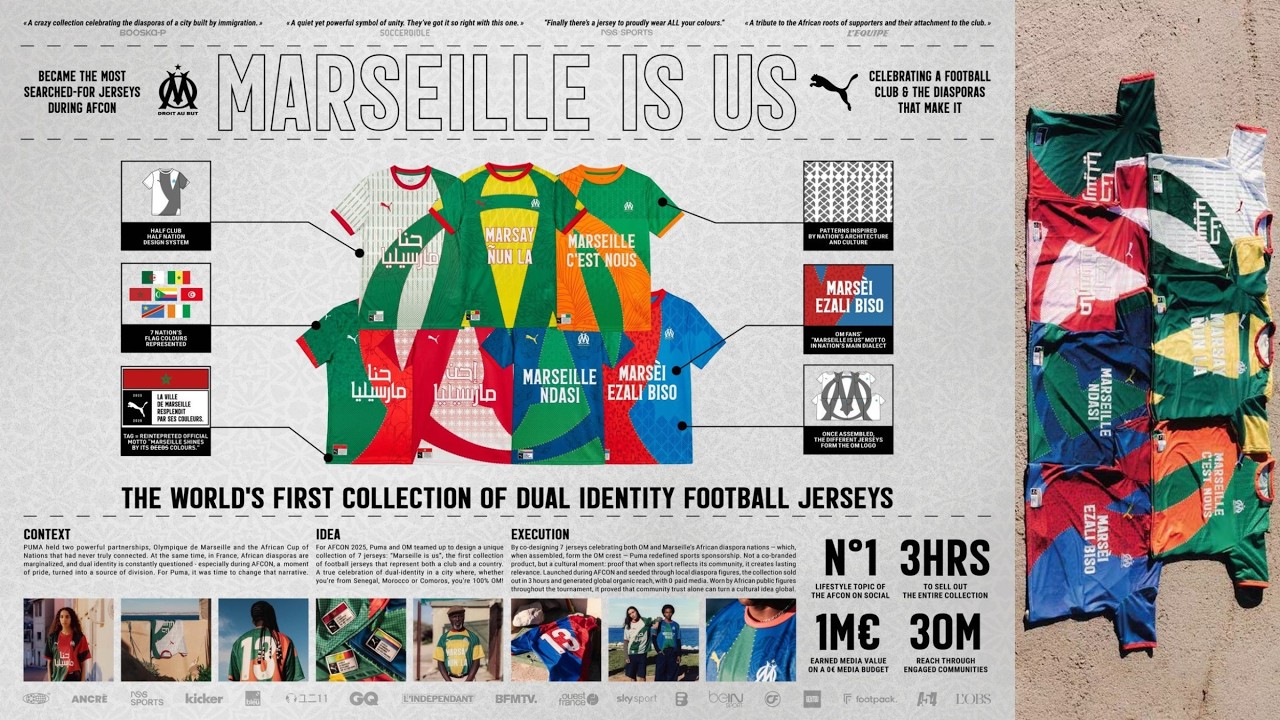 The design details drew direct inspiration from everyday life in working-class neighborhoods, using patterns based on clothes peg motifs and laundry lines. Commercial sponsors were stripped from the chest area and replaced by the phrase "Marseille C'est Nous", translated into the primary language or dialect of each represented diaspora: Algeria, Morocco, Tunisia, Senegal, Ivory Coast, DR Congo, and Comoros.
Grassroots Distribution
The campaign launched between December 18–21, 2025, right before the 2025 Africa Cup of Nations. The collection premiered at an ephemeral pop-up shop in the historic Marché du Soleil, a key hub for African trade in Marseille, alongside three exclusive retail locations: the Puma store and OM store at Les Terrasses du Port, and the official shop at the Orange Vélodrome.
Thomas Lanis, Marketing Director at Puma France, emphasized the core mission of the project: *"With this campaign, we wanted to pay tribute to the diversity of the city of Marseille to allow supporters of African origin to celebrate their roots while finding themselves united behind the crest of their club."*
Results
The campaign achieved widespread acclaim and viral reach with €1,000,000 in Earned Media Value on a €0 media budget. It received media coverage in 20+ countries and sold out completely within 3 hours. It became the most talked-about lifestyle topic of the tournament, reaching 30M+ people through engaged communities.
€1M+
Earned Media Value
3 Hours
Sold Out
30M+
Reach
Strategy Technique
Celebrate the Subculture
The campaign placed Marseille's African diaspora communities at the center of the club's official identity. By co-creating with local designers and casting real residents, Puma honored hyper-local street culture.
Explore Technique
Creative Technique
Turn Message into Product
Puma transformed its core message of unity and dual identity directly into physical apparel. The seven distinct jerseys functioned as puzzle pieces that physically assembled into the club logo.
Explore Technique
Craft Breakdown
This campaign excels through symbolic jersey design that forms a larger emblem and street-authentic photography featuring local residents.
The clever integration of national patterns and laundry-line motifs allowed seven separate jerseys to physically tile into the OM logo.
Izudin Yusuf shot authentic local diaspora residents in Marseille's working-class neighborhoods rather than studio models.
“The modular garment design combined with authentic street photography transformed sports apparel into a powerful sociopolitical statement.”