2026ToyotaAutomotiveCase video
Toyota: New Zealand’s One Big Ad
Toyota New Zealand faced a challenge where its high market share led to brand invisibility. Saatchi & Saatchi was tasked with making the brand feel fresh and exciting again for a broad audience. The goal was to increase brand sentiment and sales by transforming how consumers perceived the brand's presence on the road, moving away from traditional advertising tropes to something more culturally resonant.
Creative Idea
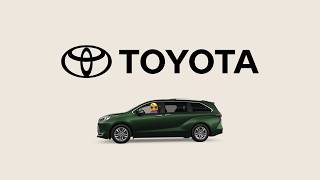
The brand convinced an entire nation they were living inside a giant Toyota commercial.
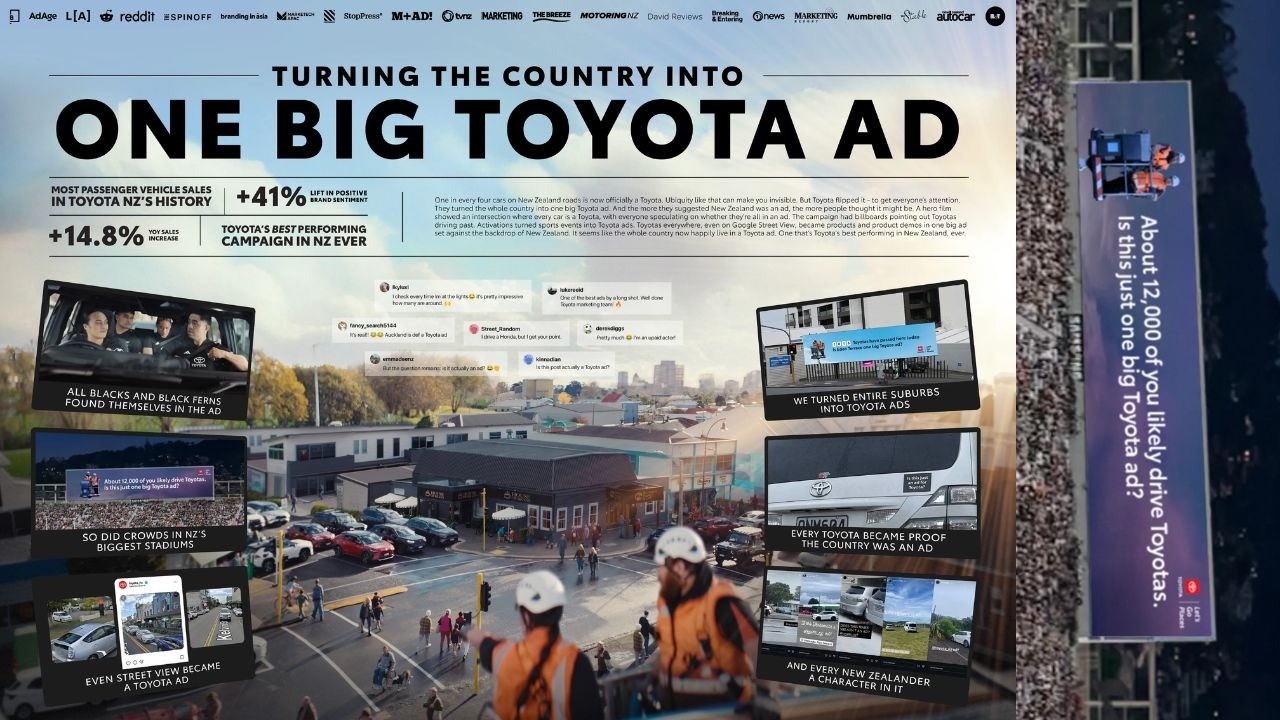
Toyota transformed its market ubiquity from a weakness into a strength by framing the entire country as one giant, living commercial, turning everyday New Zealanders into participants who questioned if their reality was actually a scripted Toyota ad.
Turning A Nation Into A Living Commercial
The Paeroa Production Trick
To achieve the scale of a national campaign on a modest budget, the hero commercial was filmed at a quiet, inconspicuous intersection in Paeroa. Director Tim Bullock and the team at Scoundrel utilized extensive post-production to transform this small-town setting. By layering in background buildings, traffic lights, and billboards filmed separately in Auckland, they successfully mimicked the look and feel of a major metropolitan hub, grounding the meta-narrative in an authentic, unpretentious Kiwi aesthetic.
Data Driven Ubiquity
The campaign was built on the insight that 1 in 4 vehicles on New Zealand roads is a Toyota, totaling over 1 million vehicles within a 4 million vehicle fleet. This statistic allowed the agency to move beyond traditional brand manifestos. Instead, they deployed dynamic out-of-home billboards at major intersections that tracked Toyota license plates in real-time to provide a live tally of passing vehicles. This data-led approach extended to Eden Park, where 47,000 stadium attendees were informed that 12,000 of them were likely driving Toyotas, effectively turning the stadium into a live set.
A Shift In Mobility
Susanne Hardy, Assistant Vice President of Marketing, noted that the campaign was essential for evolving the brand's image from a traditional car manufacturer into a modern mobility company. By featuring a diverse range of vehicles—from the bZ4X electric SUV and hydrogen-powered Mirai to Cityhop car-sharing services—the campaign successfully showcased Toyota's technological breadth. This strategy contributed to the highest volume of vehicle sales in the company's history, proving that the meta-advertising approach resonated deeply with the public and drove tangible commercial success.
4C Framework deconstruction
Company
Toyota leveraged its massive market share, where one in four vehicles on New Zealand roads is a Toyota.
Category
Automotive brands typically rely on polished, aspirational commercials that feel disconnected from the reality of daily traffic.
Customer
Consumers felt indifferent to the brand's ubiquity, viewing it as background noise rather than a mark of quality.
Culture
The rise of meta-humor and social media participation allowed audiences to actively contribute to the campaign's narrative.
Company
Toyota leveraged its massive market share, where one in four vehicles on New Zealand roads is a Toyota.
Category
Automotive brands typically rely on polished, aspirational commercials that feel disconnected from the reality of daily traffic.
Strategy:
Reframe market ubiquity as a deliberate, self-aware cultural phenomenon to drive brand relevance and engagement.
Customer
Consumers felt indifferent to the brand's ubiquity, viewing it as background noise rather than a mark of quality.
Culture
The rise of meta-humor and social media participation allowed audiences to actively contribute to the campaign's narrative.
Strategy:
Reframe market ubiquity as a deliberate, self-aware cultural phenomenon to drive brand relevance and engagement.
Results
The campaign achieved 41% lift in positive brand sentiment, a 14.8% YOY sales increase, and resulted in the most passenger vehicle sales in Toyota NZ's history. It was named Toyota's best-performing campaign in New Zealand ever, winning the Kantar Ad Impact Award.
41%
lift in positive brand sentiment
14.8%
YOY sales increase
1 in 4
cars on NZ roads is a Toyota
Strategy Technique
Turn Weakness Into Strength
Toyota faced the problem of being too common and invisible. By reframing this ubiquity as a deliberate, meta-narrative ad, they turned a potential brand liability into a source of national cultural engagement.
Explore Technique
Creative Technique
Break visual expectations
The campaign subverts the expectation of a standard car commercial by embedding the brand into the fabric of everyday life. It forces viewers to re-evaluate their surroundings as potential product placements.
Explore Technique
Craft Breakdown
This campaign's brilliance lies in its clever self-referential copywriting and expansive media planning, reframing market saturation into an interactive national media strategy.
The central concept flips standard market statistics into a witty meta-narrative that turns every Toyota on the road into part of the copy line.
Using real-time dynamic billboards, sports stadium screens, and social hooks allowed the brand to weaponize nationwide vehicle statistics contextually.
“The combination of sharp meta-copywriting with dynamic contextual media placement turned ordinary public infrastructure into active storytelling.”