IDomed: Nigrum Corpus
IDomed and Artplan São Paulo sought to address the alarming disparity in healthcare outcomes for Black patients in Brazil. They needed to confront institutional racism within medical schools where the white body remained the default clinical parameter. The goal was to provide future doctors with the tools for racial literacy, ensuring more equitable treatment and reducing medical errors rooted in unconscious bias.
Creative Idea
Reframed systemic medical racism as a series of fictional clinical conditions in a textbook.
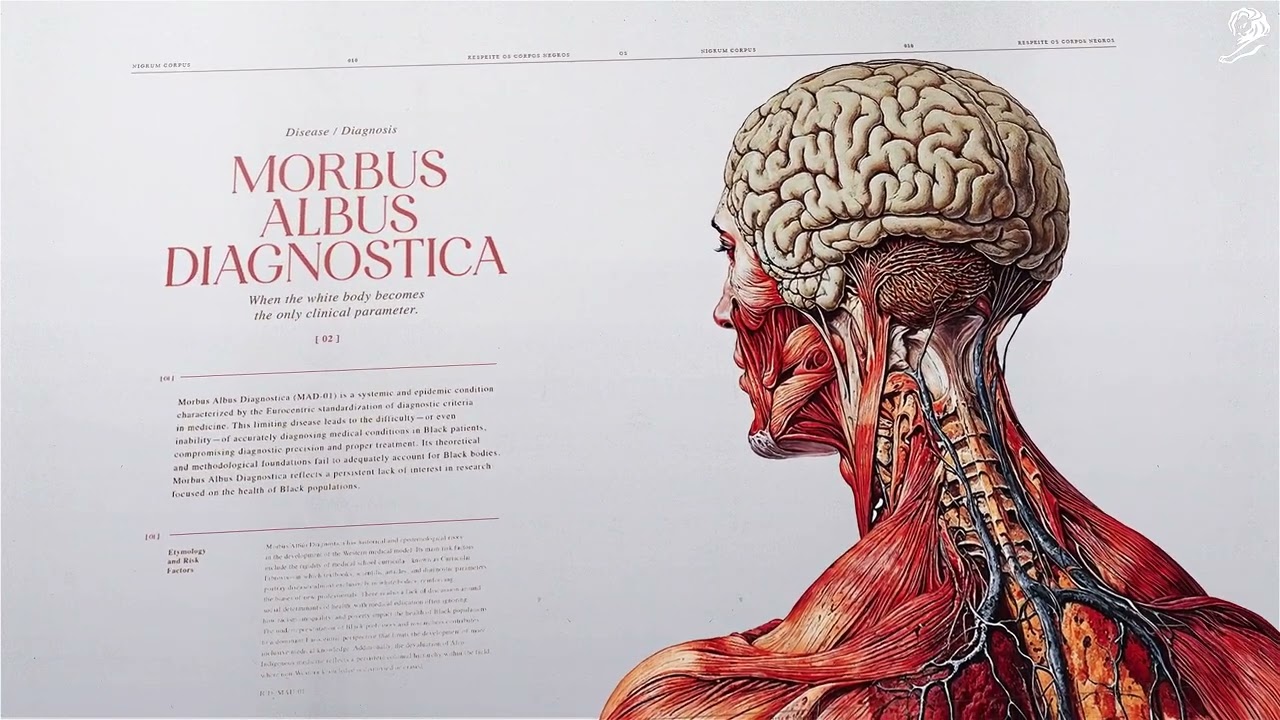
IDomed created Nigrum Corpus, a revolutionary medical textbook that reframes institutional racism as a clinical condition. By blending anatomical precision with celebratory art, it forces future doctors to confront their biases and learn from the historically ignored Black body.
Rewriting the Medical Manual for the Black Body
The Clinical Anatomy of Bias
To make systemic racism "clinically visible," the production team utilized Artificial Intelligence and 3D design to bridge the gap between 18th-century anatomical precision and modern humanism. The project identified 20 fictional diseases based on real testimonies from Black patients, such as Clinical Blindness - a term used to describe the medical dismissal of Black pain. This visual language was a deliberate attempt to fix a "glitch" in medical training where white bodies have historically served as the sole clinical parameter.
Directorial Choices in Corpo Preto
 In the accompanying short film directed by Nany Oliveira, the Black patient is frequently blurred in the frame. This was a calculated creative decision to symbolize the systemic invisibility and objectification Black individuals face in healthcare settings. Creative lead Marcello Noronha noted that the film was designed to portray the physical and emotional distance created by lack of care, even during life - threatening moments.
A Permanent Tool for Racial Literacy
The campaign’s impact extended far beyond the screen, as the Nigrum Corpus book was integrated into the MEDIVERSIDADE project and distributed to medical schools across Brazil as a permanent educational tool. The initiative addressed a stark reality: while over 55% of Brazilians identify as Black or Mixed, only 3% of doctors in the country are Black. By placing this manual in the hands of future physicians, IDOMED shifted the industry conversation from simple representation to "diversity as a clinical necessity." Following the launch, Artplan’s Rafael Gil was recognized as the top-ranked Art Director in the history of Lürzer's Archive.
Creative Strategy Deconstructed
Company
A leading medical education institution with the authority to redefine clinical standards and training curriculum.
Category
Medical education traditionally uses the white body as the universal clinical parameter, rendering Black patients invisible in textbooks.
Customer
Future doctors who want to provide equitable care but are trained within a systemically biased educational framework.
Culture
A growing global movement demanding racial literacy and the dismantling of institutional racism within essential public services.
Company
A leading medical education institution with the authority to redefine clinical standards and training curriculum.
Category
Medical education traditionally uses the white body as the universal clinical parameter, rendering Black patients invisible in textbooks.
Strategy:
Codify systemic social failures into professional standards to force institutional accountability and behavioral change.
Customer
Future doctors who want to provide equitable care but are trained within a systemically biased educational framework.
Culture
A growing global movement demanding racial literacy and the dismantling of institutional racism within essential public services.
Strategy:
Codify systemic social failures into professional standards to force institutional accountability and behavioral change.
Results
The campaign achieved significant impact across Brazil: 17 institutions have already adopted the project across 10 Brazilian states. Over 9,000 medical students have been impacted by the project. The book was endorsed by the Brazilian Minister of Health, Alexandre Padilha, who stated it is a vital tool to combat institutional racism within healthcare. The project involved over 680 hours of research, including updated data and statistics on bias in medicine, as well as testimonies and accounts from black patients.
17
Institutions adopted the project
9,000+
Medical students impacted
10
Brazilian states reached
Strategy Technique
Make the Invisible Visible
The campaign exposes the invisible systemic bias in healthcare by giving it clinical names and visual forms. It forces the medical community to acknowledge prejudices that were previously unquantified and ignored.
Explore Technique
Creative Technique
Turn Message into Product
It transforms a complex social critique into a tangible, functional educational tool. By manifesting the message as a textbook, the campaign moves from awareness to a permanent structural solution within medical training.
Explore Technique
Craft Breakdown
The campaign's craft is exceptional due to its profound integration of medical science and artistic expression, turning a textbook into a powerful tool for social change.
The anatomical drawings are not only scientifically accurate but are elevated into fine art through the use of floral motifs that celebrate the black body.
The book's layout, typography, and interactive elements like the x-ray overlays are masterfully executed to create a unique educational experience.
The use of Latin-sounding medical terms to describe forms of racism is a clever and impactful way to frame the issue within a medical context.
The consistent visual language across the book and the campaign video creates a cohesive and professional medical-educational brand.
“The synergy between the clinical data and the artistic illustrations is what makes the campaign so effective, as it appeals to both the intellect and the emotions.”