Visa: The Feathered Lamb
Visa France, working with agency Marcel, sought to address the alarming rise in AI-powered phishing scams. The client needed a way to educate consumers on digital security without relying on traditional, ignored warnings. The objective was to increase awareness of AI-driven fraud and provide actionable protection tips to a broad, vulnerable audience, reinforcing Visa's role as a leader in secure payments.
Creative Idea
Visa tricked users with AI fakes to prove that humans are the security flaw.
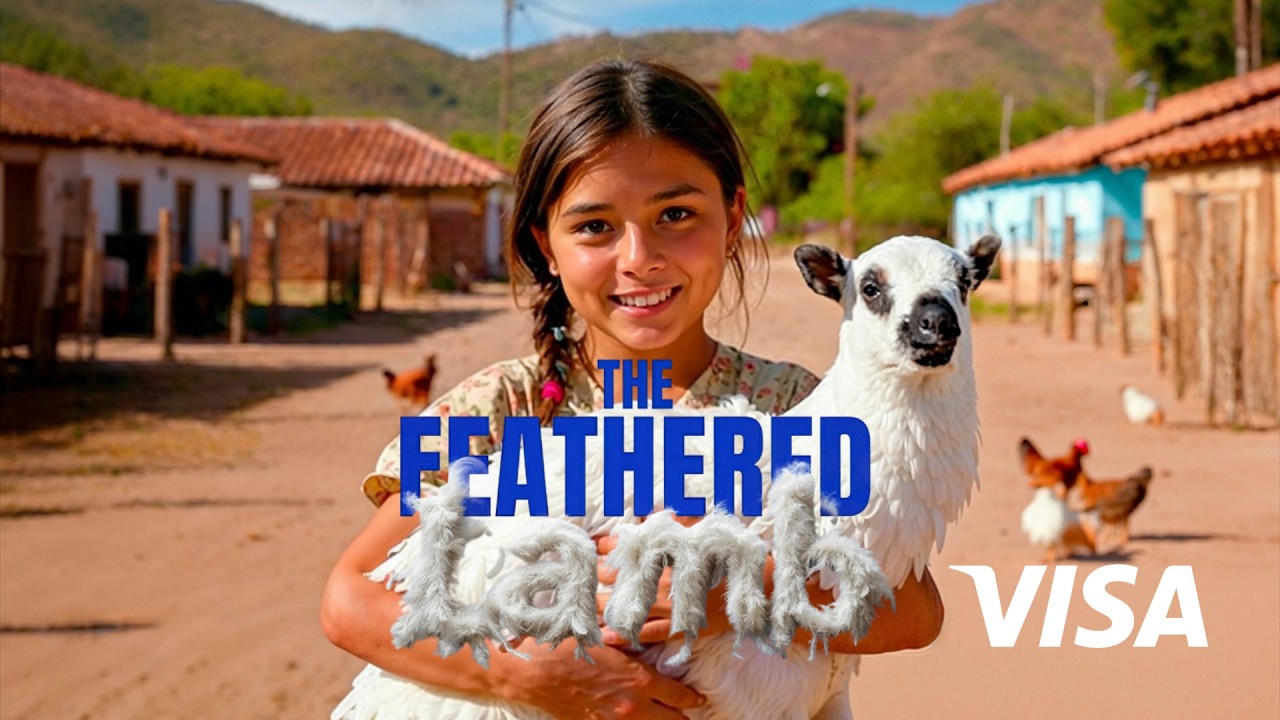
Visa used AI to create absurd, fake social media posts like a feathered lamb to trick users, then immediately revealed the scam to teach them how to spot AI-driven fraud, proving that human vulnerability is the weakest link in security.
The Social Experiment That Tricked The Internet
The Art of the Bait
To ensure the campaign felt authentic, the agency operated under the alias « Petit Pamplemousse ». This unbranded account seeded surreal AI-generated imagery, such as a lamb covered in feathers and a dog operating a vehicle, into social feeds. By bypassing traditional corporate branding, the team successfully mimicked the erratic, high-engagement content often used by bot farms and bad actors to lure unsuspecting users. This two-week seeding phase was critical, allowing the team to gather real-time data on how quickly users would engage with—and believe—synthetic content.
Turning the Tables on Fraud
The campaign’s effectiveness relied on a personalized feedback loop. Rather than a generic broadcast, users who interacted with the fake posts were served a direct message containing a reveal video. This immediate, one-to-one interaction served as a "teachable moment," transforming the user from a potential victim into an informed participant. This strategy resulted in an engagement rate of 24%, a figure that vastly outperformed standard social media benchmarks.
A New Standard for Cybersecurity
The initiative was driven by Julian Clobus and Juan Herrera-Ramirez of Visa France, who aimed to address the 1,265% surge in phishing reported in 2025. By shifting the focus from fear-based warnings to cognitive muscle memory, the campaign proved that consumers are more likely to retain security best practices when they have safely experienced the mechanics of a scam firsthand. This approach has since been cited as a landmark case study for how brands can use generative AI to combat the very threats it creates.
Creative Strategy Deconstructed
Company
Visa leveraged its global authority in payment security to position itself as the primary educator against AI-driven financial fraud.
Category
Financial brands typically rely on dry, fear-based warnings that consumers ignore due to their predictable and repetitive nature.
Customer
Users felt confident in their ability to spot fakes, unaware that AI had evolved to exploit their cognitive biases.
Culture
The rapid, unchecked proliferation of generative AI tools created a climate of confusion where reality became increasingly difficult to verify.
Company
Visa leveraged its global authority in payment security to position itself as the primary educator against AI-driven financial fraud.
Category
Financial brands typically rely on dry, fear-based warnings that consumers ignore due to their predictable and repetitive nature.
Strategy:
Use the vulnerability of the target to demonstrate the necessity of proactive digital vigilance.
Customer
Users felt confident in their ability to spot fakes, unaware that AI had evolved to exploit their cognitive biases.
Culture
The rapid, unchecked proliferation of generative AI tools created a climate of confusion where reality became increasingly difficult to verify.
Strategy:
Use the vulnerability of the target to demonstrate the necessity of proactive digital vigilance.
Results
The campaign generated 502K interactions and achieved a 24% engagement rate. It received 40+ media coverage and educated 120K people about AI scams.
502K
interactions
24%
engagement rate
120K
people educated to AI scams
Strategy Technique
Start With a Human Flaw
The campaign targets the inherent human tendency to trust visual content without verification. By exposing this flaw through a harmless prank, Visa transforms a psychological weakness into a teachable moment for digital security.
Explore Technique
Creative Technique
Conduct an Experiment
The agency staged a controlled social experiment by seeding fake AI content to observe user behavior. This allowed them to catch people in the act of being deceived before providing a corrective educational experience.
Explore Technique
Craft Breakdown
This campaign's craft is exceptional due to its innovative use of AI and CGI to create highly engaging and believable fake content, which effectively highlights the message of cybersecurity awareness.
The CGI animation of the feathered lamb, driving dog, and other animals is seamless and highly engaging, making the fake content believable and entertaining.
The script effectively balances humor with a serious message about cybersecurity, using the playful AI characters to deliver important safety tips.