2025Call of DutyMedia & EntertainmentVideo ad
Call of Duty: The Guild
Activision tasked 72andSunny with launching Call of Duty: Black Ops 7 amidst growing audience cynicism toward traditional video game marketing. The client needed a disruptive global campaign to reassert the franchise's cultural relevance by making the game's central themes of surveillance and corporate power feel immediately relevant to modern gaming and tech audiences.
Creative Idea
Activision launched a fake AI defense startup that staged a real NASDAQ takeover.
To launch Black Ops 7, Activision staged a fake Silicon Valley defense startup called The Guild, taking over NASDAQ with an actor CTO ringing the opening bell and deploying realistic robotic proxies to weaponize public paranoia about autonomous AI technology.
Ringing the Bell for a Fake Defense Giant
Paranoia Powered by Big Tech Satire
To make the fictional 2035 antagonist feel uncomfortably real, the campaign launched a direct satire of modern corporate tech culture. OOH billboards placed across San Francisco tech corridors showcased taglines such as "Don't be evil. Be protected" - a sharp parody of Google's iconic corporate motto - alongside "You don't need more friends, you need more security."
The corporate illusion extended to staged PR placements in outlets like *Wired*, *Forbes*, and *Tech Brew*, as well as a dedicated digital ecosystem at `theguild.io` and `@wearetheguild`. The blurred line between real-world tech paranoia and fiction even led prediction market platform Kalshi to run real-money user prediction markets as audiences debated whether the startup was real.
A Staged Financial Takeover
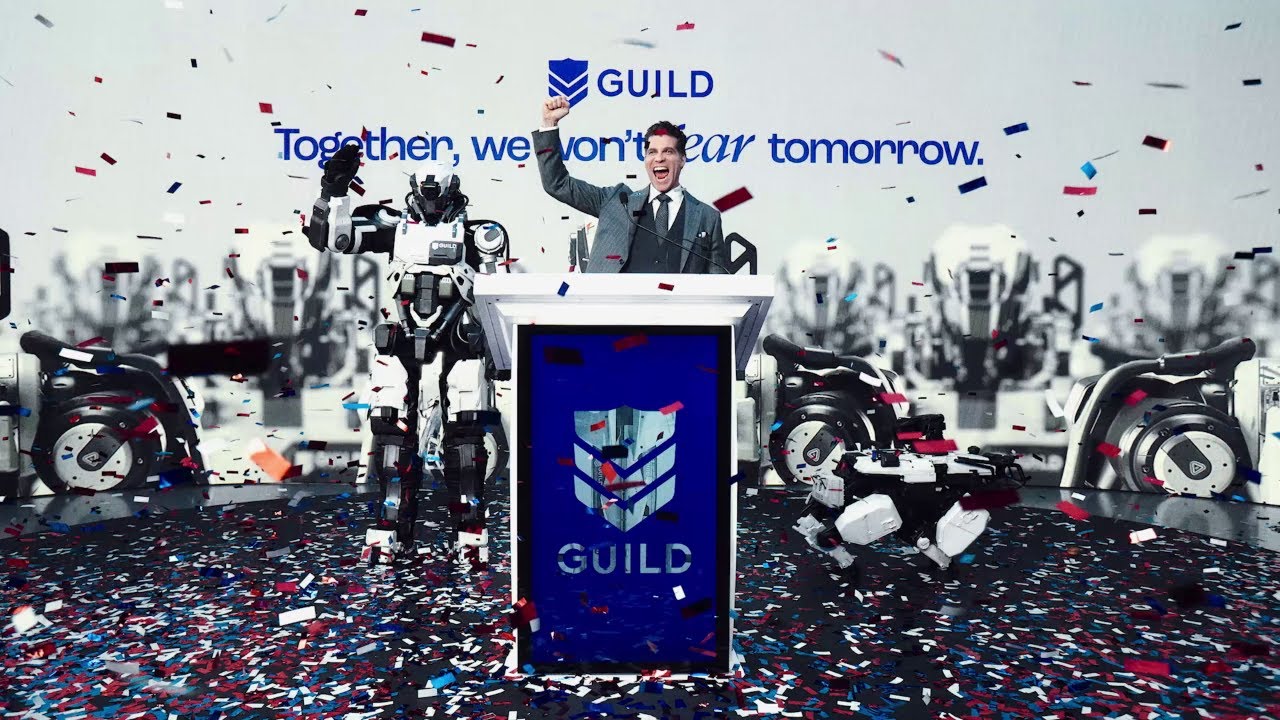 Directed by Lado via UnderWonder Content, the high-profile physical activation featured an actor playing the CTO of The Guild ringing the opening bell at NASDAQ in Manhattan, flanked by menacing physical robot proxies. On digital channels, weapon schematics and lore embedded in the campaign's Alternate Reality Game fed directly into the storyline of *Black Ops 7*.
Real-world commentary fueled the narrative, featuring staged and organic reactions from former US Navy SEAL Shawn Ryan on the *Shawn Ryan Show*, financial analysis from Caleb Hammer (*Financial Audit*), and coverage on Pubity.
Massive Reach Beyond Gaming Outlets
The campaign bypassed traditional gaming channels to hit broader cultural conversations:
* 800 Million users reached through organic social media exposure.
* Global PR coverage generated across mainstream news, tech, and entertainment media, including *IGN*, *Variety*, *GameSpot*, *MSN*, and the *Daily Mail*.
As Executive Creative Director Zach Hilder noted, *"The campaign locks eyes with that paradox, confronting the greatest fear of all… the unknown."*
4C Framework deconstruction
Company
Call of Duty possessed deep lore centered on near-future surveillance, corporate power, and militarized artificial intelligence.
Category
Gaming marketers typically rely on high-octane gameplay trailers, CGI teasers, and traditional celebrity-driven promotional campaigns.
Customer
Gamers and tech-savvy consumers were increasingly cynical toward big tech monopolies and skeptical of traditional game marketing.
Culture
Growing public anxiety around corporate AI oversight, robotic defense tech, and encroaching digital surveillance was reaching a peak.
Company
Call of Duty possessed deep lore centered on near-future surveillance, corporate power, and militarized artificial intelligence.
Category
Gaming marketers typically rely on high-octane gameplay trailers, CGI teasers, and traditional celebrity-driven promotional campaigns.
Strategy:
Manifest the game's antagonist as a real tech startup to turn public AI paranoia into active engagement.
Customer
Gamers and tech-savvy consumers were increasingly cynical toward big tech monopolies and skeptical of traditional game marketing.
Culture
Growing public anxiety around corporate AI oversight, robotic defense tech, and encroaching digital surveillance was reaching a peak.
Strategy:
Manifest the game's antagonist as a real tech startup to turn public AI paranoia into active engagement.
Strategy Technique
Create a Parallel World
By embedding the game's evil corporation into real financial markets and tech hubs, the campaign forced audiences to experience the game's dystopian surveillance themes in reality.
Explore Technique
Creative Technique
Hijack the Medium
The agency weaponized real-world financial and news platforms - including NASDAQ's opening bell ceremony - to pass off a fictional game antagonist as a legitimate public defense startup.
Explore Technique
Craft Breakdown
The campaign succeeded through flawless physical world-building and high-fidelity visual effects that passed a fictional defense firm off as real.
Staging a live corporate takeover at NASDAQ with an actor CTO and physical robotic proxies blurred real-world financial ceremonies with game fiction.
Photorealistic rendering integrated militarized humanoid robots seamlessly into live-action street footage and broadcast news segments.
“The realism of the visual effects validated the live experiential stunts, making the corporate hoax believable across news and social media.”