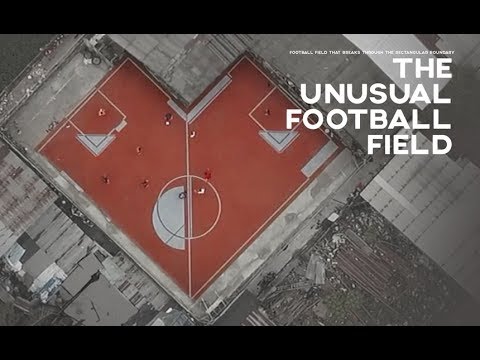
AP Thailand: The Unusual Football Field
AP Public Company Limited challenged CJ Worx Bangkok to elevate its brand image from a traditional property developer to an innovative "space expert." The goal was to connect with urban Thais by demonstrating how clever design can improve lives, even in the most challenging, densely populated environments where traditional development is impossible.
Creative Idea
Built non-rectangular football pitches in neglected slum gaps to prove design overcomes spatial constraints.
AP Thailand transformed neglected, irregularly shaped wasteland in crowded slums into functional football pitches, proving that design can unlock potential in any space and repositioning the developer as an innovative "space expert" rather than just a builder.
Winning the Grand Prix with Asymmetrical Geometry
The $2,500 Viral Masterstroke
While the project repositioned a major developer, the production itself was a masterclass in efficiency. AP Thailand invested 1.4 million baht to construct the physical pitches, but the marketing video that captured the world's attention was produced for a mere 90,000 baht (approximately $2,500 USD). This lean production by MeOur Bangkok generated over 500 million global views, proving that a powerful visual concept outweighs a massive media buy. The investment paid off commercially with a reported 35% increase in sales, as the brand successfully pivoted from a traditional builder to a "space designer."
Symmetry in the Asymmetrical
To make the L-shaped and trapezoidal plots playable, CJ Worx and Executive Creative Director Saharath Sawadatikom utilized a specific design logic. They applied symmetrical boundaries to the irregular shapes so that neither team would have a spatial advantage. If one side had a blind corner, the other did too. The fields were finished with a non-slip, brick-red coating and grey boundary lines, intentionally avoiding traditional green to signal that these were new types of urban "inventions."
From Slums to Time Magazine
The project’s significance extended far beyond advertising. It was named one of TIME Magazine’s 25 Best Inventions of 2016, sharing the list with the likes of the iPhone and Tesla. This recognition elevated the campaign into a global case study for tactical urbanism. For the Thai industry, it was a watershed moment - winning the country’s first-ever Cannes Lions Grand Prix and proving that an independent local agency could lead global innovation by solving real-world community problems.
Creative Strategy Deconstructed
Company
AP Thailand possessed deep expertise in architectural design and a commitment to maximizing the potential of urban living spaces.
Category
Property developers typically showcase luxury showrooms and perfect rectangular plots, ignoring the messy reality of dense urban environments.
Customer
Residents in crowded slums felt neglected and lacked safe, functional spaces for recreation due to the lack of traditional land.
Culture
The global rise of tactical urbanism showed that small, clever design interventions could solve massive social and spatial problems.
Company
AP Thailand possessed deep expertise in architectural design and a commitment to maximizing the potential of urban living spaces.
Category
Property developers typically showcase luxury showrooms and perfect rectangular plots, ignoring the messy reality of dense urban environments.
Strategy:
Repurpose overlooked constraints into functional assets to demonstrate design mastery through tangible community impact.
Customer
Residents in crowded slums felt neglected and lacked safe, functional spaces for recreation due to the lack of traditional land.
Culture
The global rise of tactical urbanism showed that small, clever design interventions could solve massive social and spatial problems.
Strategy:
Repurpose overlooked constraints into functional assets to demonstrate design mastery through tangible community impact.
Results
The campaign achieved a massive global reach with over 500 million global views across platforms and news outlets. Commercially, AP Thailand reported a 35% increase in sales, successfully repositioning the brand from a traditional builder to an innovative 'space designer.' The project was named one of TIME Magazine’s 25 Best Inventions of 2016, alongside brands like Apple and Tesla. It secured Thailand’s first-ever Grand Prix at the Cannes Lions International Festival of Creativity (Design category), along with a Silver Lion in Outdoor, and Bronze Lions in Promo & Activation and Entertainment. Additional accolades include 2 Yellow Pencils and 3 Wood Pencils at D&AD 2017, Gold at AdFest, and multiple One Show and Clio awards. The production was highly efficient, with a marketing video budget of only 90,000 baht (~$2,500 USD) generating a massive spike in brand sentiment and global coverage from outlets like TIME, The Guardian, and BBC.
500M+
Global Views
+35%
Increase in Sales
1st
Cannes Lions Grand Prix for Thailand
Strategy Technique
Build an Utility, Not an Ad
Instead of just claiming to be space experts, AP Thailand built actual infrastructure that solved a community problem. This physical proof of their expertise was more persuasive than any traditional advertising message.
Explore Technique
Creative Technique
Unexpected Utility
The campaign turned useless, asymmetrical urban gaps into valuable community assets. By providing a functional solution to a lack of recreational space, the brand demonstrated its design philosophy through tangible, unexpected utility.
Explore Technique
Craft Breakdown
The campaign excels by using geometric innovation to solve urban density problems, turning 'useless' land into a functional community asset through brilliant spatial design.
The use of symmetrical boundaries within asymmetrical shapes ensured fair play and transformed irregular wasteland into usable sports infrastructure.
The physical construction of the pitches provided a tangible brand experience that improved the lives of Khlong Toei residents.
The choice of a non-slip brick-red coating and grey boundary lines created a distinct visual identity that signaled urban innovation over traditional sports fields.
By solving a real-world social issue, the campaign earned massive organic global coverage and a spot on TIME's Best Inventions list.
“The magic lies in the intersection of architectural problem-solving and brand storytelling, where the physical product itself serves as the primary marketing vehicle.”