Doconomy: Do Black
Doconomy, a Swedish fintech startup, tasked Rbk Communication with creating a radical solution to help consumers reduce their carbon footprint. They needed to move beyond awareness into behavioral change, targeting conscious spenders who wanted to align their consumption with the Paris Agreement goals but lacked the tools to track their real-time impact at the point of sale.
Creative Idea
A credit card that blocks transactions once the user exceeds their personal carbon budget.
Doconomy launched the world's first credit card with a carbon limit instead of a financial one, turning every transaction into a climate decision by physically blocking purchases once the user's CO2 budget for the year was reached.
The Credit Card That Stops Spending for the Planet
From Exhaust to Ink
To ensure the physical product matched its radical message, RBK Communication utilized Air Ink for the card's printing. This specialized ink is created by capturing carbon soot from vehicle exhausts and industrial chimneys, effectively turning pollution into a design tool. The card itself was manufactured from bio-sourced materials, moving away from traditional PVC to minimize the environmental footprint of the hardware.
A Shift to Impact Tech
The campaign’s success fundamentally altered Doconomy’s business trajectory. While the "DO Black" card was eventually discontinued in 2022, it served as a high-profile proof-of-concept that transformed the startup into a B2B powerhouse. The Åland Index, the underlying technology developed with Ålandsbanken, became a banking industry standard. It is now utilized by global giants like BNP Paribas, Klarna, and Standard Chartered, while Mastercard integrated the carbon calculator for its 2.9 billion cardholders worldwide.
The Paris Agreement at the POS
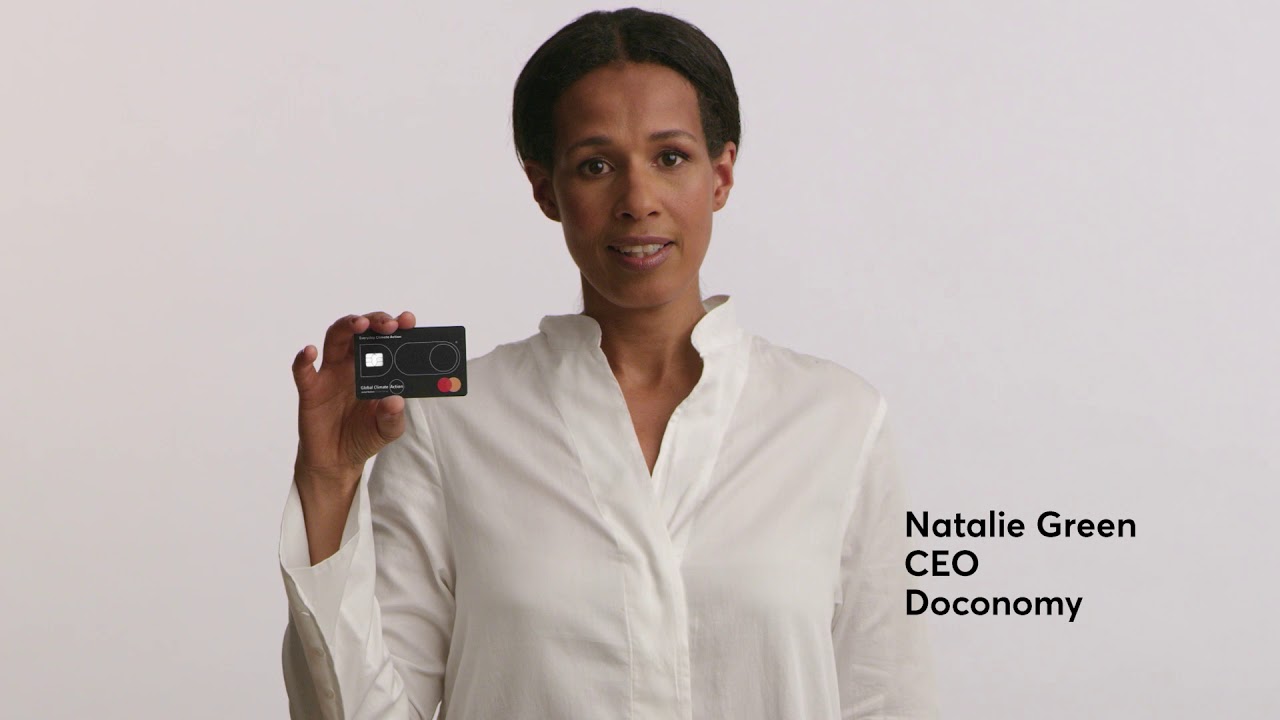
Creative leaders Mathias Wikström and Johan Pihl designed the card to flip the traditional banking model. Instead of rewarding high spending with points or increased credit, the card enforced a "carbon budget" aligned with the Paris Agreement goal to halve emissions by 2030. As CEO Nathalie Green noted, the tool was designed to remove excuses by making the urgency of the climate situation tangible at the point of sale.
Viral Conspiracy Theories
Years after its 2019 launch, the campaign took an unexpected turn in the cultural zeitgeist. In 2022 and 2023, it became a focal point for "Great Reset" conspiracy theories. Misinformation spread across social media, with some claiming the card was a tool for totalitarian government control over personal travel and diet.
Creative Strategy Deconstructed
Company
A fintech startup with a proprietary index for calculating the carbon impact of every merchant transaction.
Category
Banks focus on encouraging more spending through rewards and ignoring the environmental cost of consumption.
Customer
Conscious consumers feel guilty about their footprint but lack the real-time data to limit their impact.
Culture
The global climate crisis created an urgent need for individual accountability in carbon reduction.
Company
A fintech startup with a proprietary index for calculating the carbon impact of every merchant transaction.
Category
Banks focus on encouraging more spending through rewards and ignoring the environmental cost of consumption.
Strategy:
Weaponize the point of sale to transform passive environmental guilt into active, enforced personal accountability.
Customer
Conscious consumers feel guilty about their footprint but lack the real-time data to limit their impact.
Culture
The global climate crisis created an urgent need for individual accountability in carbon reduction.
Strategy:
Weaponize the point of sale to transform passive environmental guilt into active, enforced personal accountability.
Results
The campaign achieved an earned media reach of over 20 million within its first few months and secured 4,000 user registrations in Sweden immediately following the launch. Its business impact was transformative, leading to inquiries from over 40 global banks and credit card companies regarding white-labeling the technology. The underlying Åland Index became a banking industry standard, adopted by major firms including BNP Paribas, Klarna, and Standard Chartered. Most notably, Mastercard integrated the carbon calculator into its global network, making it available to 2.9 billion cardholders. The campaign swept the awards circuit, winning the Grand Prix for Creative eCommerce and a Titanium Lion at Cannes, a Gold Pencil and Best of Discipline at The One Show, and multiple D&AD Pencils. It was ranked the #26 best campaign in the world by the Global SABRE Awards.
2.9 Billion
Mastercard users with access to the carbon calculator
20 Million+
40+
Global banks requesting collaboration
Strategy Technique
Build an Utility, Not an Ad
Instead of just talking about climate change, Doconomy built a functional product that enforced behavioral change, proving that the most effective way to communicate values is through a useful service.
Explore Technique
Creative Technique
Unexpected Utility
By transforming a standard financial tool into a carbon-tracking device, the campaign provided a tangible solution to the abstract problem of personal emissions, making sustainability an active part of daily commerce.
Explore Technique
Craft Breakdown
This campaign excels by materializing an abstract environmental crisis into a tangible, physical product that enforces behavioral change through radical utility.
The campaign reinvented the fundamental logic of consumer banking by replacing financial limits with carbon budgets aligned with the Paris Agreement.
Utilizing the Åland Index and cloud-based merchant category codes, the campaign created a real-time carbon tracking system for every transaction.
The physical card was crafted from bio-sourced materials and printed with Air Ink made from captured industrial soot, ensuring the medium matched the message.
The campaign successfully shifted the global banking narrative from reactive carbon offsetting to proactive carbon tracking at the point of sale.
“The magic lies in the intersection of high-tech data visualization and physical product design, turning a standard credit card into a moral compass.”