Blue Ocean Strategy
How to Stop Fighting Competitors and Make Them Irrelevant
Most strategy is a knife fight in a phone booth. Everyone crowds into the same market, copies each other's features, shaves margins, and calls the bloodbath 'competition'. Blue Ocean Strategy asks a quieter, more interesting question: what if you just left the room?
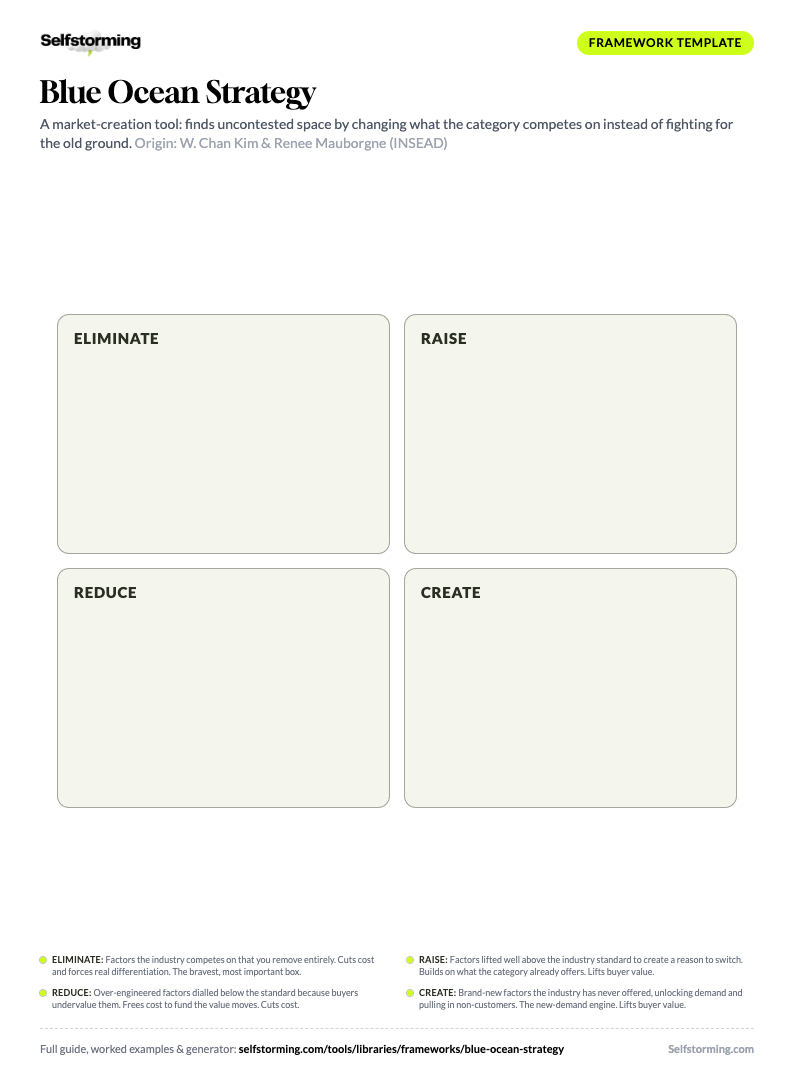
Print it. Fill it in.
The Blue Ocean Strategy as a printable A4 worksheet - write straight into the framework, on paper or in any PDF app.
Download the PDF templateKnowledge Worth Paying For
A working library of brand strategy frameworks - with worked examples on real brands, sources, and decision criteria. Not vibes.
One good deck covers the subscription. The rest is profit.
Stop competing in crowded 'red oceans' and create new market space - 'blue oceans' - where rivals are temporarily irrelevant. The tool is the ERRC grid: Eliminate factors the industry takes for granted, Reduce factors below the standard (both cut cost), Raise factors above the standard, and Create factors the industry has never offered (both lift buyer value). Doing all four at once breaks the differentiation-versus-cost trade-off and reshapes the value curve. Use it to reinvent an offer, not to optimise an existing one.
Trader Joe's
Grocery retail chain (USA, founded 1967)A grocer that escaped the supermarket price-and-range war by deleting the things the whole category competes on. Instead of out-stocking rivals, it created a different game entirely - curated, mostly private-label, treasure-hunt shopping - and built a fiercely loyal following non-shoppers crossed town for.
Nintendo (Wii)
Video game hardware and software (Japan, founded 1889)While Sony and Microsoft fought a graphics-and-power arms race for hardcore gamers, Nintendo stepped out of that ocean and aimed the Wii at people who didn't play games at all - families, older players, the gym crowd. It's a textbook value-cost break: cheaper to build, yet valuable in a way rivals weren't even measuring.
Airbnb
Online lodging marketplace (USA, founded 2008)Rather than build better hotels, Airbnb unlocked an entirely new layer of supply - spare rooms and homes - and a new kind of travel experience. It sidestepped the hotel industry's competing factors and created demand from travellers who wanted something hotels structurally couldn't offer.
Trader Joe's, Nintendo (Wii), Airbnb - filled in, line by line. Unlock to read them.
Trader Joe's (Grocery retail chain (USA, founded 1967))
A grocer that escaped the supermarket price-and-range war by deleting the things the whole category competes on. Instead of out-stocking rivals, it created a different game entirely - curated, mostly private-label, treasure-hunt shopping - and built a fiercely loyal following non-shoppers crossed town for.
Eliminate: National brands, endless SKU choice, loyalty cards, and most in-store promotions - the things every other supermarket fights over.
Raise: Private-label quality, staff friendliness, and the sense of discovery - lifted far above standard grocery, turning a chore into an outing.
Reduce: Store footprint, product range, and advertising spend - dialled well below the big-box standard, freeing cost and attention.
Create: A rotating, curated 'treasure hunt' assortment and a cult own-brand product line that customers genuinely talk about and seek out.
Nintendo (Wii) (Video game hardware and software (Japan, founded 1889))
While Sony and Microsoft fought a graphics-and-power arms race for hardcore gamers, Nintendo stepped out of that ocean and aimed the Wii at people who didn't play games at all - families, older players, the gym crowd. It's a textbook value-cost break: cheaper to build, yet valuable in a way rivals weren't even measuring.
Eliminate: The assumption that a console must target dedicated gamers and chase the cutting-edge spec sheet.
Raise: Accessibility and social, in-the-room fun - lifted so far that grandparents and gym-goers became buyers.
Reduce: Raw graphical horsepower and processing specs - cut well below the Xbox and PlayStation standard to keep cost and price low.
Create: Intuitive motion controls and pick-up-and-play physical gaming that the category had never offered, unlocking a vast non-gamer market.
Airbnb (Online lodging marketplace (USA, founded 2008))
Rather than build better hotels, Airbnb unlocked an entirely new layer of supply - spare rooms and homes - and a new kind of travel experience. It sidestepped the hotel industry's competing factors and created demand from travellers who wanted something hotels structurally couldn't offer.
Eliminate: Owning real estate and operating physical properties - the cost base the entire hotel industry is built on.
Raise: Variety, local authenticity, and value-for-space - lifted far beyond what standardised hotel rooms provide.
Reduce: Standardised, predictable hotel-grade service and uniformity - traded down in exchange for character and choice.
Create: A peer-to-peer trust layer (host and guest reviews, verified profiles) and instant access to homes as bookable inventory, both new to lodging.
1. Eliminate
Which factors that the industry has long competed on should be removed entirely - even though everyone assumes they're essential?
The boldest box, and the source of the biggest cost savings and the sharpest differentiation. Eliminate forces you to challenge factors the whole industry takes for granted, the ones nobody questions because 'that's just how this category works'. Removing one is what separates a genuine blue-ocean move from a cheaper version of the same offer.
Good answer: Trader Joe's eliminated the endless-choice supermarket. No 40 ketchup brands, almost no national brands, no aisles of options - a deliberate cut of the thing every other grocer competes on, which slashed cost and complexity at once.
Wrong answer: Leaving the Eliminate box empty. Teams happily Reduce and Raise but flinch at deleting anything, so they end up with a slightly tweaked offer in the same red ocean, not a new one.
2. Raise
Which factors should be lifted well above the industry's standard, because the current level quietly limits what buyers will pay?
One of the two value-lifting moves. Raise pushes selected factors far beyond what the category considers normal, creating a reason for buyers to switch that competitors aren't matching. It works hand in hand with Create, but Raise builds on something the industry already offers rather than inventing something brand new.
Good answer: Airbnb raised local authenticity and variety of stays. Far beyond what hotels offer - whole homes, unusual spaces, neighbourhoods tourists never reached - lifting a value dimension the lodging industry had barely touched.
Wrong answer: Raising the factors the whole industry already over-serves. Pushing a dimension everyone already competes on harder just costs more and impresses no one - Raise should target factors buyers undervalue, not the ones rivals already fight over.
3. Reduce
Which factors have been over-designed in the race to match rivals, and could be cut well below the standard without buyers caring?
The quieter cost-cutting move. Reduce targets factors the industry has over-engineered purely to keep up with competitors - features and service levels customers don't actually value as much as the category assumes. Dialling them down below the standard frees up cost and attention to fund the Raise and Create moves.
Good answer: Nintendo's Wii reduced raw graphics and processing power. Well below the Xbox and PlayStation arms race, betting that casual players cared more about motion play than teraflops - a deliberate under-investment in the spec everyone else maximised.
Wrong answer: Reducing a factor buyers secretly care about. Cut the wrong thing and you don't look lean, you look cheap - Reduce only the dimensions the industry over-serves, not the ones quietly holding the experience together.
4. Create
Which factors should we offer that the industry has never offered - sources of value buyers don't even know to ask for yet?
The new-demand engine. Create introduces factors the category has simply never had, opening value buyers couldn't get anywhere else and pulling in non-customers who ignored the old offer entirely. Where Raise amplifies the existing, Create invents - and it's usually what makes the blue ocean genuinely new rather than just better.
Good answer: Airbnb created host reviews, instant home discovery, and a peer-to-peer trust layer. Things the hotel industry had never offered, turning spare rooms into bookable inventory and unlocking demand that didn't exist before.
Wrong answer: Creating a feature nobody asked for and calling it innovation. A new factor only counts if it unlocks real demand - 'create' is not permission to bolt on a gimmick the market shrugs at.
Decide your starting point: You don't have to brainstorm a new market from a blank wall. Right here on Selfstorming you can map your industry's competing factors and sketch the four moves, or generate a first-draft Blue Ocean Strategy in minutes. Treat that draft as a head start, then run it through the steps below to pressure-test it against what buyers actually want.
List the factors the industry competes on first: Before you can change the game, name it. Write down every dimension your category fights over - price, service levels, features, range, prestige. This list of 'competing factors' is the spine of the value curve and the raw material for every ERRC move.
Plot the current value curve: Score the industry's typical offer on each factor (high to low) and draw the line. Most competitors' curves look nearly identical - that overlapping shape is the red ocean made visible, and the gap you're hunting for.
Hunt for non-customers, not just customers: The biggest blue oceans come from people who reject the category entirely. Ask why non-customers stay away - the factor that repels them is often the one to Eliminate or Reduce, and the missing factor is the one to Create.
Fill all four ERRC boxes, in order: Work Eliminate, then Reduce, then Raise, then Create. The order matters - cost-cutting moves first force discipline before you start adding value, and an empty Eliminate box is the clearest sign you're still in the red ocean.
Draw the new value curve and check its shape: A real blue-ocean move produces a curve that diverges sharply from the industry's - clearly lower on some factors, clearly higher on others. If your new curve hugs the old one, you've optimised, not reinvented.
Pressure-test the value-cost break: Confirm the Eliminate and Reduce moves genuinely fund the Raise and Create moves. The whole promise is breaking the differentiation-versus-cost trade-off - if your new offer is just more expensive, you haven't made a blue ocean, you've made a luxury line.
Plan for the ocean turning red: A successful blue ocean attracts imitators fast. Decide upfront how you'll extend the head start - brand, network effects, cost advantage, or speed of iteration - because the open water won't stay open.
Best for: Reinventing an offer or category, escaping a commoditised price war, or finding growth among people who reject the category entirely. Bold, market-creating moves. / Incremental optimisation, defending an existing position, or any situation where the real job is executing better in a market you already lead.
Output: An ERRC grid plus a new value curve that diverges sharply from the industry's - a concrete picture of what to cut and what to add to make rivals irrelevant. / A competitive benchmark, a financial forecast, or a defence plan for an existing market. Blue Ocean is about creating space, not holding it.
Time to complete: A focused workshop to draft the ERRC grid and value curve, then weeks of testing the new offer against non-customers before committing. / A quick tactical decision - the framework's whole point is rethinking the market, which takes real validation, not an afternoon.
vs Porter's Five Forces: Blue Ocean Strategy assumes industry structure can be reshaped, so it works to redraw the value curve and create new space outside the existing rules. / Porter's Five Forces takes industry structure as given and analyses how to compete profitably within it. Use Five Forces to understand the red ocean, Blue Ocean to leave it.
vs SWOT: Blue Ocean Strategy is forward-creating and market-level, forcing four explicit moves to invent a new offer that breaks the cost-value trade-off. / SWOT is descriptive and single-unit, cataloguing strengths, weaknesses, opportunities, and threats. Use SWOT to assess where you stand, Blue Ocean to change the game.
vs Playing to Win: Blue Ocean Strategy concentrates on creating uncontested space - the ERRC moves that make competition irrelevant. / Playing to Win works the full cascade of where to play, how to win, and what capabilities are needed, including in existing markets. Use Playing to Win for the whole strategy, Blue Ocean for the market-creation chapter.
Blue Ocean Strategy was developed by W. Chan Kim and Renée Mauborgne, both professors at INSEAD, out of consulting and research work through the 1990s. They first laid out the core ideas in a series of Harvard Business Review articles, including the October 2004 piece Blue Ocean Strategy, before publishing the full book in 2005. The argument was a clean inversion of the prevailing competition-centric view: instead of fighting over a 'red ocean' of known market space, companies should pursue 'blue oceans' of uncontested space where the competition is irrelevant. Their flagship example was Cirque du Soleil, which reinvented the circus and grew revenue many times over while the traditional circus industry declined. The book became one of the best-selling strategy titles ever, selling over four million copies, and spawned a follow-up, Blue Ocean Shift (2017), that laid out a step-by-step market-creating process around the same tools, including the ERRC grid first published in 2005.
The critiques cluster around durability and evidence. The most obvious is that blue oceans turn red: open water attracts imitators, so the strategy is far stronger on entry than on defence. Academics have flagged survivorship bias and cherry-picking - the famous cases all succeeded, there's no control group of blue-ocean attempts that failed, and the theory is therefore hard to falsify. Execution risk is severe: creating a new market means no reference points for pricing, design, or demand, so a confident value curve can still meet an indifferent audience. Critics also note the framework takes successful marketing and adoption somewhat for granted, and struggles in regulated or infrastructure-heavy industries where most competing factors are frozen. Even the canonical Cirque du Soleil example is now so overused it has become a punchline. The fair reading: the ERRC grid is a genuinely useful forcing function for bold moves, but it describes a hypothesis to be tested, not a guaranteed path to open water.
What is Blue Ocean Strategy?
Blue Ocean Strategy is an approach that says the best growth comes from creating new, uncontested market space - a 'blue ocean' - rather than fighting rivals in an existing, crowded market - a 'red ocean'. Its main tool is the ERRC grid: Eliminate and Reduce factors to cut cost, Raise and Create factors to lift buyer value, all at once, so you break the trade-off between being cheap and being differentiated and make the competition irrelevant.
Who created Blue Ocean Strategy?
It was developed by W. Chan Kim and Renée Mauborgne, both professors at INSEAD. They introduced the ideas in a series of Harvard Business Review articles, including the October 2004 article 'Blue Ocean Strategy', and published the full book in 2005, followed by 'Blue Ocean Shift' in 2017. The work grew out of years of research and consulting, and became one of the best-selling business strategy books ever written.
What is the ERRC grid in Blue Ocean Strategy?
The ERRC grid is the core tool of Blue Ocean Strategy. It poses four questions about your industry's competing factors: which to Eliminate entirely, which to Reduce below the standard, which to Raise above it, and which to Create that the category has never offered. Eliminate and Reduce lower your cost; Raise and Create lift buyer value. Filling all four boxes reshapes your value curve and breaks the cost-versus-differentiation trade-off.
What is the difference between a blue ocean and a red ocean?
A red ocean is an existing market with defined rules and known competitors, where growth means taking share from someone else - a bloody, zero-sum fight. A blue ocean is new market space you create, where demand is yours to define and the competition is, for a while, irrelevant. The whole point of Blue Ocean Strategy is to stop swimming in the red and open up the blue, while remembering the blue eventually turns red as imitators arrive.
What are the main criticisms of Blue Ocean Strategy?
Three big ones. First, blue oceans turn red - the strategy explains entry well but defence poorly. Second, survivorship bias - the famous examples all worked, there's no record of the blue-ocean attempts that failed, so the theory is hard to falsify. Third, execution risk - creating a new market means no reference points for price or demand, so a confident grid can still meet an indifferent audience. Treat Blue Ocean Strategy as a hypothesis to test, not a guarantee.
How is Blue Ocean Strategy different from Porter's Five Forces?
They start from opposite assumptions. Porter's Five Forces takes industry structure as fixed and analyses how to compete profitably within it - it's a map of the red ocean. Blue Ocean Strategy assumes structure can be reshaped and works to create new space outside the existing rules. Use Five Forces to understand the market you're in, and Blue Ocean Strategy when you want to leave it for one you create.
Does Blue Ocean Strategy still work today?
The logic holds, but with eyes open. Creating uncontested space still drives outsized growth, and the ERRC grid is a sharp way to force bold moves. The caveat is that digital markets imitate faster than ever, so blue oceans redden quickly - which makes the defence question (brand, network effects, iteration speed) more important than Kim and Mauborgne's original framing emphasised. Use it to find the move, then plan hard for the day the imitators arrive.
Can a small business use Blue Ocean Strategy?
Yes - arguably better than a giant can. A small business can't out-spend incumbents in a red ocean, but it can use the ERRC grid to redefine what its corner of the market competes on and serve non-customers the big players ignore. The Eliminate and Reduce moves keep cost low enough to survive, while Create and Raise give a small player a reason to be chosen that scale can't buy.
A market-creation tool: finds uncontested space by changing what the category competes on instead of fighting for the old ground.
The idea is that the best growth doesn't come from beating rivals in an existing market - the red ocean, where the water is bloody from everyone clawing for the same share - but from creating a new market where the competition is, briefly, irrelevant. The engine that gets you there is the ERRC grid, a two-by-two that forces four uncomfortable questions about your industry's unwritten rules: what to Eliminate, what to Reduce, what to Raise, and what to Create. Eliminate and Reduce strip out cost. Raise and Create lift buyer value. Do both at once and you break the old trade-off that says you can be cheap or you can be premium, but not both. This page walks through the grid, where the strategy quietly oversells itself, and how to use it without kidding yourself that you've found open water.
Related Frameworks
Playing to Win
Five linked choices, top to bottom: Winning Aspiration (what winning looks like, for whom), Where to Play (the specific market, segment, geo
OKRs
One Objective (qualitative, ambitious, memorable - the hill worth taking) plus three Key Results (numeric, measurable, with zero grey area -
SWOT Analysis
Four boxes, two axes: Strengths and Weaknesses are internal and controllable, Opportunities and Threats are external and mostly not. Left si
Eisenhower Matrix
Score every task on two axes: important (does it matter to your goals?) and urgent (does it need attention now?). That gives four boxes. Do