Left-Brain Bias in Modern Advertising

Logic explains, but creativity sells.

Look, I know your client loves the 'product features' slide. They think if they just explain the logic clearly enough, consumers will flock to them like moths to a flame. They won't. They’re bored, and frankly, so am I. We’ve spent the last decade stripping the soul out of advertising in favor of flat, literal, 'left-brain' garbage that has the emotional resonance of a spreadsheet. You’re not being 'clear'; you’re being invisible. If you want to stop lighting money on fire, you need to stop treating humans like calculators and start treating them like, well, humans. This is the structural rot of modern marketing, and it's time you learned why your 'logical' approach is actually a commercial suicide mission.
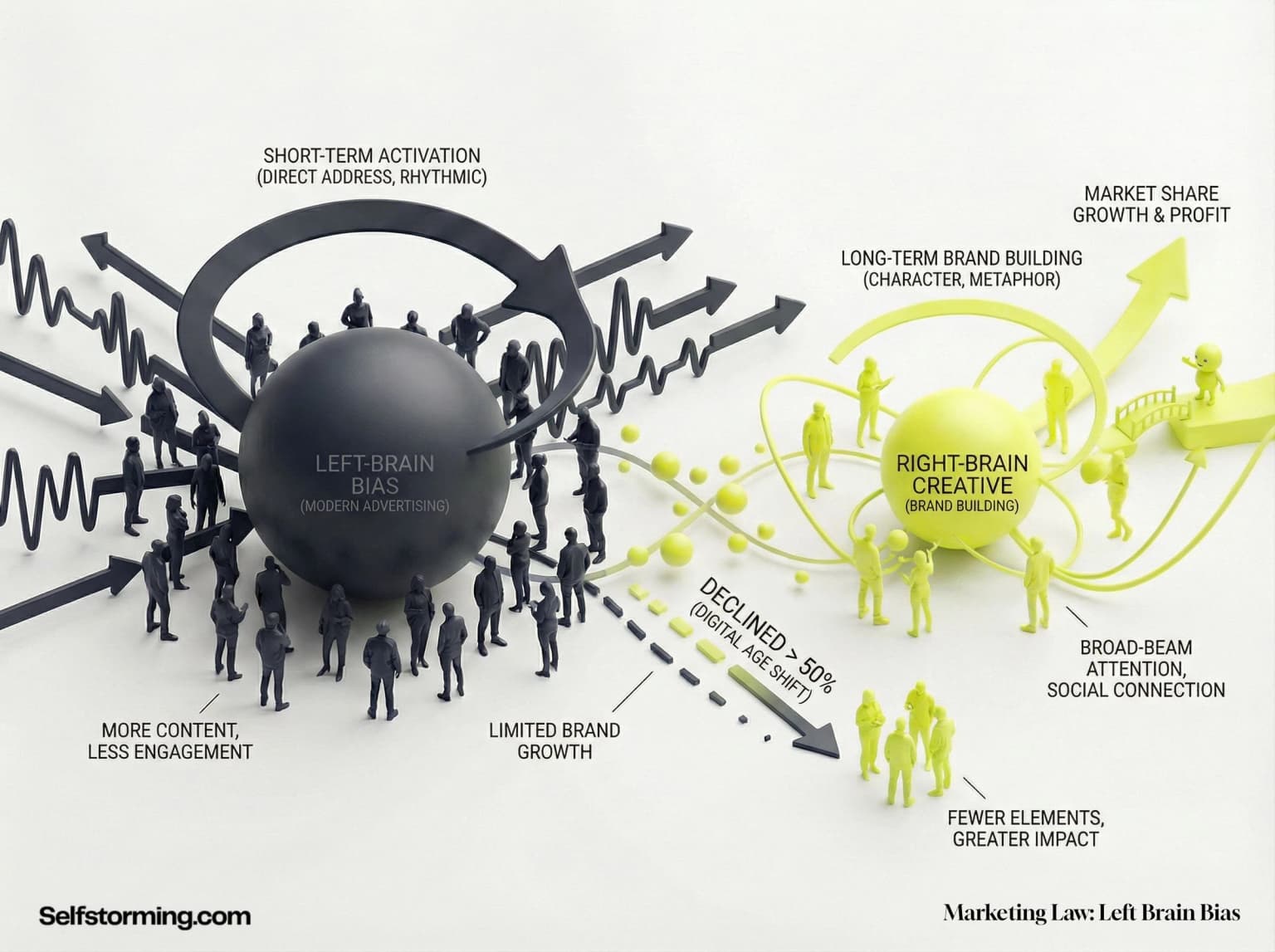
Left-Brain Bias in Modern Advertising describes a systemic shift in creative execution toward literal, rhythmic, and decontextualized content, which fails to generate long-term brand growth. Rooted in the neuro-psychological research of Iain McGilchrist and popularized by Orlando Wood, the law posits that the right hemisphere of the brain—responsible for broad attention, social connection, and metaphor—is increasingly ignored by modern 'flat' advertising. While 'left-brain' creative (direct address, heavy text, rhythmic editing) can drive short-term activation, it lacks the 'broad-beam' attention required for brand building. Research shows that ads featuring 'right-brain' elements—such as character, incident, place, and humor—are significantly more likely to drive market share growth and profit, yet these features have declined by over 50% in the digital age.

LEFT-BRAIN BIAS IN MODERN ADVERTISING

Systemic dominance of literal, non-metaphorical, and decontextualized creative elements in advertising results in a failure to engage the right hemisphere of the brain, ultimately diminishing long-term brand effectiveness and commercial return.

Left-Brain Bias in Modern Advertising marketing law: Logic explains, but creativity sells. - Visual illustration showing key concepts and examples

Key Takeaways

  • Literal, flat advertising kills long-term commercial effectiveness.
  • The right brain is the gateway to long-term memory and brand building.
  • Human connection, metaphor, and 'place' are essential for broad-beam attention.
  • Modern creative has become too rhythmic, decontextualized, and soul-less.
  • Effective advertising requires 'the between-ness' of human interaction and social nuance.

Genesis & Scientific Origin

The concept was formally introduced to the marketing industry by Orlando Wood, Chief Innovation Officer at System1 Group, in his seminal 2019 publication 'Lemon: How the Advertising Brain Turned Sour'. Published by the IPA (Institute of Practitioners in Advertising), the work drew upon the neuro-psychological foundations established by Dr. Iain McGilchrist in 'The Master and His Emissary' (2009). Wood further expanded this research in the 2021 follow-up, 'Look Out', which analyzed the impact of technological shifts on creative styles and their subsequent commercial performance. These studies were supported by the IPA's extensive Databank, linking creative style to business outcomes over several decades.

Ads with right-brain features are 2.5x more likely to drive large business effects.

The Mechanism: How & Why It Works

The mechanism of Left-Brain Bias is rooted in brain lateralization—the different ways the two hemispheres of the brain attend to the world. The left hemisphere is specialized for 'narrow-beam' attention; it is literal, logical, focused on tools, and views things in isolation. It prefers rhythm, repetition, and decontextualized imagery. Conversely, the right hemisphere is specialized for 'broad-beam' attention; it understands context, social nuance, metaphor, and 'the between-ness' of things.

In modern advertising, the 'left-brain' has taken over. This manifests as creative that features: 1) Flatness (lack of depth), 2) Direct address (talking to the camera), 3) Rhythmic, staccato editing, 4) Heavy use of text/words on screen, and 5) Abstract or white-space backgrounds. While this style is efficient for capturing the narrow attention required for a 'buy now' click, it is fundamentally incapable of building mental availability. The right brain is the gateway to long-term memory. By removing 'right-brain' features—such as character development, a sense of place, and implicit communication—marketers are creating ads that the brain's broad-attention system simply filters out as noise. This leads to the 'crisis in creative effectiveness,' where ads become increasingly similar and forgettable, despite sophisticated targeting and high frequency.

Left-Brain Bias in Modern Advertising mechanism diagram - How Left-Brain Bias in Modern Advertising works in consumer behavior and marketing strategy

Empirical Research & Evidence

In 'Lemon' (2019), Orlando Wood's research published in the IPA (Wood, 2019) analyzed over 1,000 television advertisements from the IPA Databank between 2000 and 2018. The study used System1’s 'Star Rating' (a measure of emotional response and long-term brand growth potential). The data revealed a staggering correlation: ads with 'right-brain' features (humor, dialogue, clear setting, and melodic music) achieved an average Star Rating of 3.8, while those dominated by 'left-brain' features (rhythmic editing, close-ups of products, and text-heavy visuals) averaged only 2.1. Crucially, the research demonstrated that the percentage of ads featuring 'right-brain' elements had declined from approximately 45% in the mid-2000s to less than 20% by 2017. Furthermore, ads that utilized right-brain creative strategies were 2.5 times more likely to report 'very large' business effects (profit, market share, and penetration) compared to their left-brain counterparts.

Real-World Example:
Cadbury

Situation

In the mid-2010s, Cadbury had moved toward highly rational, product-centric advertising that focused on the functional benefits of its chocolate and specific 'joy' moments that felt forced and literal. Their market share was stagnating as the brand became a commodity in the eyes of the consumer.

Result

Following the principles of right-brain engagement, Cadbury shifted its strategy with the 'Mum's Birthday' campaign. The ad featured a young girl 'buying' a bar of chocolate for her mother using her own trinkets as currency. There was no direct product pitch, no list of ingredients, and no rhythmic 'staccato' editing. Instead, it focused on 'the between-ness'—the emotional nuance and human connection. This right-brain approach led to a significant increase in brand salience and a 9% volume growth in a stagnant market, proving that emotional, contextual storytelling outperforms literal product demonstrations.

Strategic Implementation Guide

1

Step 1

Audit your current creative library for 'flatness'. If your ads look like they could be a static PowerPoint slide with a beat behind them, you're suffering from Left-Brain Bias.

2

Step 2

Reintroduce 'Place' and 'Context'. Stop using white backgrounds or abstract voids. Give your characters a world to inhabit; the right brain needs to see where things are happening to find them meaningful.

3

Step 3

Focus on 'The Between-ness'. Instead of a person looking at the camera, show two people looking at each other. The right brain is hyper-attuned to social cues, eye contact, and implicit body language.

4

Step 4

Use Metaphor over Literalism. Don't just say your product is fast; show a metaphor for speed. The left brain wants the fact; the right brain wants the feeling. The feeling is what sticks.

5

Step 5

Kill the 'Staccato' Editing. Rapid-fire cuts and heavy rhythm appeal to the left brain's love of pattern but prevent the right brain from forming an emotional connection. Slow down and let the scene breathe.

6

Step 6

Prioritize Melodic Music. Avoid purely rhythmic or percussive soundtracks. Melodic, evolving music engages the right hemisphere and aids in emotional encoding.

7

Step 7

Embrace the 'Living' over the 'Mechanical'. Show human imperfections, humor, and spontaneity. The left brain loves the perfect and the symmetrical; the right brain loves the messy reality of life.

Frequently Asked Questions

Is Left-Brain Bias only a problem for TV commercials?

Absolutely not. While Wood's research began with TV, the bias is even more prevalent in digital, social, and out-of-home media. The 'scroll-stopping' mentality often forces creators into high-contrast, rhythmic, and literal executions that might get a click but fail to build any long-term mental availability. The challenge is bringing right-brain features into shorter formats.

Does this mean rational product features don't matter anymore?

They matter, but they don't 'build' the brand. Rational features are for the 'Short' (activation). They help people justify a purchase they've already emotionally decided on. If you only provide the rational, you're competing solely on price and utility, which is a race to the bottom.

Why has advertising become more 'Left-Brain' if it's less effective?

Blame the tools. Modern production software, the rise of global 'standardized' campaigns that need to work without local nuance (metaphor is hard to translate), and the obsession with short-term digital metrics have all incentivized a literal, 'flat' style. It's easier and cheaper to produce, but it costs more in lost effectiveness.

How do I convince a data-driven client to use 'Right-Brain' creative?

Show them the money. Use the IPA data that links right-brain features to market share growth. Explain that the left brain is the 'emissary'—it’s great for execution—but the right brain is the 'master' that actually decides what to care about. If the right brain doesn't 'look out' and notice the ad, the left brain never gets the chance to process the logic.

Can B2B brands use these principles, or is it just for FMCG?

B2B is perhaps the biggest victim of Left-Brain Bias. B2B buyers are still humans with right brains. In fact, because B2B decisions are higher risk, emotional trust and brand salience are even more critical. A B2B ad with character and humor will stand out like a flare in a sea of blue-tinted stock photos of servers.

We use cookies on our site to enhance your user experience, provide personalized content, and analyze our traffic. Cookie Policy