Reciprocity Principle

Give something to get something back.

Congratulations, you’ve discovered the oldest trick in the human operating system. You think you’re being generous by giving away a PDF or a sample? Please. You’re just weaponizing social debt. The Reciprocity Principle is the reason you feel like a total jerk when you don't tip the barista who drew a heart in your foam, even if the coffee tasted like battery acid. It’s not kindness; it’s a biological glitch that forces humans to balance the scales. If you aren't using this to tilt the market in your favor, you’re not a marketer—you’re a charity, and a bad one at that. Let’s look at how to stop being a doormat and start being a strategist.
The Reciprocity Principle is a foundational social psychology axiom stating that humans are evolutionarily hardwired to return favors, gifts, and concessions. In a marketing context, this creates a 'web of indebtedness' where a brand provides upfront value—be it information, samples, or concessions—to trigger a psychological obligation in the consumer to comply with a future request (like a purchase). Unlike traditional 'tit-for-tat' transactions, reciprocity is often asymmetrical; a small initial favor can lead to a significantly larger return. This principle bypasses the rational 'Liking' rule, meaning consumers will often reciprocate even if they dislike the person or brand providing the initial gift. For modern marketers, it is the engine behind content marketing, freemium models, and the 'rejection-then-retreat' sales strategy.

RECIPROCITY PRINCIPLE

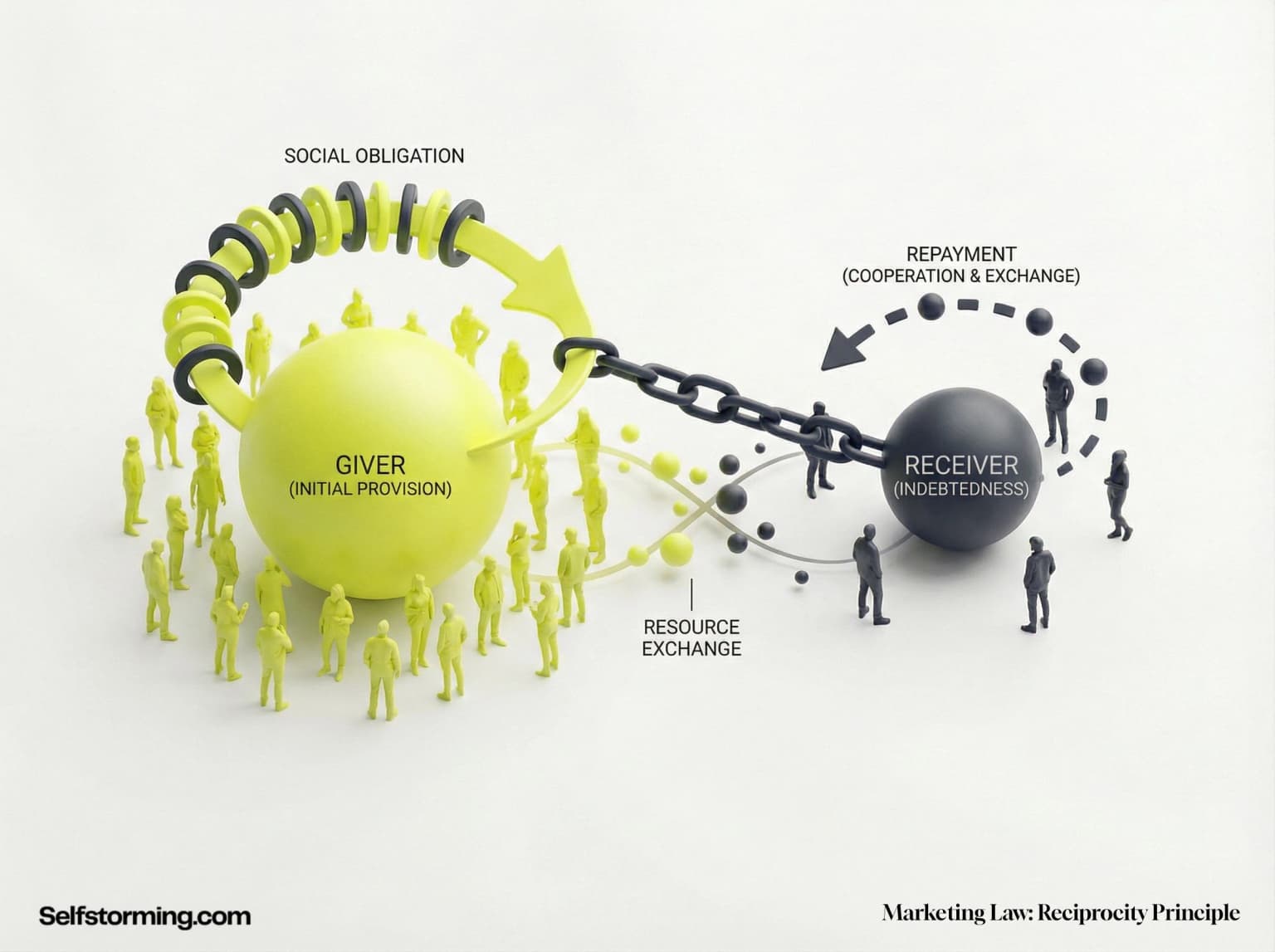
Social evolution mandates an internalized obligation to repay what another person has provided, creating a system of indebtedness that facilitates cooperation and resource exchange.

Reciprocity Principle marketing law: Give something to get something back. - Visual illustration showing key concepts and examples

Key Takeaways

  • Reciprocity triggers an evolutionary obligation to return favors, regardless of brand liking.
  • Unsolicited gifts create more psychological debt than requested ones or rewards.
  • Small initial favors can lead to significantly larger returns (Asymmetrical Exchange).
  • The 'Rejection-then-Retreat' technique uses concessions as favors to drive compliance.
  • Indebtedness is a temporary state; the urge to reciprocate fades over time.

Genesis & Scientific Origin

While the concept of social exchange has existed since the dawn of trade, the formal academic codification of the Reciprocity Principle as a primary tool of social influence was spearheaded by Dr. Robert Cialdini in his seminal 1984 work, 'Influence: The Psychology of Persuasion'. Cialdini, a Regents' Professor Emeritus of Psychology and Marketing at Arizona State University, derived the principle from years of 'participant observation'—embedding himself in the training programs of sales organizations, fundraisers, and advertisers. However, the sociological roots go deeper. In 1960, sociologist Alvin Gouldner published 'The Norm of Reciprocity: A Preliminary Statement' in the American Sociological Review, arguing that the rule is a universal human constant. Gouldner posited that no society can exist without this norm, as it provides the 'starting mechanism' for social relationships, allowing individuals to initiate exchanges without the immediate fear of loss. Further refinement came from the work of Marcel Mauss in his 1925 essay 'The Gift', which explored how the obligation to receive and the obligation to repay form the bedrock of human culture.

Waiters who provided a single mint with the bill saw tips increase by 3%, while two mints (given as a 'special' favor) increased tips by 14% (Journal of Applied Social Psychology).

The Mechanism: How & Why It Works

The Reciprocity Principle operates on a deep-seated evolutionary mechanism designed to reduce the risk of social cooperation. In ancestral environments, those who shared resources without the expectation of return were exploited and died out; those who refused to return favors were ostracized. Consequently, the 'rule of reciprocation' became a survival-critical cognitive shortcut. There are three distinct structural components to how this works in a marketing environment: First, the 'Uninvited Debt.' The rule is so powerful that it triggers an obligation even when the initial gift was not requested. This removes the consumer’s choice in the matter; they are 'forced' into a state of indebtedness by the brand’s proactive generosity. Second, the 'Asymmetry of Exchange.' Because the feeling of indebtedness is psychologically unpleasant (a state of cognitive dissonance), people are often willing to agree to a much larger favor than the one they received just to relieve themselves of the psychological burden. This is why a $2 beer can lead to the purchase of $50 worth of raffle tickets. Third, the 'Rejection-then-Retreat' (or Door-in-the-Face) technique. This is a subtle variation where the 'favor' is a concession. If a marketer makes an extreme request that is rejected, and then moves to a smaller, more 'reasonable' request, the consumer perceives this move as a favor (a concession). To reciprocate this 'favor,' the consumer feels a heightened obligation to agree to the second request. Mathematically, this mirrors a 'Regression to the Mean' in social expectations, where the second offer is viewed not in isolation, but in contrast to the first, making it appear significantly more attractive than it would have been otherwise.

Reciprocity Principle mechanism diagram - How Reciprocity Principle works in consumer behavior and marketing strategy

Empirical Research & Evidence

One of the most definitive studies on the Reciprocity Principle was conducted by Dennis Regan of Cornell University, published as 'Effects of a Favor and Liking on Compliance' in the Journal of Experimental Social Psychology (Regan, 1971). In this experiment, subjects were told they were participating in an 'art appreciation' study alongside a partner named Joe (who was actually a confederate). During a short break, Joe left the room and returned in two different scenarios. In the 'favor' condition, Joe returned with two bottles of Coca-Cola, telling the subject, 'I asked the assistant if I could go get myself a Coke, and he said it was okay, so I bought one for you, too.' In the 'no favor' condition, Joe returned empty-handed. Later, Joe asked the subject to do him a favor by buying some 25-cent raffle tickets, claiming he needed to sell as many as possible to win a prize. The results were staggering: Subjects who had received the unsolicited Coke bought twice as many raffle tickets as those who hadn't. Crucially, Regan also measured how much the subjects liked Joe. In the 'no favor' condition, there was a high correlation between liking Joe and buying tickets. However, in the 'favor' condition, the reciprocity effect was so powerful that it completely overrode the liking variable. Subjects who disliked Joe but received a Coke bought just as many tickets as those who liked him. This proves that reciprocity is not about 'friendship' or 'brand affinity'—it is a mechanical social obligation.

Real-World Example:
The Hare Krishna Society

Situation

In the 1970s, the International Society for Krishna Consciousness (ISKCON) faced a funding crisis. Their traditional method of chanting and soliciting donations in public spaces was failing because the public found them 'weird' and 'annoying.' They lacked 'Liking' and 'Affinity.'

Result

They pivoted to a strategy based purely on the Reciprocity Principle. Instead of asking for money immediately, members would approach travelers in airports and press a 'gift' into their hands—usually a flower or a copy of the Bhagavad Gita. When the target tried to return it, saying they didn't want it, the member would refuse, saying, 'No, this is our gift to you.' Only after the gift was accepted would they ask for a donation. Despite the public's continued dislike of the group, the strategy was a massive success, generating millions in revenue and allowing the society to fund temples and businesses globally. The 'gift' created a debt that the target felt compelled to cancel with a donation, even if they threw the flower in the trash ten seconds later.

Strategic Implementation Guide

1

Give First, Ask Later

Audit your funnel. If the first interaction with a prospect is an 'Ask' (Sign up! Buy! Subscribe!), you're doing it wrong. Provide a high-value asset—a physical sample, a deep-dive report, or a free consultation—before you ever present a call-to-action.

2

Ensure the Gift is Unsolicited

Reciprocity is strongest when the gift feels like a proactive choice by the brand rather than a response to a request. Surprise a segment of your 'Light Buyers' with an unannounced bonus or upgrade.

3

Personalize the 'Favor'

A generic discount code feels like a transaction. A handwritten note or a curated recommendation based on their specific business challenges feels like a favor. The more personalized the gift, the higher the perceived debt.

4

Master the 'Rejection-then-Retreat'

In your pricing strategy, lead with a 'Platinum' or 'Enterprise' tier that is intentionally high-priced. When the prospect balks, offer your 'Standard' tier as a concession. They will be significantly more likely to accept the second offer because you 'gave ground' first.

5

Highlight the Cost (Subtly)

For reciprocity to work, the recipient must perceive that the giver incurred a cost (time, effort, or money). Don't be a martyr, but ensure the consumer understands the work that went into the 'free' value you provided.

6

Time the Request

The sense of indebtedness has a half-life. It is strongest immediately after the favor is received. Don't wait three months to follow up on a lead who downloaded your whitepaper; the 'debt' will have evaporated into the 'Effort Minimisation' void.

Frequently Asked Questions

Is the Reciprocity Principle just 'bribery' with a fancy name?

No. Bribery is a 'quid pro quo'—an explicit agreement where the reward is contingent on the action. Reciprocity is about the *unsolicited* gift. If you say 'I'll give you this if you buy that,' you're negotiating. If you give the gift first with no strings attached, you're triggering a biological obligation. One is a contract; the other is a psychological ambush.

Does this still work if the customer knows what I'm doing?

Surprisingly, yes. While 'persuasion knowledge' can dampen the effect, the social discomfort of being 'in debt' is so ingrained that even when we recognize the tactic, we often comply just to end the internal tension. However, the more authentic the gift feels, the more powerful the response.

What if they take the gift and run?

That’s called 'The Moocher Risk.' In any population, there are people who will ignore the norm. However, statistical evidence shows that the majority of humans will comply. You aren't marketing to the 5% of sociopaths; you're marketing to the 95% of people who don't want to feel like a 'leech' in their social circle.

Can I use Reciprocity in B2B where there are procurement rules?

Procurement rules exist *because* Reciprocity is so dangerous. While you can't buy a procurement officer a Rolex, you can provide 'organizational favors' like free pilot programs, deep industry benchmarking data, or training for their staff. The debt then shifts from the individual to the organization’s culture.

Is there a limit to the asymmetry? Can I give a sticker and expect a car purchase?

There is a 'credibility gap.' If the initial gift is too small relative to the ask, it feels manipulative rather than generous. The gift must have 'perceived value.' It doesn't have to be expensive, but it must be useful or meaningful enough to create a genuine sense of 'Thanks, I owe you one.'

Sources & Further Reading

We use cookies on our site to enhance your user experience, provide personalized content, and analyze our traffic. Cookie Policy