Usage Drives Attitude
Experience is the only ad that sticks
You’ve spent millions on a manifesto video that makes the CMO cry, but guess what? Nobody cares. Your 'brand purpose' is a fart in a windstorm compared to the actual experience of using your product. People don't think their way into liking you; they use their way into it. If your app crashes or your coffee tastes like battery acid, no amount of emotional storytelling is going to save your quarterly projections. Stop trying to brainwash them and start getting them to actually try the damn thing.
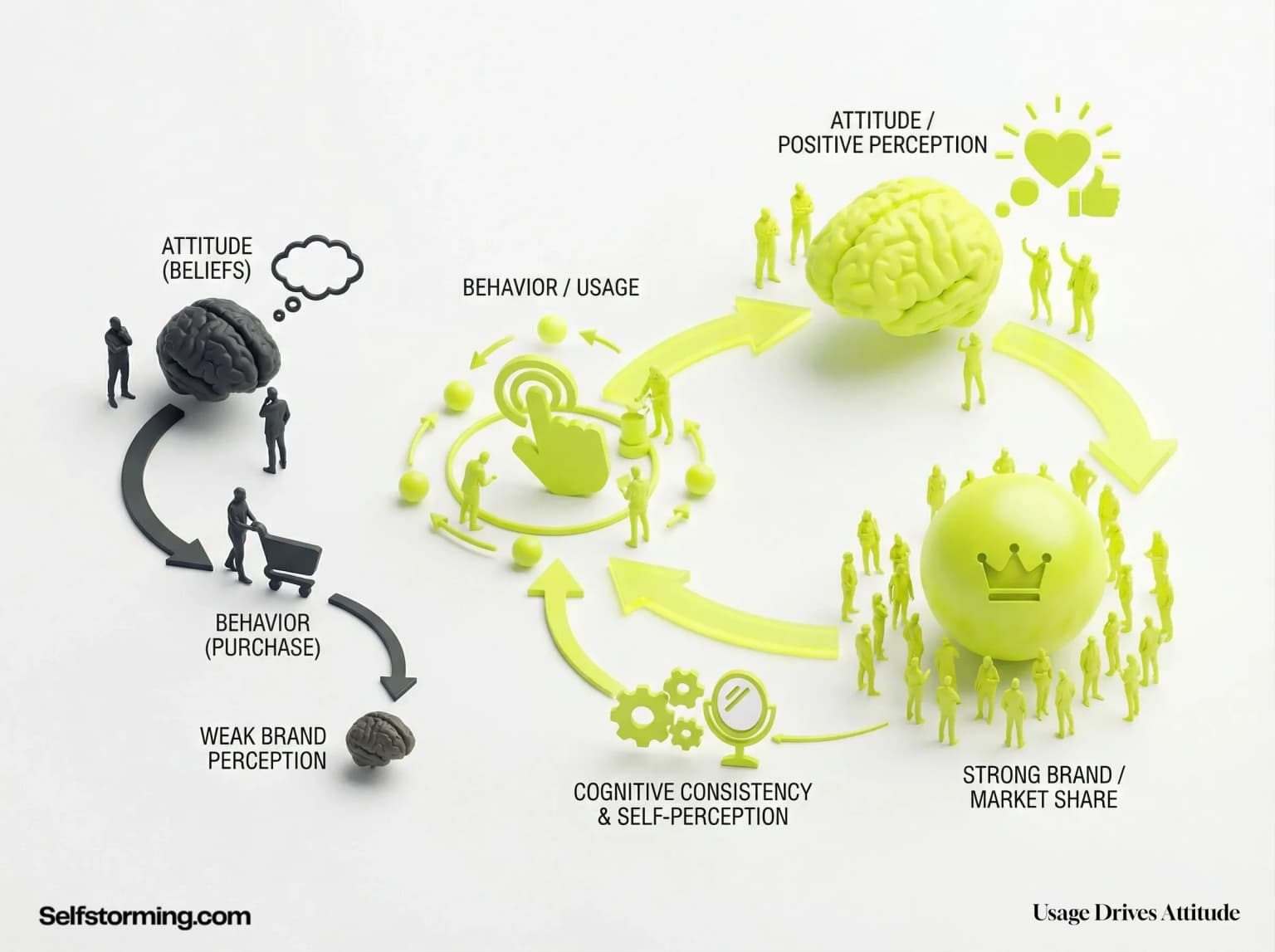
The 'Usage Drives Attitude' law flips traditional marketing on its head. While most marketers believe they must first change a consumer's mind (Attitude) to get them to buy (Behavior), the empirical evidence shows the reverse is true: behavior precedes attitude. Consumers develop positive perceptions of a brand primarily because they use it. This phenomenon is driven by cognitive consistency and the self-perception theory - people align their beliefs with their actions to avoid dissonance. Consequently, the most effective way to build a 'strong brand' isn't through abstract persuasion, but by maximizing trial, physical availability, and the quality of the user experience. High brand attribute scores are often just a reflection of high market share, not the cause of it.
USAGE DRIVES ATTITUDE
“Consumer perceptions and brand attribute associations are primarily a retrospective rationalization of usage experience rather than a prospective driver of initial purchase behavior.”

Key Takeaways
- •Behavioral change is the most effective precursor to attitudinal change in consumers.
- •High brand attribute scores are a consequence of high market share, not a cause.
- •Product experience is the most potent form of brand communication available.
- •Non-users have no brand attitude; stop trying to 'fix' their perceptions with ads.
- •Focus on trial and penetration to naturally lift all brand health metrics.
Consequences Of Applying The Law
| Aspect | When Applied | When Not Applied |
|---|---|---|
| Brand Health Tracking & KPIs | Management benchmarks brand attribute scores against market share. They recognize that low scores among non-users are a function of lack of experience, not a messaging failure. Growth is measured by penetration gains, knowing that attitudinal metrics will naturally follow as the user base expands. | Low brand attribute scores are misinterpreted as a 'perception problem.' The brand wastes resources on 'rebranding' or 'repositioning' campaigns to change the minds of non-users through advertising alone, ignoring the fact that these scores are low simply because people don't use the brand. |
| Customer Acquisition Strategy | The strategy prioritizes trial-driving mechanisms such as sampling, introductory offers, and maximizing physical availability. The goal is to get the product into the consumer's hands, letting the physical experience do the heavy lifting of brand building. | The strategy relies on 'persuasion-led' advertising to convince consumers of brand benefits before they have tried the product. This results in high cost-per-acquisition as the brand attempts to bypass the most potent form of communication: actual usage. |
| Messaging & Creative Strategy | Creative focuses on building mental availability by linking the brand to Category Entry Points (CEPs). Messaging is functional and clear, designed to facilitate a first purchase rather than attempting to forge deep emotional bonds with people who have no experience with the product. | Messaging focuses on complex 'brand purpose' or abstract emotional storytelling. It assumes that consumers must 'love' or 'align' with the brand's values before they will buy it, which contradicts the reality that brand affinity is a consequence of satisfied usage. |
| Budget Allocation | Budget is weighted toward ensuring product quality and wide distribution (physical availability). Marketing spend is directed at broad-reach media to ensure the brand is 'easy to buy' for the largest possible number of light buyers. | Significant budget is diverted into 'sentiment' campaigns or 'engagement' initiatives. The brand over-invests in high-production emotional ads while neglecting the friction points in the customer journey or product experience that actually dictate long-term brand perception. |
| Competitive Analysis | The brand accepts that market leaders will always have higher 'brand love' and 'trust' scores due to their larger user base (Double Jeopardy). Competitive benchmarking focuses on closing the penetration gap rather than trying to 'out-message' the leader on brand image. | Marketing teams obsess over why the market leader is 'better liked' or 'more trusted.' They attempt to copy the leader's high-level brand imagery, failing to realize those high scores are a result of the leader's scale, not the cause of it. |
| Product Development | R&D and Marketing collaborate to ensure the 'first moment of truth' is flawless. Every touchpoint of the physical product experience is treated as the primary brand-building asset, ensuring that usage reinforces the promised brand image. | The product is treated as separate from the brand. Marketing 'wraps' a mediocre product in high-gloss advertising. This creates a disconnect when the usage experience fails to match the ad claims, leading to negative brand perceptions that no amount of advertising can fix. |
Genesis & Scientific Origin
The 'Usage Drives Attitude' principle was formally codified through the longitudinal research of Andrew Ehrenberg and his colleagues, later popularized by Byron Sharp and the Ehrenberg-Bass Institute for Marketing Science. The foundational work can be traced back to studies in the late 1960s and 70s, notably the research published in the Journal of Marketing Research by Bird, Channon, and Ehrenberg (1970). They demonstrated that brand image measures are heavily dependent on the brand's current market share and the respondent's usage history, debunking the 'linear persuasion' models taught in traditional MBAs.
“Users are 3x to 5x more likely to associate a brand with positive attributes than non-users (Bird et al., 1970).”
The Mechanism: How & Why It Works
The mechanism behind Usage Drives Attitude is rooted in both statistical reality and psychological theory.
Psychologically, it relies on 'Self-Perception Theory' (Daryl Bem, 1967). Humans are not as self-aware as we like to think. We often observe our own behavior - like buying a specific brand of detergent - and then conclude, 'I must like this brand because I keep buying it.' This is a form of cognitive economy; it’s easier to assume we like what we use than to constantly re-evaluate every purchase decision. Furthermore, 'Cognitive Dissonance' (Festinger, 1957) ensures that once a purchase is made, the brain filters for information that supports the choice and ignores information that contradicts it.
Statistically, the law is a function of the 'Double Jeopardy' effect. Large brands have more users. These users, by definition, have more experience with the brand. When surveyed about brand attributes, these users provide positive responses based on their lived experience. Non-users, who have no experience, either provide neutral answers or none at all. Therefore, a brand's 'image' is largely a mathematical reflection of its penetration.
In the 'Usage-Image Loop,' usage creates mental structures. Every time a consumer uses a product, a memory trace is reinforced. These traces are far more robust than the ephemeral memories created by a 15-second YouTube pre-roll. Over time, these reinforced traces aggregate into what we call 'Brand Attitude.' In short: Usage creates the memory, and the memory creates the attitude.

Real-World Example:
Netflix
Situation
In the early 2010s, Netflix transitioned from a DVD-by-mail service to a streaming giant. Traditional marketers argued they needed 'brand building' ads to convince people that 'streaming' was the future and that Netflix was a premium entertainment brand.
Result
Netflix ignored the 'persuasion first' model and focused entirely on trial and friction-reduction (the one-month free trial). By getting millions of people to actually *use* the interface, the attitude shifted. People didn't join Netflix because they 'loved the brand'; they loved the brand because the service was seamless and the content was accessible. The 'attitude' of Netflix being an essential utility was a direct byproduct of the daily usage habit, not the 'Tudum' sound or the marketing billboards.
Strategic Implementation Guide
Kill the Persuasion Obsession
Stop trying to 'convince' non-users that you are better/cooler/greener. Most people don't care enough to be convinced. Focus your creative on being remembered, not being 'liked'.
Prioritize Trial Above All
If usage drives attitude, then the 'Free Trial,' 'Sampling,' or 'Entry-level SKU' is your most powerful brand-building tool. Get the product in their hands.
Fix the Product Friction
A bad user experience is a brand-building disaster that no ad budget can fix. If the 'Usage' part of the law is negative, the 'Attitude' will follow suit.
Maximize Physical Availability
You cannot drive usage if you aren't there. Be in more stores, more digital marketplaces, and more mental consideration sets. Presence precedes usage.
Reinforce the Post-Purchase
Use your communication budget to talk to people who just bought you. Remind them why their choice was smart to lean into the cognitive dissonance effect.
Measure Penetration, Not 'Love'
Stop obsessing over NPS and Brand Favorability in a vacuum. If your penetration is growing, your 'Brand Love' will naturally follow. If penetration is stalling, your 'Love' is a lie.
Use Distinctive Assets
Ensure that every usage occasion is branded with consistent colors, sounds, and logos so the brain knows exactly which brand to credit for the positive experience.
Frequently Asked Questions
Does this mean advertising is useless?
Hardly. Advertising's job isn't to 'persuade' people through rational arguments; it's to build and refresh mental structures (Mental Availability) so that when a buying situation arises, your brand is thought of. Advertising gets you into the consideration set; usage then cements the attitude.
What about luxury brands where 'image' seems to come first?
Even in luxury, the 'dream' is built on the observation of others using the brand. The 'attitude' is still driven by usage - either your own or the visible usage by a reference group. Without the 'usage' (the sight of the bag on a celebrity), the 'attitude' (desire) wouldn't exist.
Can a brand have a great attitude but low usage?
Rarely, and it's usually a 'phantom' attitude. People might say they 'like' a brand in a survey because it sounds virtuous (e.g., a local organic brand), but if they don't use it, that attitude is shallow and won't translate into sales. We call this 'Cheap Talk'.
Does negative usage drive negative attitude?
Absolutely. This law works both ways. A single bad experience (usage) is more powerful than a thousand 'we care about you' commercials. This is why customer service is actually a subset of branding.
How do I launch a new brand if usage doesn't exist yet?
You rely on Mental Availability (being noticed) and Physical Availability (being there). You don't need 'brand love' to get the first trial; you need to be an easy, low-risk option. Once they use you, the love starts.
Sources & Further Reading
Related Marketing Laws
Repertoire Buying Behaviour
Consumers buy from a set of acceptable brands, not one favorite.
Fluency Over Persuasion
Easy-to-process messages outperform complex, rational arguments.
Effort Minimisation
People choose the easiest acceptable option, not the best one.
Autopilot Decision-Making
Most brand choices are made without conscious deliberation.