New PHD x WARC research: AI agents will facilitate $3.35 trillion in consumer spending by 2030. The map of what gets delegated first - and what brands must do about it.
Somewhere in 2030, a telecom contract will be cancelled, compared against 40 competitors, renegotiated and re-signed - and no human will read a single word of it.
That is not a sci-fi premise. It is the central forecast of a new research report from PHD and WARC, built on Acxiom and Oxford Economics data across ten markets. Their framing question deserves to be pinned above every marketing department's door: if the role of a brand is to signal quality and influence choice for people, what happens when the machine is making the choice?
The numbers, before you file this under hype
This year, agentic AI will already facilitate $944 billion of global consumer spending - 1.3% of all private consumption on the planet. By 2030 that triples to $3.35 trillion, or 3.8% of everything consumers buy. The US alone accounts for $1.1 trillion of it.
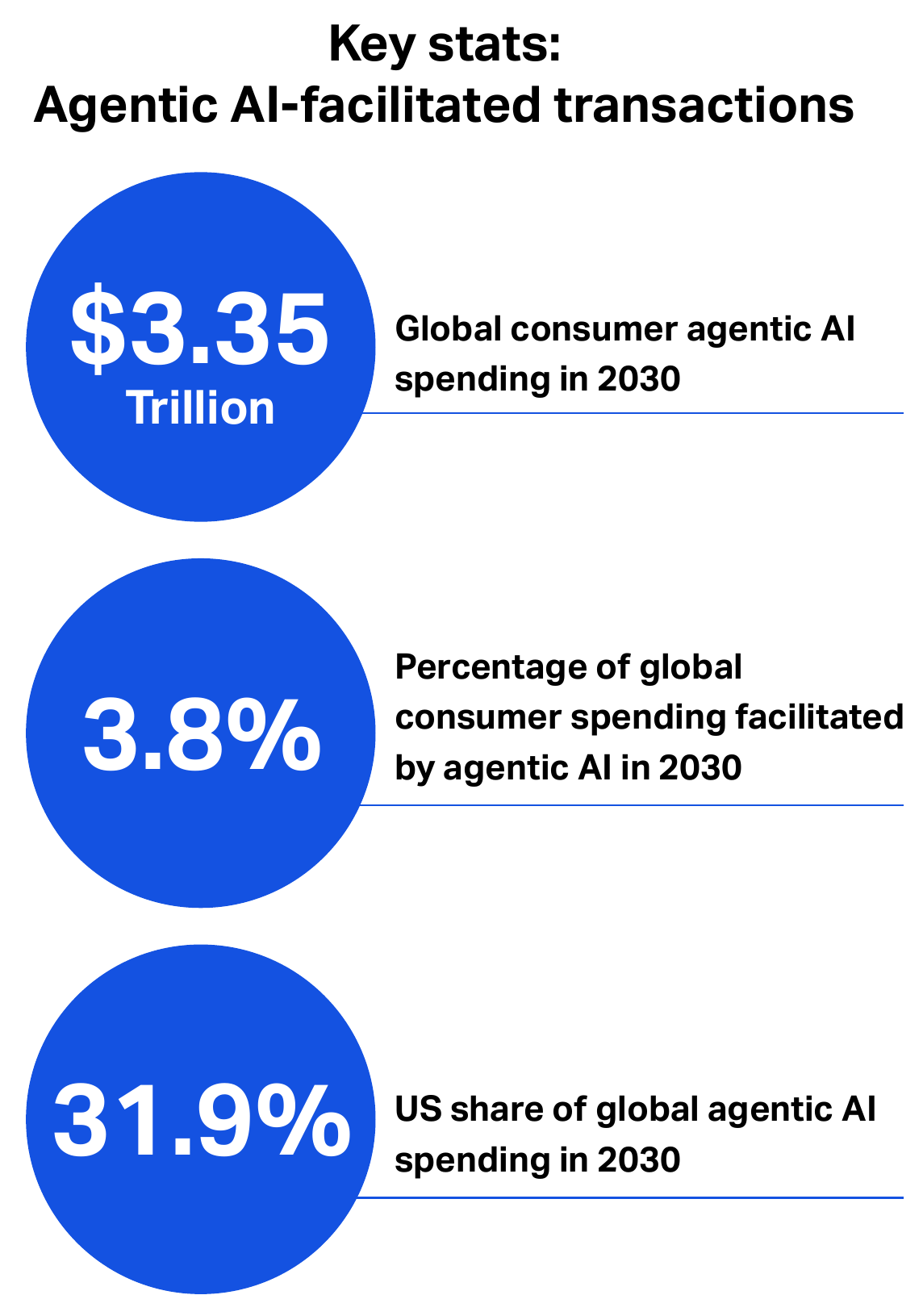
Source: PHD x WARC, "From Abundance to Agents", July 2026
Not every dollar of that is a robot buying things unsupervised. The research counts transactions where an agent curates the comparison, finds the price or surfaces the recommendation. But that is precisely the point: the agent doesn't need to hold the credit card to hold the influence. It only needs to write the shortlist.
A map of the handover
The report's most useful tool is the Four Modes Framework - a 2x2 that plots every category on two axes: who makes the choice (people vs. agents) and whether brands control it or merely influence it.
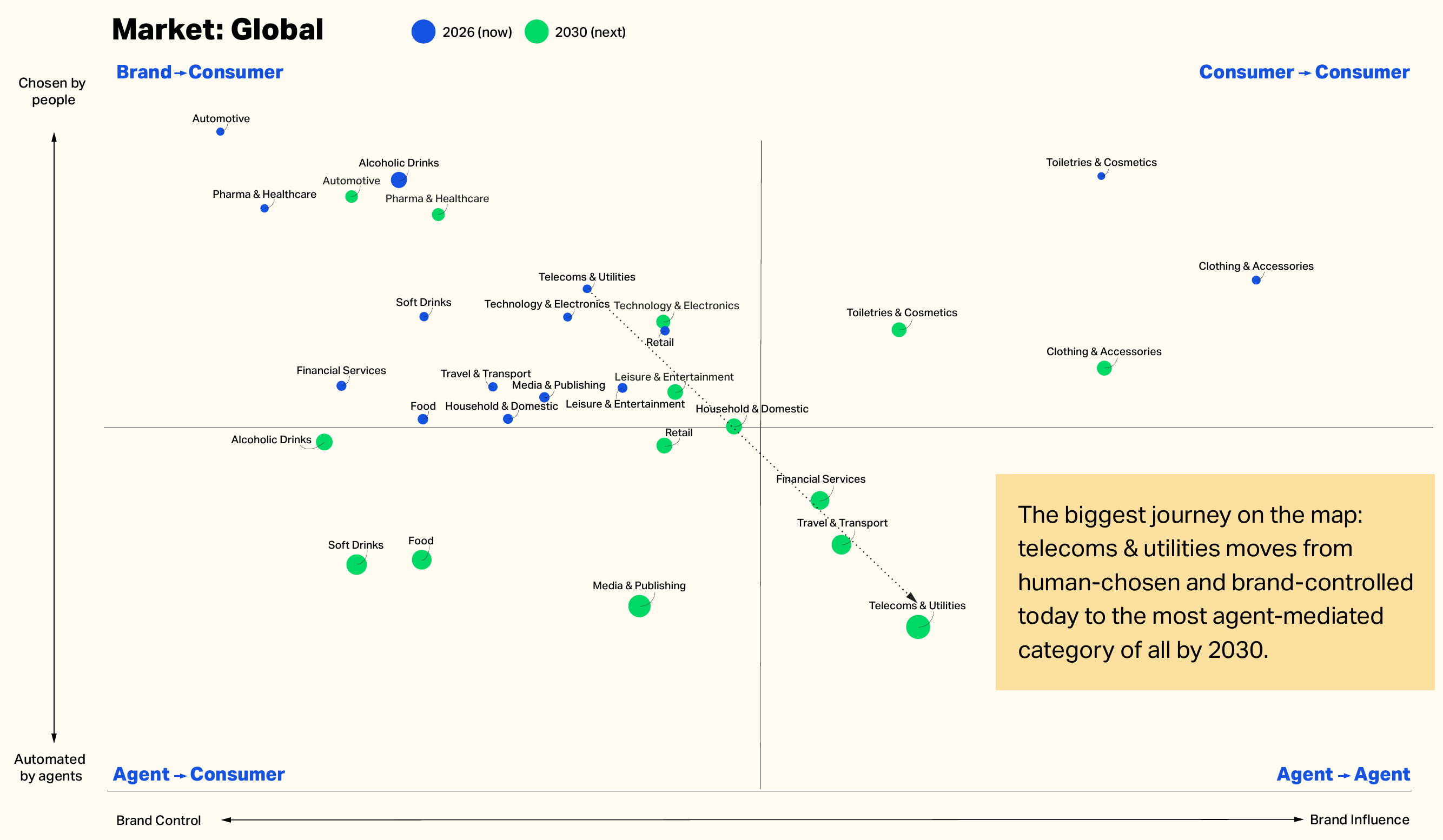
Source: PHD x WARC, "From Abundance to Agents", July 2026
Four modes, all coexisting: Brand→Consumer (people still choose, brands still control - cars, pharma), Consumer→Consumer (peers and creators rule - beauty, fashion), Agent→Consumer (agents buy, brands keep the relationship - food, soft drinks, media) and Agent→Agent (machines talk to machines - telecoms, financial services, travel).
The boring categories go first
Here is the delicious irony: the least glamorous category in marketing is about to become the most automated. Telecoms & utilities - the industry of hold music and incomprehensible tariffs - will grow 611.9% to become the single biggest agentic category by 2030, at $410.3 billion.
Why? Because agents love exactly what humans hate. Information-dense decisions, frequent billing, comparison-led switching. Nobody enjoys comparing 40 broadband tariffs; an agent does it before you finish your coffee. The journey doesn't need to be low-value to be delegated - it needs to be repetitive, searchable and measurable.
Financial services (+235% to $237.9bn) and travel (+253% to $275.6bn) follow the same path. Meanwhile cars, healthcare and electronics stay stubbornly human - too expensive, too regulated, too emotional to hand over.
The fight moves up the funnel
When an agent writes the shortlist, the competition stops being for attention and starts being for criteria. The report puts it beautifully: people may not ask for "a credit card"; they may ask for "the safest card for travel with no hidden fees." Whoever owns that sentence wins the transaction.
Which means trust signals quietly become ranking signals. Reviews, complaints data, regulator ratings, service scores - the unglamorous paperwork of reputation - may now decide whether an agent recommends you or your competitor. Audi's data lead Dr. Oksana Koval describes the shift in one line: "We can no longer describe a product as 'great' or 'nice' - that is not meaningful for machines. We need specific attributes, such as trunk size or maximum speed."
Marketing to people | Marketing to machines |
|---|---|
One clear, memorable message | Comprehensive, structured information |
Emotion, trust, habit | Logic, data, comparable attributes |
"The best coffee in town" | Origin, roast date, price per kg, delivery time |
Attention is the currency | Being in the agent's criteria is the currency |
Won at the moment of choice | Won before the query is even typed |
Diageo's Michael Ditter compresses the whole report into one instruction: invest in making the brand both memorable to people and legible to the machines.
The trap on the other side
Before you fire your brand team and hire a schema engineer: every marketer interviewed for the report - from Uber to Unilever to Skoda - lands on the same warning. People, not agents, still buy the products. Agents inherit human preferences; someone has to put "order the Pepsi" into the prompt, and that preference was built by years of thoroughly human brand work. Under-invest in memory and there is nothing for the machine to inherit.
The winning move isn't either/or. It's building the kind of distinctive, well-documented brand that a human remembers at a party and an agent can parse at 2 a.m. - the same discipline you see in campaigns that crack local markets, now with a second, machine-shaped audience reading along.
The machine is starting to make the choice. Your job is to make sure that long before it does, a human already made it for you.