Burger King: Whopper Sacrifice
Burger King tasked Crispin Porter + Bogusky with re-energizing the Whopper's iconic status among young, digitally-native consumers. The brand needed a highly engaging social media idea to generate significant buzz and demonstrate the Whopper's irresistible appeal. The challenge was to make the product feel so precious that people would actively participate in a memorable, shareable experience, driving conversation and brand relevance in a competitive market.
Creative Idea
Burger King gave free Whoppers for deleting Facebook friends, proving the burger's power over loyalty.
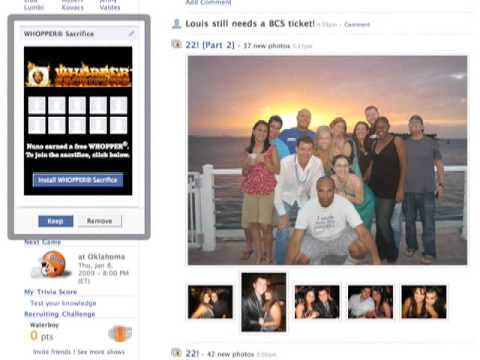
Burger King created a Facebook app called "Whopper Sacrifice" where users could get a free Whopper by deleting 10 friends from their friend list. The campaign humorously challenged people's loyalty by asking them to choose between their virtual friendships and a free burger, which ultimately resulted in 200,000 friends being sacrificed in just over a week.
Trading 233,906 Friendships for Flame Grilled Beef
The 25,000 Coupon Surplus
The campaign was born from a logistical leftover rather than a massive budget. Crispin Porter + Bogusky (CP+B) had 25,000 unredeemed coupons from a previous promotion and needed a provocative way to distribute them. Developed in-house over eight weeks with Ascent Marketing and Refresh Partners, the app featured a custom "burn" animation that incinerated the profile picture of every sacrificed friend.
Defying the Facebook Algorithm
At a time when social platforms were obsessed with growth and "adding," Whopper Sacrifice introduced the concept of "friend inflation." The app was so effective at highlighting the superficiality of digital bonds that users formed "Sacrifice Groups" - adding strangers specifically to delete them for food. CP+B Technology Director Scott Prindle and his team built a notification system that told users they were worth less than one-tenth of a Whopper, a feature that eventually led to the campaign's demise.
The Ultimate Earned Media Sacrifice
The campaign lasted only 10 days before Facebook intervened. The platform demanded the removal of the "sacrifice notification," but CP+B refused, arguing the notification was the heart of the social experiment. When the app was disabled on January 15, 2009, it triggered a second wave of PR. Despite the short run, it generated 40 million media impressions and a 20% spike in web traffic. As Matt Walsh famously noted, the campaign itself was sacrificed, but not before proving that for 82,000 people, a burger was more valuable than a digital connection.
Creative Strategy Deconstructed
Company
Burger King leveraged its identity as a provocative challenger brand with a fanatically loved flagship product. They could credibly claim the Whopper was more valuable than the superficial digital connections people accumulated online.
Category
The category typically promotes social sharing, togetherness, and 'happy' gatherings. Most loyalty programs reward engagement and adding friends, rather than encouraging users to actively destroy their social networks for a burger.
Customer
Users felt the burden of 'friend inflation' on Facebook, where lists were cluttered with meaningless acquaintances. They harbored a secret desire to prune their networks but lacked a socially acceptable excuse to do so.
Culture
In 2009, Facebook was the dominant cultural force, and 'friend counts' were a sacred metric of social status. By making friends a currency for food, the brand subverted the platform's entire value proposition.
Company
Burger King leveraged its identity as a provocative challenger brand with a fanatically loved flagship product. They could credibly claim the Whopper was more valuable than the superficial digital connections people accumulated online.
Category
The category typically promotes social sharing, togetherness, and 'happy' gatherings. Most loyalty programs reward engagement and adding friends, rather than encouraging users to actively destroy their social networks for a burger.
Strategy:
Prove the Whopper’s value by weaponizing the hidden desire to purge low-value digital friendships for tangible, delicious rewards.
Customer
Users felt the burden of 'friend inflation' on Facebook, where lists were cluttered with meaningless acquaintances. They harbored a secret desire to prune their networks but lacked a socially acceptable excuse to do so.
Culture
In 2009, Facebook was the dominant cultural force, and 'friend counts' were a sacred metric of social status. By making friends a currency for food, the brand subverted the platform's entire value proposition.
Strategy:
Prove the Whopper’s value by weaponizing the hidden desire to purge low-value digital friendships for tangible, delicious rewards.
Results
The Whopper Sacrifice campaign achieved significant results: - Over 200,000 friends were sacrificed in just over a week. - Specifically, 233,906 friendships were sacrificed. - The campaign generated 35 million free media impressions. - The application was taken down by Facebook after 82,771 people removed their friends in less than a week.
233,906
friendships sacrificed
35M
free media impressions
Strategy Technique
Find the Consumer Truth
The campaign exposed the consumer truth that virtual friendships often hold less value than a tangible reward. It leveraged this insight to generate massive engagement and buzz.
Explore Technique
Creative Technique
Challenge your target group
Burger King dared users to delete 10 Facebook friends for a free Whopper. This actively challenged their loyalty to virtual connections, making the Whopper feel irresistible.
Explore Technique
Craft Breakdown
This campaign's craft was exceptional in its audacious, psychologically provocative idea, masterfully executed through a highly engaging and viral social media application.
The flawless development and integration of the 'Whopper Sacrifice' Facebook application, complete with the visually impactful 'burning' of sacrificed friends, provided the perfect interactive platform for the campaign's central idea.
The provocative and witty messaging, from the direct challenge ('Delete ten friends and receive a free Whopper') to the campaign tagline ('Friendship is strong, but the Whopper is stronger'), fueled the debate and amplified the campaign's impact.
“The campaign's remarkable success was a direct result of the powerful synergy between its brilliant, provocative idea and its seamless, engaging digital execution, amplified by sharp, impactful copywriting.”