Belgian Red Cross: Crosses for Crisis
The Belgian Red Cross tasked Mutant with addressing a severe, recurring blood shortage. Despite the vital need for donations, public awareness remained low and disconnected from the urgency of the situation. The goal was to reach citizens in their daily environment without relying on expensive, traditional paid media, ultimately driving a significant increase in both first-time and repeat blood donations.
Creative Idea
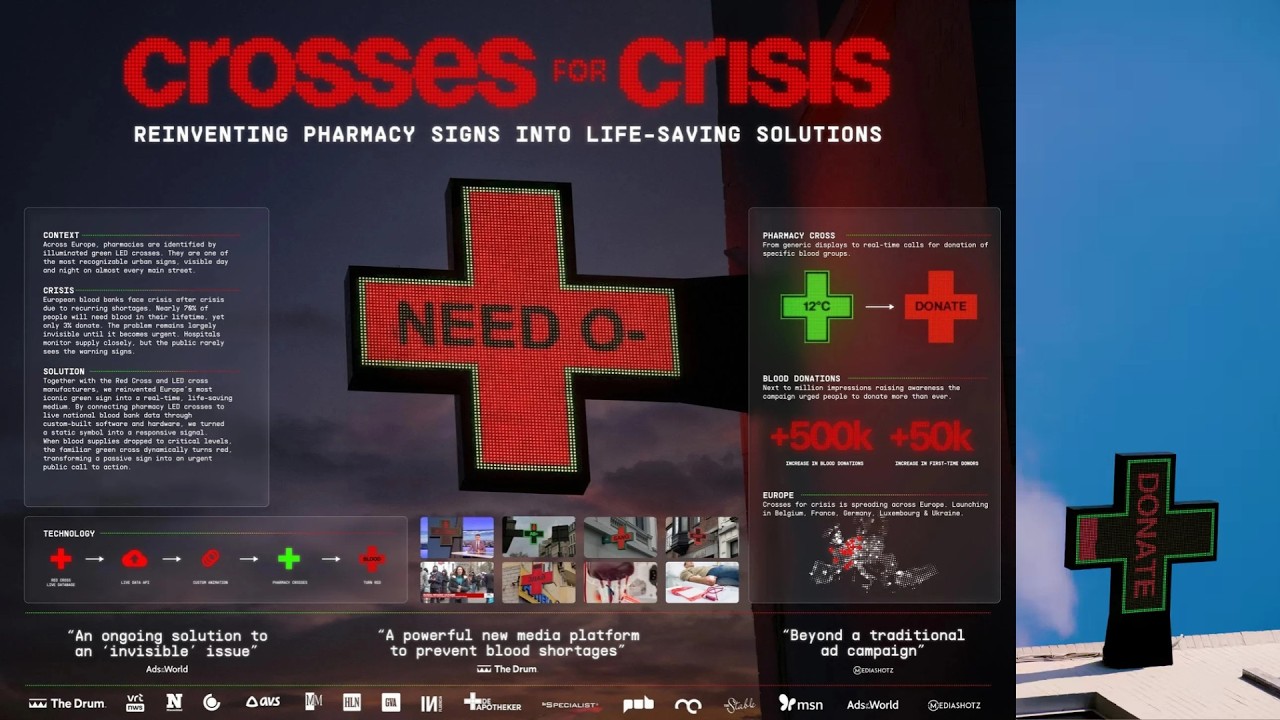
Pharmacy signs dynamically changed color to signal real-time blood shortages to the public.
By transforming ubiquitous pharmacy LED crosses into real-time blood supply monitors, the campaign turned passive urban signage into a life-saving emergency alert system, effectively bridging the gap between critical donation needs and public awareness without requiring new media infrastructure.
Turning Pharmacy Signs Into Life Saving Signals
Engineering a Civic Alert Network
The project moved beyond a typical marketing stunt by integrating directly into the hardware ecosystem. Mutant collaborated with Pharmes, a market leader in pharmacy LED signage, to develop custom software that bridges the gap between national blood bank databases and street-level displays. By equipping these signs with 4G SIM cards, the system allows for real-time, automated updates. This infrastructure ensures that when blood reserves hit critical lows, the signs shift from their standard green to a warning red, displaying the specific blood type required.
Scaling Beyond a Local Pilot
What began as a 14-cross pilot across Flanders and Brussels has evolved into a permanent, structural solution. Because the technology is now integrated into all new hardware sold by Pharmes, the system has scaled organically across Europe. This model proved highly effective, resulting in 246,468 total blood donations in Belgium alone during the campaign period. By turning pharmacies into active healthcare hubs, the initiative successfully converted 22,011 first-time donors, accounting for 16.8% of the entire national donor base.
A Sustainable Media Model
The campaign succeeded by avoiding traditional paid media, instead utilizing existing urban architecture to reach citizens. This created a unique win-win-win scenario: the Belgian Red Cross secured nationwide, real-time OOH coverage at zero ongoing media cost, Pharmes gained a significant technological differentiator for their products, and local pharmacies reinforced their role as essential community health partners. As noted by Simon Pyson of Mutant, the project was designed as a long-term, meaningful partnership rather than a fleeting activation, with the technology now contributing to over 500,000 blood donations across the European market.
Creative Strategy Deconstructed
Company
The Red Cross leveraged its authority to access national blood supply data and coordinate with pharmacy hardware providers.
Category
Non-profits typically rely on passive awareness campaigns, posters, or digital ads that are easily ignored by the public.
Customer
People are generally willing to help but remain disconnected from the immediate, urgent reality of blood shortages.
Culture
The ubiquity of pharmacy signs as familiar urban landmarks provided a perfect, high-visibility canvas for urgent civic messaging.
Company
The Red Cross leveraged its authority to access national blood supply data and coordinate with pharmacy hardware providers.
Category
Non-profits typically rely on passive awareness campaigns, posters, or digital ads that are easily ignored by the public.
Strategy:
Integrate essential messaging into existing infrastructure to transform passive awareness into immediate, actionable public participation.
Customer
People are generally willing to help but remain disconnected from the immediate, urgent reality of blood shortages.
Culture
The ubiquity of pharmacy signs as familiar urban landmarks provided a perfect, high-visibility canvas for urgent civic messaging.
Strategy:
Integrate essential messaging into existing infrastructure to transform passive awareness into immediate, actionable public participation.
Results
The 'Crosses for Crisis' initiative achieved remarkable real-world impact across Europe: - +50,000 increase in first-time blood donors. - +500,000 total increase in blood donations. - Expanded from Belgium across Europe, including Germany, France, Luxembourg, and Ukraine. - Transformed ubiquitous pharmacy signage into an open-source, AI-driven real-time public health broadcast system.
+500,000
increase in blood donations
+50,000
increase in first-time donors
Strategy Technique
Build an Utility, Not an Ad
Instead of running traditional awareness ads, the brand integrated its message into essential infrastructure. This approach makes the brand's mission a functional part of daily life rather than a fleeting interruption.
Explore Technique
Creative Technique
Unexpected Utility
The campaign repurposes existing pharmacy signage to provide a critical, real-time public service. This unexpected utility turns a static, overlooked urban object into a dynamic, life-saving communication tool.
Explore Technique
Craft Breakdown
This campaign ingeniously transforms existing European infrastructure into a dynamic real-time media network. By hacking ubiquitous pharmacy LED signs using open-source tech, it creates a seamless alignment between brand identity, utility, and urgent public health messaging.
Reimagined thousands of existing LED pharmacy street signs into ambient, real-time public emergency broadcast channels.
Developed an open-source, AI-driven API that hooks real-time blood bank inventory data directly into street-level LED sign hardware.
“The brilliant intersection of ambient media design and real-time data technology enabled a zero-cost media channel that drove massive real-world behavior change.”