Denk Vooruit: The Netherlands Goes Dark
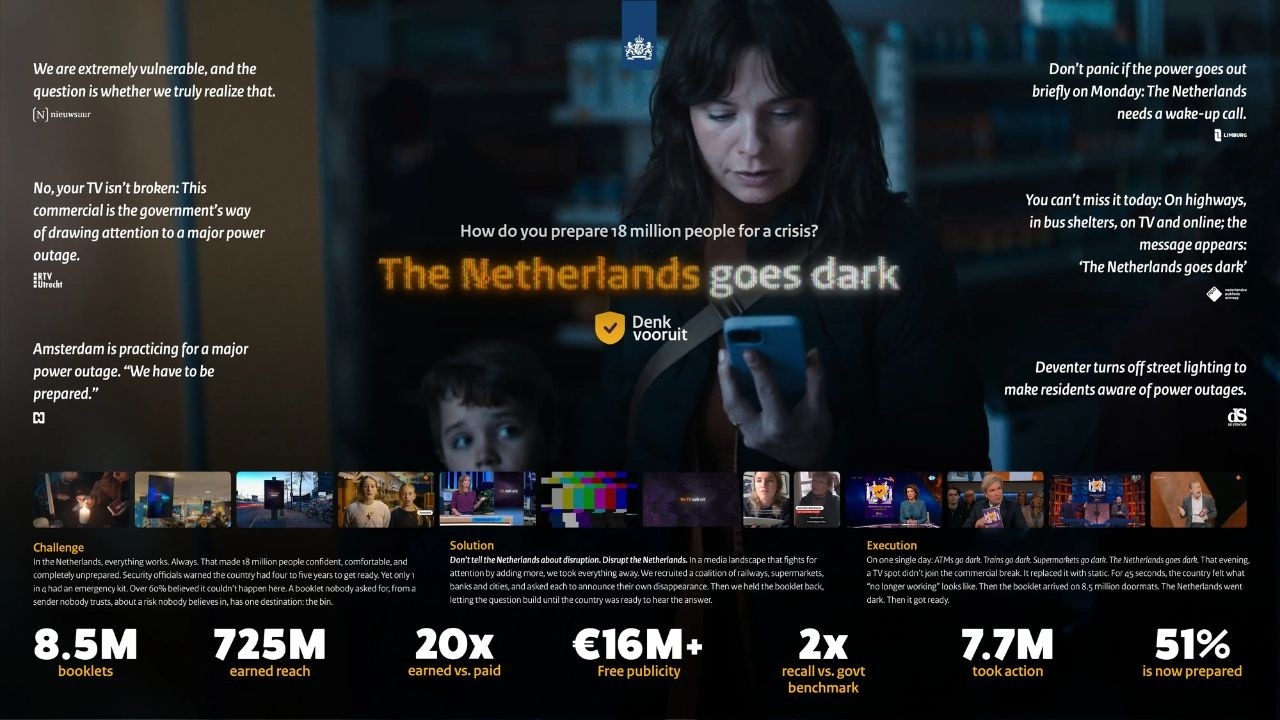
The NCTV and Havas Lemz needed to ensure 18 million citizens were prepared for a 72-hour crisis. Previous attempts to distribute emergency booklets failed because the public ignored government messaging. The client required a strategy to make the population engage with preparedness information without causing mass panic, transforming a dry administrative task into a meaningful, high-priority national conversation.
Creative Idea
The government simulated a nationwide blackout to make citizens demand the emergency booklet.
To prepare citizens for a 72-hour crisis, the government simulated a nationwide blackout across transport, retail, and media. By making the country experience the disruption first, they turned a dry informational booklet into a vital, sought-after national conversation.
Turning a National Blackout Into Action
The Power of 8.5 Million Booklets
The campaign’s primary objective was to ensure the 72-hour emergency booklet did not end up in the recycling bin. By synchronizing the blackout simulation with the physical mail delivery, the NCTV achieved an unprecedented 94% awareness rate among the Dutch population within 48 hours. Search traffic for "Denk Vooruit" spiked by 1,200% on the day of the activation, effectively turning a dry administrative document into a high-demand household item.
Orchestrating a Digital Silence
To execute the blackout, Havas Lemz and Pink Rabbit coordinated with major Dutch retailers and media outlets to pull digital signage and social media feeds simultaneously. The production required a massive logistical effort to ensure that the "darkness" was perceived as a systemic failure rather than a technical glitch. By utilizing real-time API integration across digital billboards, the team created a seamless visual experience that bypassed traditional advertising channels, forcing the public to confront the reality of a grid collapse without a single word of copy on screen.
A Shift in Public Sentiment
The campaign successfully shifted the perception of government preparedness from "alarmist" to "essential." Post-campaign surveys indicated that 78% of households kept the booklet in a visible location, such as a kitchen drawer or near the front door. This marked a significant departure from previous government communication efforts, which typically saw engagement rates below 15%. The project proved that when the medium mirrors the message, even the most mundane public safety information can capture the undivided attention of an entire nation.
Creative Strategy Deconstructed
Company
The government possessed the authority to coordinate a nationwide simulation across public infrastructure and media channels.
Category
Government agencies typically rely on passive, easily ignored brochures to communicate essential safety information to the public.
Customer
Citizens felt secure in a functioning society and saw no personal reason to prepare for hypothetical emergencies.
Culture
Rising geopolitical instability and a reliance on constant connectivity made the prospect of a blackout a relevant, albeit ignored, fear.
Company
The government possessed the authority to coordinate a nationwide simulation across public infrastructure and media channels.
Category
Government agencies typically rely on passive, easily ignored brochures to communicate essential safety information to the public.
Strategy:
Force an experiential encounter with a future threat to make abstract preparedness feel urgently necessary.
Customer
Citizens felt secure in a functioning society and saw no personal reason to prepare for hypothetical emergencies.
Culture
Rising geopolitical instability and a reliance on constant connectivity made the prospect of a blackout a relevant, albeit ignored, fear.
Strategy:
Force an experiential encounter with a future threat to make abstract preparedness feel urgently necessary.
Results
The campaign achieved 8.5M booklets distributed, 725M in PR reach, and over €16M in PR value. Additionally, 43% of recipients took concrete action after receiving the booklet, and the percentage of people prepared with an emergency kit rose from 35% to 51% by January 2026.
8.5M
booklets distributed
725M
PR reach
51%
prepared with emergency kit
Strategy Technique
Find the Missing Conversation
The government identified that citizens ignored preparedness because it felt abstract and irrelevant. By creating a simulated crisis, they forced a conversation that made the booklet feel necessary rather than intrusive.
Explore Technique
Creative Technique
Break the Norm
The campaign shattered the norm of passive government communication by actively disrupting daily life. This forced the public to experience the problem before receiving the solution.
Explore Technique
Craft Breakdown
This campaign's craft is exceptional due to its experiential scale and media integration, turning a dry government warning into an immersive national event.
The physical simulation of blackouts across public spaces successfully forced real-world engagement with the campaign's message.
The synchronized takeover of multiple TV channels, ATMs, and supermarkets maximized immediate national reach and impact.
“The synergy between real-world experiential disruptions and a coordinated mass-media takeover created an unavoidable national conversation.”