IBM: Outdoor as Utility
IBM sought to tangibly demonstrate its "Smarter Planet" vision to urban dwellers. The client wanted to showcase how IBM's smart ideas could improve daily life in cities, moving beyond abstract concepts to relatable, practical solutions for the general public.
Creative Idea
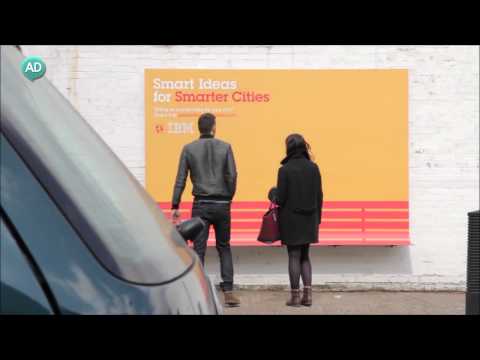
Billboards were curved to become useful urban furniture.
IBM transformed traditional, often ignored, outdoor billboards into genuinely useful urban amenities like benches, ramps, and awnings, effectively demonstrating its "Smart Ideas for Smarter Cities" vision by providing practical solutions to everyday urban frustrations.
The Low Tech Masterstroke From a High Tech Giant
Analog Solutions for Digital Problems
While IBM is synonymous with complex computing, this campaign succeeded by stripping away the technology. Created by Ogilvy & Mather France, the production relied on simple bent sheetmetal structures and vibrant paint rather than digital screens or sensors. By physically curving the billboards to create benches, rain shelters, and ramps, the team transformed "visual pollution" into a "gift" for the city. This approach utilized the Reciprocity Principle, building immediate brand goodwill by solving physical urban frustrations - like a lack of seating or steep stairs - to prove a corporate philosophy.
Impact Beyond the Street
 The initiative served as a physical gateway to the People for Smarter Cities digital hub, where citizens shared hundreds of urban improvement ideas. The campaign generated over 5 million impressions and nearly 3.8 million Twitter impressions shortly after launch. Strategically, it supported IBM’s broader Smarter Planet strategy during an era when the company reached a 16-year revenue high of $106.92 billion. Executive Creative Director Susan Westre noted that the goal was to reach both regular citizens and city leaders by providing "utility" in every communication.
The Trojan Horse of Value
Industry critics often refer to these installations as a Trojan Horse of Value. They appeared to be simple street furniture but functioned as sophisticated brand-positioning tools that redefined the role of out-of-home advertising. Even a decade later, the work remains a staple case study for Design Thinking. As Tony Granger, Cannes Outdoor Jury Head, observed, the campaign was "classic outdoor" - work that could only exist in a physical environment, proving that even the most established tech brands can benefit from a human-centric, low-tech touch.
Creative Strategy Deconstructed
Company
IBM's core vision was to build a "Smarter Planet" through intelligent, interconnected, and instrumented solutions, emphasizing practical innovation.
Category
Outdoor advertising typically serves as static visual communication, often perceived as urban clutter rather than a helpful resource for citizens.
Customer
Urban dwellers experienced daily frustrations like lack of seating, difficult stairs, and exposure to rain, seeking practical improvements in their environment.
Culture
There was a growing societal desire for cities to be more livable, efficient, and user-friendly, valuing smart solutions to everyday problems.
Company
IBM's core vision was to build a "Smarter Planet" through intelligent, interconnected, and instrumented solutions, emphasizing practical innovation.
Category
Outdoor advertising typically serves as static visual communication, often perceived as urban clutter rather than a helpful resource for citizens.
Strategy:
Demonstrate brand vision through tangible, community-focused innovation that addresses everyday urban challenges.
Customer
Urban dwellers experienced daily frustrations like lack of seating, difficult stairs, and exposure to rain, seeking practical improvements in their environment.
Culture
There was a growing societal desire for cities to be more livable, efficient, and user-friendly, valuing smart solutions to everyday problems.
Strategy:
Demonstrate brand vision through tangible, community-focused innovation that addresses everyday urban challenges.
Strategy Technique
Build an Utility, Not an Ad
IBM's campaign literally built useful urban utilities from advertising structures. It shifted from mere messaging to tangible problem-solving, embodying the brand's "smarter planet" vision.
Explore Technique
Creative Technique
Unexpected Utility
The campaign transformed static billboards into functional urban furniture. This provided unexpected, practical value to city dwellers, directly addressing common inconveniences.
Explore Technique
Craft Breakdown
This campaign's craft excels in transforming static advertising into dynamic, functional urban infrastructure, demonstrating IBM's 'Smarter Cities' concept through tangible, helpful interventions.
The core innovation lies in designing advertisements that are not just visually engaging but also provide practical, useful experiences for city dwellers, directly embodying the 'Smarter Cities' concept.
The physical construction and seamless integration of these functional billboards into the urban landscape, ensuring they are sturdy, safe, and effective as benches, ramps, and awnings, is expertly executed.
The visual appeal of the billboards, using bold colors and clean graphic patterns, is instrumental in making them inviting and clearly distinct from typical city clutter, enhancing their visibility and welcoming nature.
The concise and impactful messaging, such as 'Smart Ideas for Smarter Cities' and 'ads with a purpose,' clearly communicates the campaign's intent and brand philosophy effectively, driving engagement and understanding.
“The campaign's strength lies in the seamless synergy between functional design and compelling messaging, where the physical utility of the ads directly reinforces IBM's brand promise of smarter solutions for urban living.”