International Committee of the Red Cross: Laws Under Attack
The International Committee of the Red Cross needed to address the alarming rise in attacks on healthcare facilities. They tasked TBWA\RAAD with creating a campaign that would hold world leaders accountable to the Geneva Conventions. The objective was to move beyond traditional advocacy and create a powerful, undeniable visual reminder that hospitals are not targets, effectively pressuring nations to publicly reaffirm their commitment to humanitarian law.
Creative Idea
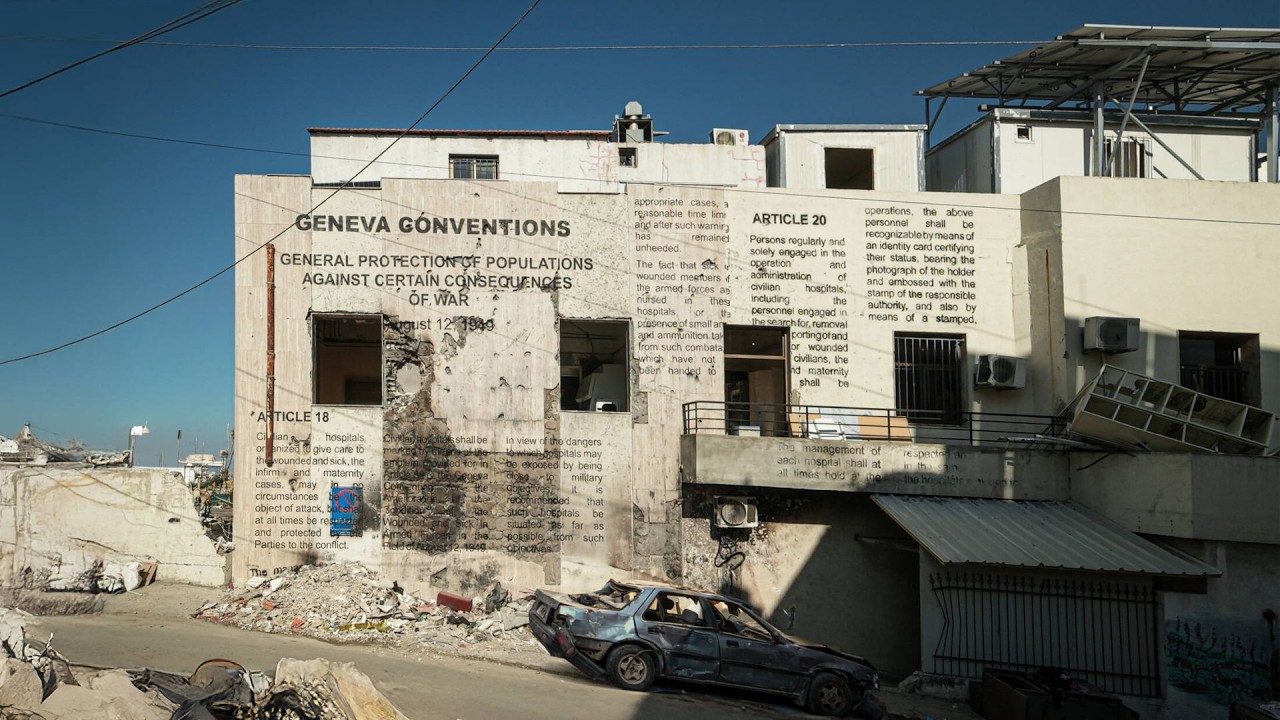
They painted the Geneva Conventions onto bombed hospitals to make war crimes visible.
The ICRC spray-painted the Geneva Conventions directly onto bombed hospitals and ambulances. By forcing bullet holes and shrapnel scars to physically intersect with the legal text, they transformed war damage into undeniable, visual evidence of international humanitarian law violations.
Turning War Scars Into Legal Evidence
The Calligraphy of Conflict
To ensure the legal text was perfectly integrated with the physical destruction, the agency collaborated with renowned Lebanese muralist Ghaleb Hawila. He utilized traditional calligraphy techniques to map the 1949 Geneva Conventions directly onto the crumbling, shrapnel-scarred surfaces of the last operational hospital in Southern Lebanon. By aligning the text with existing bullet holes and blast patterns, the team ensured the law was physically interrupted by the very violence it was designed to prevent.
Drone-Proof Messaging
The rooftop execution required a different technical approach. The phrase "THIS IS NOT A TARGET" was applied using high-visibility paint, specifically calibrated for legibility from high altitudes. The dimensions and placement were calculated to be unmistakable for military commanders and drone operators monitoring live aerial feeds, effectively turning the hospital roof into a high-stakes communication channel.
A Global Diplomatic Tracker
The campaign moved beyond awareness by creating a digital accountability hub at upholdhumanityinwar.org. This platform served as a real-time tracker, categorizing UN member states based on their response to the ICRC’s lobbying efforts. The initiative successfully pressured 102 countries to publicly renew their commitment to International Humanitarian Law, while simultaneously highlighting the 94 nations that chose to remain silent.
A Bittersweet Creative Milestone
Reflecting on the project, Derek Green, Chief Creative Officer at TBWA\RAAD, noted the complex nature of the work. While the campaign achieved significant industry recognition, the team emphasized that the project was born out of necessity rather than ambition. The goal remained strictly focused on reminding the international community that the protections established 76 years ago are not optional, but essential for the survival of medical personnel in active conflict zones.
Creative Strategy Deconstructed
Company
The ICRC possessed the unique authority and access to document war crimes directly within active conflict zones.
Category
Humanitarian organizations typically rely on passive reporting and diplomatic statements that often fail to capture global attention.
Customer
The global public felt helpless and disconnected from the escalating brutality occurring in distant war zones.
Culture
A 2024 surge in attacks on healthcare facilities created an urgent need for visceral, undeniable accountability.
Company
The ICRC possessed the unique authority and access to document war crimes directly within active conflict zones.
Category
Humanitarian organizations typically rely on passive reporting and diplomatic statements that often fail to capture global attention.
Strategy:
Manifest abstract legal protections as physical evidence to force accountability in conflict zones.
Customer
The global public felt helpless and disconnected from the escalating brutality occurring in distant war zones.
Culture
A 2024 surge in attacks on healthcare facilities created an urgent need for visceral, undeniable accountability.
Strategy:
Manifest abstract legal protections as physical evidence to force accountability in conflict zones.
Strategy Technique
Make the Invisible Visible
It forces the world to confront the reality of war crimes by physically manifesting abstract legal violations onto destroyed infrastructure. This makes the invisible breach of international law impossible to ignore.
Explore Technique
Creative Technique
Turn Message into Product
The campaign physically integrated the legal text into the damaged structures themselves. This turned the wreckage into a medium that literally embodies the violation of the law.
Explore Technique
Craft Breakdown
This campaign elevates guerrilla street art into a powerful humanitarian statement by turning a bombed hospital wall itself into the canvas for international law.
Installing the exact legal treaty text directly onto bomb-damaged architecture transforms physical war damage into undeniable evidence of legal violation.
Scale typography printed across massive concrete walls interacts directly with shrapnel holes, letting the destruction literalize the broken promises.
“The combination of outdoor typography and physical ambient installation creates a visceral metaphor where architectural destruction visually punches through written human rights laws.”