2019LusionConsumer Services & B2BVideo ad
Lusion: Lusion
Lusion created a self-initiated, interactive 3D portfolio website to showcase their technical capabilities in WebGL and real-time physics. The project was developed in-house by the Bristol-based studio to serve as a flagship demonstration of their production expertise.
Creative Idea
The portfolio became a playable 3D game, proving technical skill through direct experience.
Lusion transformed their portfolio website into an immersive, game-like 3D playground, proving their technical expertise by making the site itself the ultimate demonstration of their real-time WebGL, physics, and interactive design capabilities.
Lusion: Crafting an Interactive 3D WebGL Playground
Rejecting Minimalism for Technical Freedom
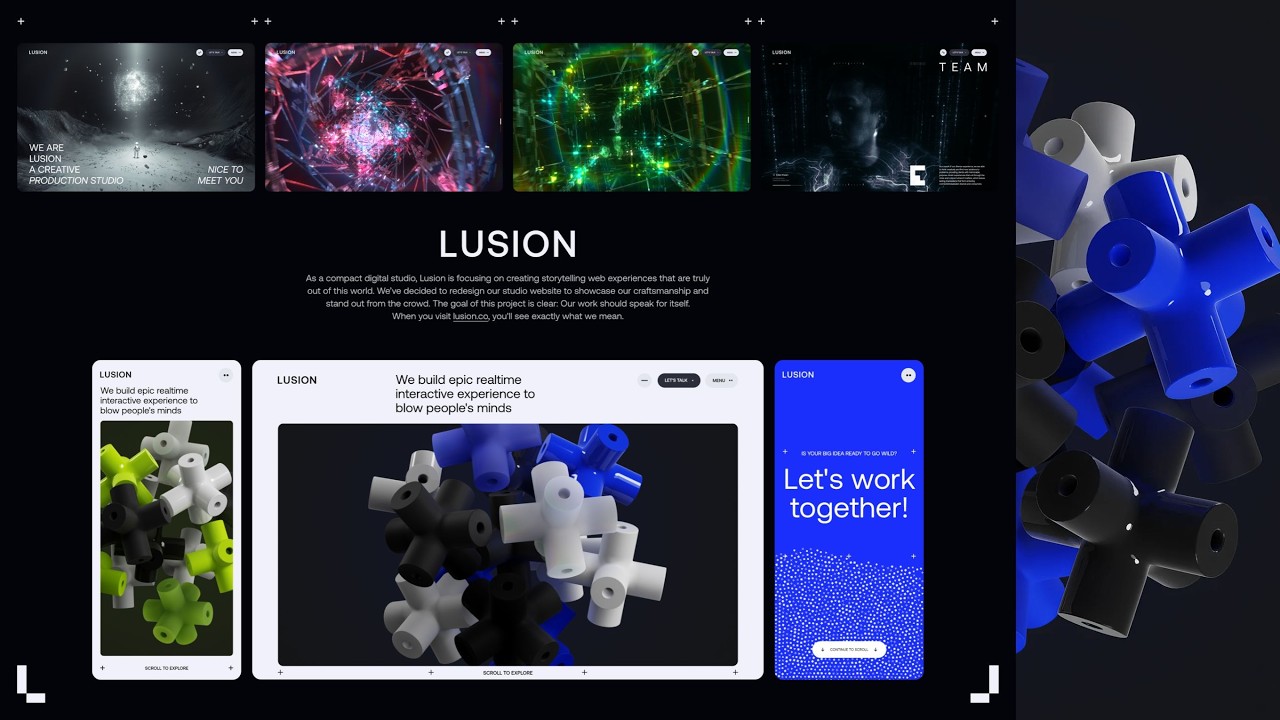
Founded in 2017 by creative technologist Edan Kwan and based in Bristol, United Kingdom, Lusion established its digital studio with a mandate to connect abstract ideas with immersive experiences. To showcase its technical capabilities, the team spent roughly a year on and off developing its first official studio website. Instead of adopting a minimalist look, the studio deliberately embraced a complex, game-like design to give the team creative and technical freedom while demonstrating state-of-the-art digital craft.
The project serves as a flagrant demonstration of real-time 3D WebGL graphics, fluid user interfaces, dynamic character modeling, procedural visual environments, and real-time lighting shaders. Rather than following a linear workflow where creative assets are passed down to developers, Lusion advocated for continuous collaboration between design and development to build custom technical assets.
Bespoke Engineering and Pre-Calculated Physics
Built as a purely static site generated via a custom Node.js site generator, the production relied on a stack including Houdini FX, Redshift3D, three.js, TweenLite, budo, webpack, and less. To ensure smooth web performance without compromising visual complexity, the homepage cloth simulation was pre-calculated in Houdini FX by dragging finger-like geometry across cloth in four directions, storing the results in a 220KB gzipped ArrayBuffer blended dynamically by user interaction.
For the contact scene, character cloth simulations in three directions were pre-calculated and stored into two PNG textures for positions and normals, running at 983KB on desktop and 246KB on mobile. The big screen scene was rendered offline in Redshift3D as static video paired with camera data exported to JSON and 3D glTF scenes. To resolve browser discrepancies with inaccurate video timekeeping, the team engineered a universal workaround by encoding a binary frame counter directly into the video and decoding it in real time using WebGL readPixels().
Industry Recognition and Continued Evolution
The studio's self-initiated site established a benchmark for interactive web design, earning recognition for its WebGL scroll navigation and interactive figure click. Lusion's commitment to pushing technical boundaries continued with later iterations, such as Lusion v3 and their 2024 website redesign, led by Creative Director Edan Kwan and Design Director Marco Grimaldi.
Over time, the studio expanded its profile, accumulating awards across global platforms including Awwwards, D&AD, Cannes Lions, and the Webby Awards, while building a client roster that includes Coca-Cola EP, Google Creative Lab, Opera North, and MaxMara.
4 Points Strategy deconstruction
This framework shows how Lusion turned traditional agency self-promotion on its head by turning their technical capability into the site experience itself.
Results
The 2019 studio website won Awwwards Site of the Month for May 2019 and was named Site of the Day on May 20, 2019, with an overall score of 7.96/10 and a Developer Award score of 7.87/10. Lusion's broader body of work has earned 1 Site of the Year, 3 Sites of the Month, 14 Sites of the Day, and 20 Honorable Mentions on Awwwards, alongside a Silver Cannes Lion in 2024 and a Webby Award in Best Mobile Visual Design - Aesthetic.
7.96/10
Awwwards Site of the Day score
8.55
Awwwards Creativity sub-score
8.67
Awwwards Animations/Transitions score
7.87/10
Awwwards Developer Award score
Strategy Technique
Build an Utility, Not an Ad
Instead of advertising their services, the studio built a high-performance digital tool that functions as a live proof-of-concept. The product itself serves as the primary marketing asset, demonstrating capability through direct user interaction.
Explore Technique
Creative Technique
Cutting-edge Tech
The studio utilized custom WebGL architecture and real-time physics to turn a static portfolio into a living 3D environment. This technical execution directly showcases their core service offering through the medium of the website itself.
Explore Technique
Craft Breakdown
Lusion demonstrates state-of-the-art interactive digital craft, seamlessly blending real-time 3D WebGL graphics with complex particle systems and fluid user interface interactions.
Flawless real-time WebGL performance and interactive physics built directly into a smooth, responsive web environment.
Breathtaking procedural 3D visual environments, real-time lighting shaders, dynamic character modeling, and particle effects.
Questions about Lusion: Lusion
Who created the 2019 Lusion website?
The site was developed in-house by Lusion, a digital studio based in Bristol, UK, founded in 2017 by creative technologist Edan Kwan.
What technologies were used to build the 2019 Lusion website?
The static site was built using a custom Node.js site generator along with Houdini FX, Redshift3D, three.js, TweenLite, budo, webpack, and less.
How did Lusion handle complex cloth simulations on the web?
Lusion pre-calculated cloth simulations in Houdini FX and stored the data in compact formats - such as a 220KB gzipped ArrayBuffer for the homepage and PNG textures for the contact scene - blending them in real time via user interaction.
What awards did the 2019 Lusion website win?
The website won Awwwards Site of the Month for May 2019, Site of the Day on May 20, 2019 (scoring 7.96/10), and an Awwwards Developer Award (scoring 7.87/10).
How did Lusion solve browser video frame inaccuracy in WebGL?
The team encoded a binary frame counter into the video files and decoded it in real time using WebGL's readPixels() method to maintain accurate frame sync across browsers.
Who are some of Lusion's notable clients?
Lusion's client list includes Coca-Cola EP, Google Creative Lab, Opera North, and MaxMara.
Sources (4)
- About Lusion · v2.lusion.co
- Lusion - Webby Awards 2024 · winners.webbyawards.com
- Lusion.co - D&AD Awards archive · dandad.org
- Design > Digital & Interactive Design - Lusion - Cannes Lions · lovethework.com