Philips | Refurb | Case
Philips tasked LePub to address the growing environmental impact of product returns and e-waste, aiming to shift consumer perception and drive sales of refurbished products. They sought to establish Philips as a leader in sustainable consumption by making returned items desirable to a broad audience.
Creative Idea
Philips made returned products more desirable than new ones, combating e-waste.
Philips launched 'Better Than New,' a radical e-commerce shift selling only returned and refurbished products at lower prices with upgraded warranties, using an AR installation to dramatically expose the environmental cost of returns and drive consumers to a sustainable shopping alternative.
The E-commerce Flip That Outsold New Stock
Turning Trash Into High Art
To strip away the "second-hand" stigma, LePub Amsterdam collaborated with TOILETPAPER Magazine, founded by artist Maurizio Cattelan and photographer Pierpaolo Ferrari. They reimagined vintage mid-century Philips posters, blending a surrealist "retro-future" aesthetic with modern products like the OneBlade. This high-saturation visual language repositioned refurbished items as premium collectibles rather than budget alternatives. The production team at Ambassadors Amsterdam and Shotz Berlin handled the complex task of making returned goods look more aspirational than factory-fresh units.
The Bold Earth Day Blackout
 On Earth Day, Philips executed a radical "e-commerce flip" by closing its website for all new products. Customers were only permitted to purchase refurbished items until the inventory was completely depleted. This move addressed the industry-wide secret that it is often cheaper to landfill a return than to inspect and repackage it. By absorbing these logistical costs, Philips proved the circular model's viability, resulting in their fastest promotion ever. The initiative successfully diverted 185 tons of e-waste and prevented an estimated 277 tons of CO2 emissions.
Visualizing the Mountain of Waste
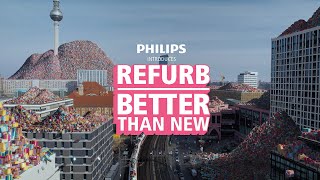
In Berlin’s Alexanderplatz, Lens That and LeGarage deployed an AR experience that visualized the scale of consumer waste. By scanning a QR code, users saw a virtual mountain of 10 million discarded gifts piled in the square - the actual number of items that end up in landfills annually. This tech-driven intervention, combined with a two-year warranty parity, dismantled the primary barrier to sustainable shopping: lack of trust. The campaign resulted in 52,000 refurbished products sold, moving Philips closer to its goal of generating 25% of revenue from circular propositions by 2025.
Creative Strategy Deconstructed
Company
Philips possessed a strong reputation for manufacturing durable, long-lasting products, making refurbished items a credible, high-quality offering.
Category
The electronics category typically discards returned products due to the perceived high cost of rechecking, repacking, and reshipping them.
Customer
Consumers sought good value and increasingly felt guilt or concern about environmental waste, desiring more sustainable shopping options.
Culture
Growing global awareness and concern about e-waste and the environmental impact of consumerism created fertile ground for this initiative.
Company
Philips possessed a strong reputation for manufacturing durable, long-lasting products, making refurbished items a credible, high-quality offering.
Category
The electronics category typically discards returned products due to the perceived high cost of rechecking, repacking, and reshipping them.
Strategy:
Reframe consumer returns from waste into a valuable, sustainable product offering.
Customer
Consumers sought good value and increasingly felt guilt or concern about environmental waste, desiring more sustainable shopping options.
Culture
Growing global awareness and concern about e-waste and the environmental impact of consumerism created fertile ground for this initiative.
Strategy:
Reframe consumer returns from waste into a valuable, sustainable product offering.
Results
The campaign resulted in all refurbished products selling out "in no time." Specifically, 52,000 refurbished gifts were sold. This led to 0 Philips products ending up in landfills and 185 tons of e-waste being avoided. The video also highlights the problem the campaign addresses: "Every year, 10 million returned gifts are thrown away," and that "Waste electronics will weigh more than the Great Wall of China."
52,000
refurbished gifts sold
0
Philips products in landfills
185 tons
of e-waste avoided
Strategy Technique
Reframe the Problem
Philips reframed the problem of returned items being discarded into an opportunity for sustainable consumption. By offering 'Better Than New' refurbished products, they transformed waste into a desirable, eco-conscious choice for consumers.
Explore Technique
Creative Technique
Dramatize the Problem
The campaign used an augmented reality installation to visually depict a massive pile of returned gifts, dramatically exposing the hidden problem of e-waste. This shocking visualization made the abstract environmental issue tangible and immediate for passersby.
Explore Technique
Craft Breakdown
This campaign's craft is exceptional in its ability to transform a complex environmental problem into an engaging, actionable, and visually stunning brand initiative. The blend of digital innovation with bold visual storytelling elevates it.
The AR installation effectively brought the abstract problem of e-waste to life in a tangible, shocking, and interactive way, directly engaging the public and prompting action.
The 'Better Than New' campaign's visual identity, with its retro-futuristic, space-themed aesthetic and vibrant color palette, successfully rebranded refurbished products as desirable and innovative.
The seamless integration of the AR experience with the e-commerce platform, allowing direct action from the immersive installation, demonstrates strong digital execution.
The video effectively uses diverse shot types, from intimate close-ups to sweeping aerials and dynamic CGI, to convey emotion, scale, and the campaign's innovative spirit.
“The campaign's magic truly comes from the synergy between the impactful experiential design (AR installation and e-commerce model flip) and the bold, distinctive art direction, which together created a compelling and memorable narrative for sustainability.”