Pearson: Project Literacy
Pearson wanted to evolve from a textbook publisher into a purpose-led brand. FCB Inferno London was tasked with raising global awareness for illiteracy, which had become an invisible issue. They needed to move the needle with world leaders and the public by proving that literacy is not just about books, but a fundamental human right essential for survival and health.
Creative Idea
Subverted a children's alphabet to link illiteracy to 26 of the world's deadliest social crises.
Pearson reframed illiteracy from a niche educational issue into a life-threatening global health crisis by creating a provocative 'Alphabet of Illiteracy,' linking the inability to read to 26 of the world's most devastating social and medical problems.
Subverting the ABCs to Solve Global Crises
The Grotesque Art of Wilfred Wood
To ensure the campaign felt visceral rather than clinical, the team bypassed traditional CGI in favor of physical craftsmanship. Artist Wilfred Wood, famous for his satirical work on *Spitting Image*, hand-sculpted 26 figures representing the "Alphabet of Illiteracy." These models were designed to look like a dark, distorted children's book - capturing what Wood described as the "shameful" nature of the statistics. Once the physical sculptures were complete, they were 3D-scanned and animated by Rick & Mario at 1stAveMachine to create the final film. This tactile approach ensured the characters felt human and grounded, even when representing harrowing topics like FGM or AIDS.
A Coalition of Alphabet Adopters
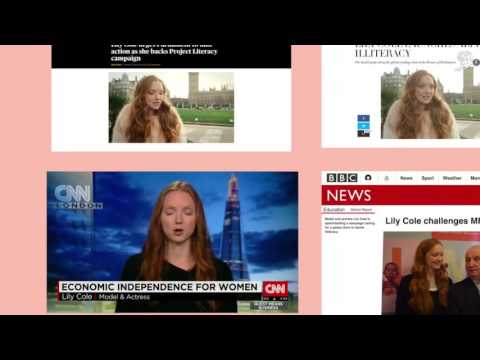 The campaign’s scale was amplified by a massive network of "Alphabet Adopters." High-profile ambassadors including Idris Elba, Julianne Moore, Usain Bolt, and Emma Watson each selected a specific letter and cause to champion, driving the message to a global audience. This strategy helped the campaign achieve a total reach of over 3 billion people over five years. The impact was more than just awareness; the percentage of people likely to donate to literacy causes doubled, and the initiative directly reached 650,000 learners through supported programs.
From Textbooks to Global Policy
The project successfully repositioned Pearson from a textbook manufacturer to a social impact leader. By framing illiteracy as the root cause of poverty and disease, the campaign gained enough institutional gravity to be invited into the UNESCO Global Alliance for Literacy. In the US, the "Mighty Pencil Machine" installation in NYC bridged the digital and physical worlds, turning social media messages of support into real pencils distributed to literacy partners. This effort ultimately helped secure literacy as a core component of the UN’s Sustainable Development Goals.
Creative Strategy Deconstructed
Company
Pearson's deep expertise in global education and its network of literacy-focused NGO partners.
Category
Educational brands often focus on the joy of reading, which feels distant from urgent global crises.
Customer
People view illiteracy as a non-urgent issue, failing to see how it prevents solving other major world problems.
Culture
A growing global demand for corporate accountability and the UN's focus on Sustainable Development Goals.
Company
Pearson's deep expertise in global education and its network of literacy-focused NGO partners.
Category
Educational brands often focus on the joy of reading, which feels distant from urgent global crises.
Strategy:
Reposition a foundational skill as the critical prerequisite for solving all other global humanitarian crises.
Customer
People view illiteracy as a non-urgent issue, failing to see how it prevents solving other major world problems.
Culture
A growing global demand for corporate accountability and the UN's focus on Sustainable Development Goals.
Strategy:
Reposition a foundational skill as the critical prerequisite for solving all other global humanitarian crises.
Results
The campaign achieved significant global impact, including over 6,200,000 film views and more than 20,300,000 social impressions. It reached a total audience of over 460,000,000. Beyond metrics, the campaign successfully moved the needle on policy: Project Literacy was invited to join the UNESCO Global Alliance for Literacy, a panel advising on global illiteracy. It also garnered extensive earned media coverage from outlets like The Guardian, CNN, BBC News, and The Times, and was featured in Adweek and The Drum as 'Ad of the Day'.
460M+
audience reach
20.3M+
social impressions
6.2M+
film views
Strategy Technique
Reframe the Problem
Instead of treating illiteracy as a lack of schooling, the campaign positions it as the root cause of humanity's greatest crises, forcing global leaders to prioritize it as a health emergency.
Explore Technique
Creative Technique
Analogy for the Problem
It subverts the innocent 'A is for Apple' children's format to illustrate how illiteracy fuels adult tragedies like AIDS and Bloodshed, making a complex, invisible problem tangible and shocking.
Explore Technique
Craft Breakdown
The campaign's power lies in the jarring juxtaposition of innocent, childlike aesthetics with devastating global tragedies, executed through world-class 3D character design.
The unique, slightly grotesque 3D character designs create a memorable and unsettling visual language that demands attention.
The subversion of the traditional alphabet song is a brilliant conceptual hook that makes complex global issues instantly digestible.
The use of bright, friendly colors to depict dark themes creates a cognitive dissonance that reinforces the campaign's message.
Strategically launching at the Houses of Parliament and using interactive social tools ensured the campaign moved from awareness to political action.
“The synergy between the haunting nursery rhyme music and the grotesque 3D animation creates a 'sugar-coated' horror that is impossible to ignore.”