2025AudiAutomotiveCase video
Audi: Audi Reader
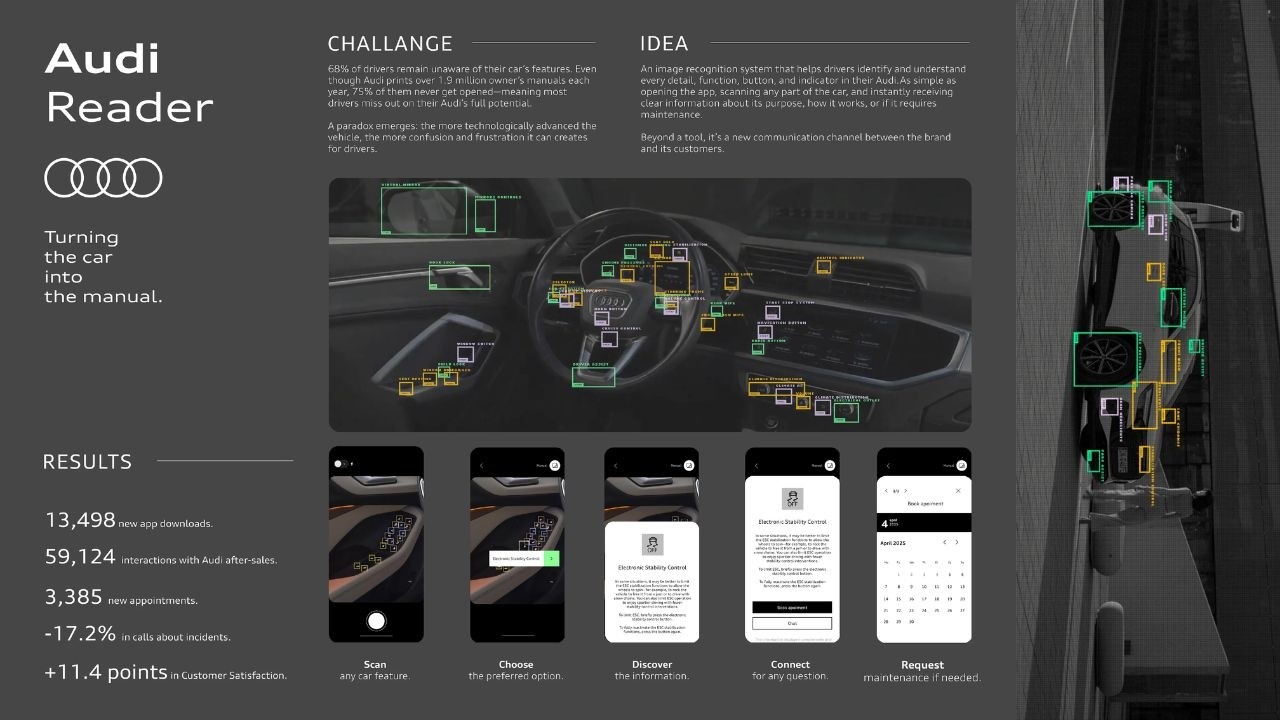
Audi Spain faced a challenge where 70% of owners never opened their 400-page manuals, leaving them unaware of their vehicle's capabilities. Ogilvy Spain was tasked with improving customer engagement and satisfaction. The client needed a solution that would make vehicle information accessible and useful, moving away from outdated paper formats to bridge the gap between complex innovation and everyday driver needs.
Creative Idea
The car manual became a camera-based digital assistant that explains buttons on demand.
Audi Reader replaced the static, ignored 400-page owner's manual with an AI-powered smartphone interface. By using image recognition to scan dashboard controls, it provided instant, visual explanations, transforming a burdensome reference document into a frictionless, interactive digital assistant.
Turning Complex Manuals Into Intuitive Visual Tools
Engineering a Two Stage AI Pipeline
The technical backbone of Audi Reader relies on a sophisticated two-stage computer vision architecture developed in partnership with the AI startup Roboflow. The first stage utilizes an object-detection model to pinpoint the specific region of the dashboard or cabin control within the live camera feed. Once the target is identified, a secondary classification model triggers, instantly pulling the relevant instructional text from the owner’s manual. This seamless integration allows the app to function as a real-time digital assistant rather than a static document.
Training on Ten Thousand Images
To ensure high-precision recognition across the entire Audi fleet, the team curated a massive training dataset consisting of over 10,000 custom-captured photos. This exhaustive library covers all 27 current Audi models, mapping every physical button, warning light, and interior indicator. By anchoring the software to the physical vehicle, the agency successfully moved the brand toward a "point-and-act" standard, where the user interface is defined by the car's own hardware.
Closing the Knowledge Gap
The project was spearheaded by Lorenzo Spadoni, Innovation and Technology Partner at Ogilvy Spain, who emphasized that the goal was to simplify the driver's interaction with vehicle technology. With 68% of drivers previously unaware of many features in their own cars, the tool serves as a critical bridge between Audi's €4.6 billion annual R&D investment and the actual user experience. Beyond simple explanations, the app integrates with the myAudi&Me ecosystem, enabling users to book garage appointments or request roadside assistance directly from the identified control, effectively turning the manual into a functional aftersales service.
4C Framework deconstruction
Company
Audi leveraged its technical expertise and existing myAudi&Me app ecosystem to integrate advanced computer vision capabilities directly into the ownership experience.
Category
Automotive brands traditionally rely on dense, physical paper manuals that are rarely read and difficult to navigate during moments of confusion.
Customer
Drivers felt overwhelmed by complex vehicle technology and ignored manuals because finding answers was a high-friction, time-consuming process.
Culture
The rise of AI-driven visual recognition tools normalized the expectation for instant, object-responsive digital assistance in everyday life.
Company
Audi leveraged its technical expertise and existing myAudi&Me app ecosystem to integrate advanced computer vision capabilities directly into the ownership experience.
Category
Automotive brands traditionally rely on dense, physical paper manuals that are rarely read and difficult to navigate during moments of confusion.
Strategy:
Transform static documentation into an intuitive, real-time digital service to eliminate user friction.
Customer
Drivers felt overwhelmed by complex vehicle technology and ignored manuals because finding answers was a high-friction, time-consuming process.
Culture
The rise of AI-driven visual recognition tools normalized the expectation for instant, object-responsive digital assistance in everyday life.
Strategy:
Transform static documentation into an intuitive, real-time digital service to eliminate user friction.
Results
The campaign achieved impressive measurable results: - Generated 59,124 new interactions with Audi after-sales. - Increased Customer Satisfaction by +11.4 points. - Featured in major trade publications such as Trend Watching, elEconomista, and AdAge.
59,124
new interactions with Audi after-sales
+11.4
points in Customer Satisfaction
Strategy Technique
Solve a Daily Annoyance
Audi identified that the physical manual was a source of frustration and abandonment for most drivers. By fixing this micro-problem, they improved the overall ownership experience and increased customer satisfaction.
Explore Technique
Creative Technique
Unexpected Utility
The campaign turns a traditionally static, ignored document into a dynamic, helpful tool. It provides immediate value by solving the specific friction of decoding complex vehicle controls through a simple camera scan.
Explore Technique
Craft Breakdown
Audi Reader turns a static, universally ignored physical owner's manual into an intuitive AI vision tool built into the existing Audi app ecosystem. The campaign stands out through custom AI model training on tens of thousands of car component images combined with seamless UI/UX design.
Custom computer vision models were trained on over 10,000 images across 27 Audi models to instantly map physical car components to precise digital manual content.
The seamless mobile AR UI integrates camera detection with immediate after-sales service booking and advisor chat functionality.