What is the Find an Enemy Strategy and when should I use it?
Look, humans are tribal creatures who love a good fight more than a boring solution. The Find an Enemy strategy is about identifying a specific villain—a competitor, a bad habit, or a societal norm—and positioning your brand as the only weapon against it. You use it when your category is a sea of sameness and you need to wake people up with a punch to the face. If you are launching something that challenges the status quo or if your competitors are getting away with murder, pick up the pitchfork. It is not about being mean; it is about being the hero people actually need right now. Got it? Yes
How to execute this strategy effectively
First, find a villain that actually matters to your audience, not just your CFO. If the enemy is too small, you look like a bully; if it is too vague, you look like a politician. Apple did not just attack phones; they attacked the creepy data-brokers hiding in the shadows. You need to draw a line in the sand and force your customers to pick a side. This is not about features; it is about values. Make the enemy’s behavior look unacceptable, then show how your brand is the shield. If you are not making someone slightly uncomfortable, you are probably doing it wrong. Just do it now, okay? Fine.
Example: Apple: Privacy on iPhone
Apple’s "Privacy. That’s iPhone" campaign is the gold standard for picking a fight. Instead of bragging about pixels, they targeted the entire ad-tech industry—specifically Meta. By making data tracking the enemy, Apple positioned the iPhone as the only safe house in a digital surveillance state. They used simple, jarring visuals of people’s private lives being auctioned off. It turned a tech spec into a moral crusade for the user. Simple stuff.
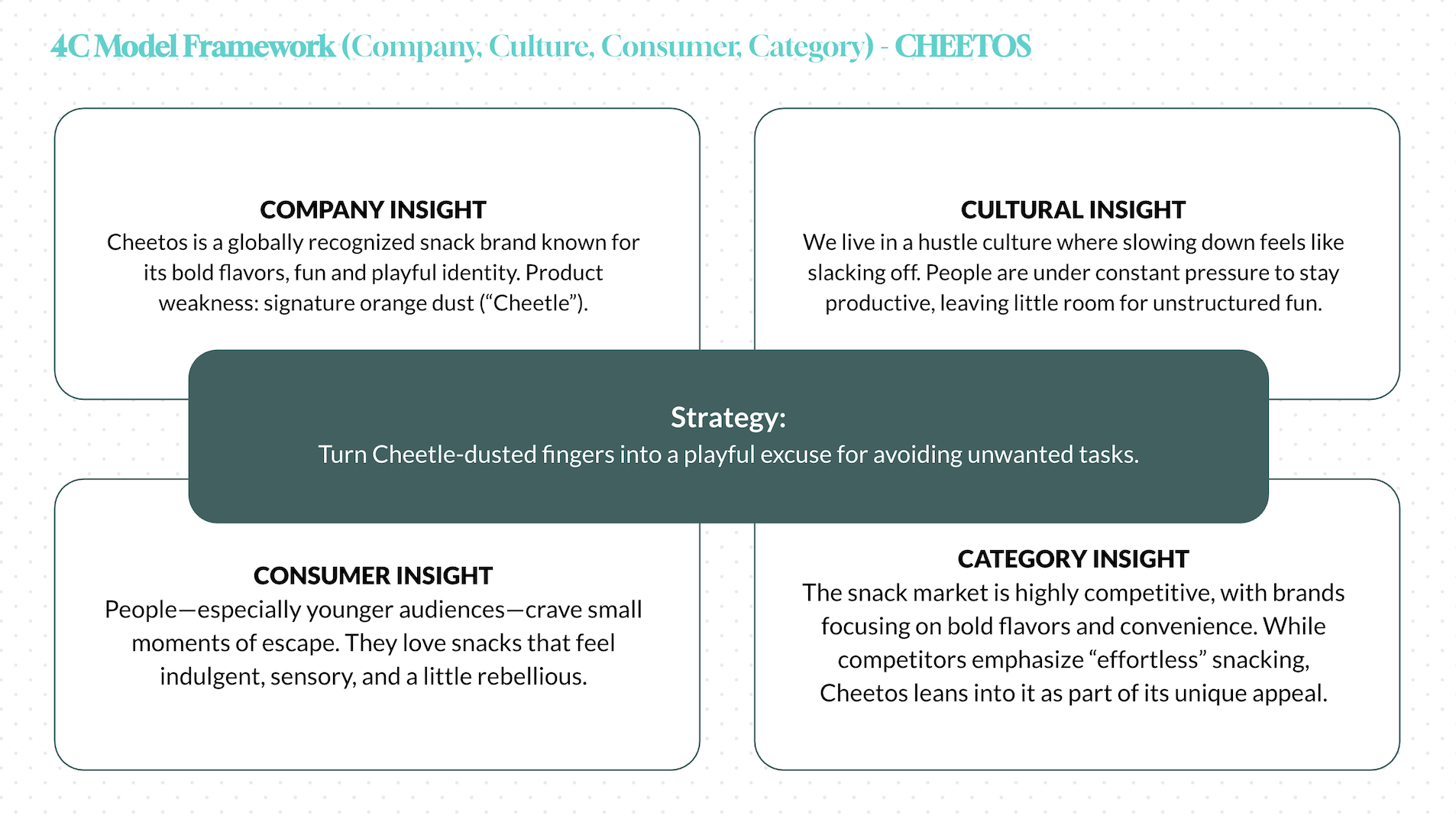
Creative Strategy Deconstructed in 4C Framework
Company INSIGHT
Apple owns the entire ecosystem, from hardware to software, allowing them to implement privacy controls that competitors reliant on ad revenue simply cannot match.
Category INSIGHT
The tech category treated personal data as a free-for-all commodity, assuming users wouldn't notice or care as long as services stayed free.
Strategy:
Position the iPhone as the ultimate tool for digital self-defense against a predatory data-tracking industry.
Customer INSIGHT
Users felt a growing, creeping sense of violation regarding their digital lives but felt powerless to stop the invisible tracking happening behind their screens.
Culture INSIGHT
High-profile data leaks and the 'Surveillance Capitalism' discourse turned privacy from a niche tech concern into a mainstream human rights issue.
Strategy:
Position the iPhone as the ultimate tool for digital self-defense against a predatory data-tracking industry.
Company INSIGHT
Apple owns the entire ecosystem, from hardware to software, allowing them to implement privacy controls that competitors reliant on ad revenue simply cannot match.
Category INSIGHT
The tech category treated personal data as a free-for-all commodity, assuming users wouldn't notice or care as long as services stayed free.
Customer INSIGHT
Users felt a growing, creeping sense of violation regarding their digital lives but felt powerless to stop the invisible tracking happening behind their screens.
Culture INSIGHT
High-profile data leaks and the 'Surveillance Capitalism' discourse turned privacy from a niche tech concern into a mainstream human rights issue.
Why is Find an Enemy a Great Strategy?
Rallying people against a common threat is basically the only thing humans are consistently good at.
Creates instant tribal loyalty and belonging.
Simplifies complex value propositions into battles.
Forces a binary choice for customers.
Generates earned media through inevitable conflict.
It works because it taps into primal psychology. You aren't just selling a product anymore; you're offering a way to fight back against something they already hate. It turns passive consumers into active allies who will defend your brand like it's their own identity.
! When not to use the "Find an Enemy" Strategy
Don't use this Strategy if your brand is the actual villain or if you're too cowardly to handle the backlash from the people you've just insulted.
Steps to implement: Pick a Fight Without Looking Like a Jerk
Identify the Villain Your Customers Actually Hate
Don't pick a fight with a ghost. Look for the specific frustration, competitor, or outdated norm that makes your audience's blood boil. If you're Apple, the enemy isn't just 'other phones,' it's the creepy corporations auctioning off your digital soul. Find the thing that makes people feel exploited or ignored, then name it. If you can't name the enemy, you don't have one.
Draw a Clear Line in the Sand
Ambiguity is where bad strategies go to die. You need to make it incredibly clear where you stand and where the enemy stands. There is no middle ground here. You are either with the brand that protects your data, or you're with the ones selling it. Use sharp, polarizing language that forces people to choose. If everyone likes you, you've failed the assignment.
Position Your Brand as the Only Shield
Being a critic is easy; being a solution is harder. Once you've pointed out the villain, you must demonstrate how your product is the only way to defeat it. Apple didn't just complain about tracking; they built 'App Tracking Transparency.' Your features need to be framed as weapons. If your product doesn't actually solve the problem you've highlighted, you're just another noisy hypocrite.
Use Visual Shorthand to Humanize the Conflict
Abstract enemies are boring. You need to make the threat feel real and personal. In the Apple campaign, they didn't show lines of code; they showed creepy strangers following people around in real life. Use metaphors and imagery that make the enemy's behavior look as ridiculous or invasive as it actually is. Make the audience feel the tension in their gut, not just their head.
Prepare for the Inevitable Counter-Attack
When you punch someone, they usually punch back. If you've picked a real enemy—like Meta or the entire ad-tech industry—expect them to get loud. This is actually a good thing. The more they scramble to defend themselves, the more they validate your position as the hero. Stay the course, don't apologize for your values, and let the controversy do your marketing for you.
Famous Campaigns Using Find an Enemy









Related Creative Strategy Techniques
Explore Strategy Frameworks
Use these proven frameworks to build your creative strategy and implement the Find an Enemy approach effectively.