The Messy Middle
How People Actually Decide What To Buy
The funnel is a lie we tell ourselves because it fits on a slide. People do not glide down a tidy cone from awareness to purchase. They loop. They open seventeen tabs, read one review, forget the brand, get re-triggered by an ad three days later, and circle back. Google looked at this chaos and, instead of pretending it was linear, named it: the messy middle - everything that happens between a trigger and a purchase.
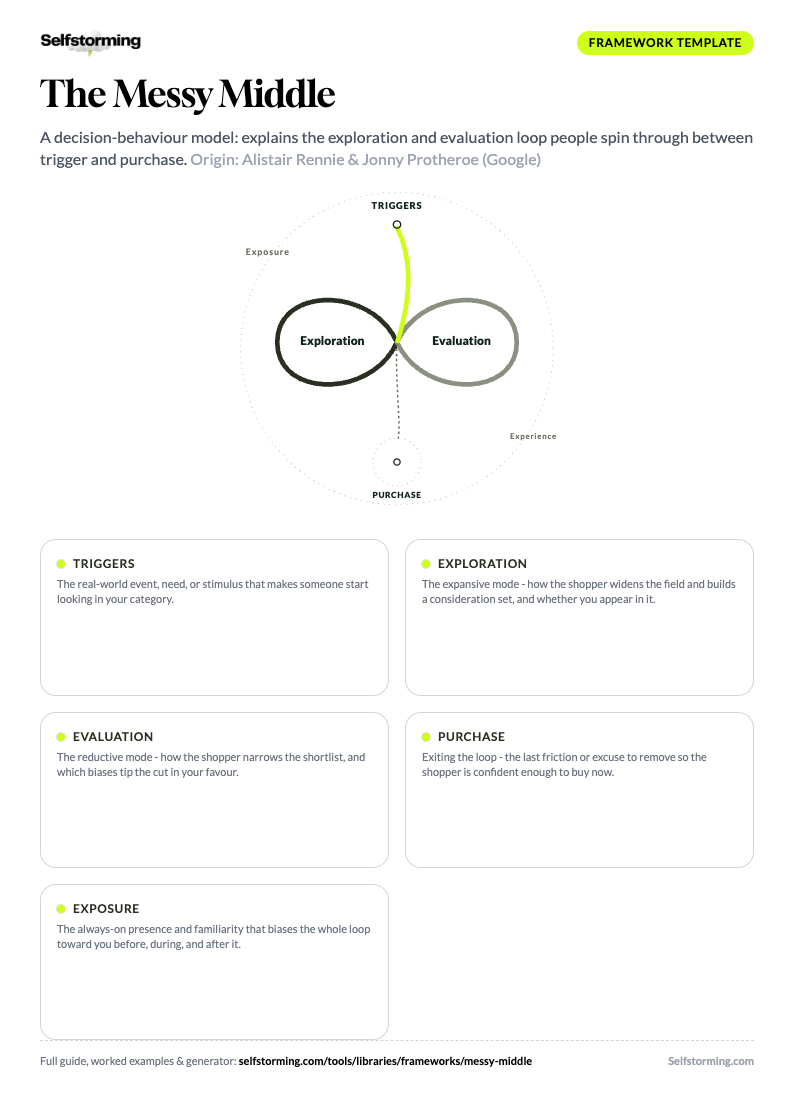
Print it. Fill it in.
The The Messy Middle as a printable A4 worksheet - write straight into the framework, on paper or in any PDF app.
Download the PDF templateKnowledge Worth Paying For
A working library of brand strategy frameworks - with worked examples on real brands, sources, and decision criteria. Not vibes.
One good deck covers the subscription. The rest is profit.
Between a trigger and a purchase, shoppers loop between two modes: exploration (expansive - building a set of options) and evaluation (reductive - narrowing them down). They repeat the loop until cognitive biases tip them into buying. The whole loop sits inside exposure - everything your brand does to stay present and familiar, biasing the loop in your favour. Six biases do the tipping: category heuristics, power of now, social proof, scarcity bias, authority bias, and power of free. Stop optimising a linear funnel; win the loop instead.
Liquid Death
DTC challenger water (USA, founded 2019)A masterclass in exposure doing the heavy lifting. Liquid Death is not the cheapest or most nutritious water - it wins the loop because it is so distinctive and famous that it gets pulled into exploration on sheer mental availability, and survives evaluation on identity rather than spec.
A host wants something non-boring to serve at a party, or a sober drinker wants a can that does not signal 'I am the only one not drinking'.
The brand surfaces through viral ads, social shares, and 'funny water brand' word of mouth long before a category search happens - exploration starts with the name already known.
Evaluation is short because the choice is emotional: the tallboy can and the in-joke beat any spec comparison. Social proof (everyone is posting it) closes the gap.
Wise
Cross-border money transfer fintech (UK, formerly TransferWise)Financial services was one of Google's tested categories, and Wise shows the messy middle in a high-anxiety, high-comparison purchase. The loop is long and evaluation-heavy because real money is at stake - so authority and transparency do the tipping.
Someone moves abroad, pays an overseas invoice, or gets stung by a hidden bank fee and thinks 'there has to be a cheaper way to send money'.
They search 'cheapest way to send money abroad', stack up banks, PayPal, and challengers, and read comparison roundups - a wide, cautious exploration.
Evaluation is brutal: live fee calculators, mid-market rate transparency, and Trustpilot scores. Category heuristics (the real exchange rate) and authority (regulated, named in press) survive the cut.
Decathlon
Sporting goods retailer (France, global)Retail across many categories is exactly where the messy middle gets messiest - a beginner exploring an unfamiliar sport has no expertise to evaluate with. Decathlon wins by simplifying the loop itself: own-brand category heuristics that turn paralysis into a confident pick.
A friend invites someone to start climbing, padel, or hiking, and they realise they own none of the gear and know none of the brands.
They search 'beginner climbing gear' and land in Decathlon's buying guides, which double as both discovery and a starter consideration set.
Evaluation is simplified by clear good-better-best own-brand tiers and a price that removes risk from a hobby they might quit - category heuristics doing exactly their job.
Liquid Death, Wise, Decathlon - filled in, line by line. Unlock to read them.
Liquid Death (DTC challenger water (USA, founded 2019))
A masterclass in exposure doing the heavy lifting. Liquid Death is not the cheapest or most nutritious water - it wins the loop because it is so distinctive and famous that it gets pulled into exploration on sheer mental availability, and survives evaluation on identity rather than spec.
Triggers: A host wants something non-boring to serve at a party, or a sober drinker wants a can that does not signal 'I am the only one not drinking'.
Exploration: The brand surfaces through viral ads, social shares, and 'funny water brand' word of mouth long before a category search happens - exploration starts with the name already known.
Evaluation: Evaluation is short because the choice is emotional: the tallboy can and the in-joke beat any spec comparison. Social proof (everyone is posting it) closes the gap.
Purchase: Wide retail and DTC availability plus impulse pricing means the exit is frictionless - it is grabbed at checkout, not deliberated over.
Exposure: Relentless, distinctive, horror-trailer advertising keeps the brand mentally available so it is the default 'fun water' the moment a trigger fires.
Wise (Cross-border money transfer fintech (UK, formerly TransferWise))
Financial services was one of Google's tested categories, and Wise shows the messy middle in a high-anxiety, high-comparison purchase. The loop is long and evaluation-heavy because real money is at stake - so authority and transparency do the tipping.
Triggers: Someone moves abroad, pays an overseas invoice, or gets stung by a hidden bank fee and thinks 'there has to be a cheaper way to send money'.
Exploration: They search 'cheapest way to send money abroad', stack up banks, PayPal, and challengers, and read comparison roundups - a wide, cautious exploration.
Evaluation: Evaluation is brutal: live fee calculators, mid-market rate transparency, and Trustpilot scores. Category heuristics (the real exchange rate) and authority (regulated, named in press) survive the cut.
Purchase: A clear upfront fee shown before signup and a fast first transfer remove the last 'what is the catch' hesitation that sends people looping back.
Exposure: Consistent 'hidden fees are theft' positioning keeps Wise mentally available as the honest option, so it enters the loop pre-trusted.
Decathlon (Sporting goods retailer (France, global))
Retail across many categories is exactly where the messy middle gets messiest - a beginner exploring an unfamiliar sport has no expertise to evaluate with. Decathlon wins by simplifying the loop itself: own-brand category heuristics that turn paralysis into a confident pick.
Triggers: A friend invites someone to start climbing, padel, or hiking, and they realise they own none of the gear and know none of the brands.
Exploration: They search 'beginner climbing gear' and land in Decathlon's buying guides, which double as both discovery and a starter consideration set.
Evaluation: Evaluation is simplified by clear good-better-best own-brand tiers and a price that removes risk from a hobby they might quit - category heuristics doing exactly their job.
Purchase: Low price plus generous returns kills the 'what if I hate the sport' hesitation, so the beginner buys instead of looping for weeks.
Exposure: Big-box stores and a reputation for 'cheap gear that is good enough to start' keep Decathlon top of mind whenever a new-sport trigger fires.
1. Triggers
What real-world event, need, or stimulus makes someone start looking in your category in the first place?
The spark that kicks off a search. A trigger can be a need (the old phone cracked), an event (a baby is on the way), or a stimulus (an ad, a friend's recommendation, a competitor's price drop). Triggers are where demand is born - and most brands ignore them because they are harder to buy than a click.
In practice: A landlord finally allows pets, so a renter searches 'best vacuum for pet hair' that same evening. The trigger is specific, dated, and emotional - and a brand that owns the 'pet hair' angle gets pulled in before the loop even warms up.
Common mistake: Treating the trigger as the moment your campaign launches. The trigger lives in the shopper's life, not your media calendar. Brands that only define triggers as 'saw our ad' miss the 90% of demand that started somewhere they were not.
2. Exploration
When someone is opening up the field of options in your category, are you one of the names they can even consider?
The expansive mode. Here the shopper widens the field - searching 'best', 'ideas', 'options', stacking up brands, reading roundups, building a consideration set. Exploration rewards mental availability and discoverability. If you are not findable and familiar here, you are not in the game later.
In practice: A first-time buyer types 'best running shoes for flat feet' and a brand shows up in the roundup, the YouTube comparison, AND a friend's reply. Three appearances in exploration earns a seat in the evaluation that follows - presence compounds.
Common mistake: Spending the whole budget on bottom-funnel retargeting and nothing on being discoverable. You cannot retarget someone who never found you. A brand absent from exploration is invisible no matter how sharp the closing offer.
3. Evaluation
When someone is narrowing down to a shortlist, does your option survive the cut - and why?
The reductive mode. The shopper shrinks the set - comparing specs, reading reviews, checking prices, weighing trade-offs. This is where the six biases do the heaviest lifting. Evaluation rewards clarity, proof, and reassurance: the things that make choosing you feel like the obvious, low-risk move.
In practice: A product page that leads with the two specs people actually compare, shows 1,400 reviews at 4.7 stars, and names the expert who tested it. Category heuristics, social proof, and authority stacked on one screen - the shortlist shrinks in your favour.
Common mistake: Burying the deciding facts under brand poetry and a hero video. In evaluation the shopper is in reductive mode, hunting for reasons to cut options. Make them dig for the answer and you have handed the cut to a competitor.
4. Purchase
What is the last thing standing between 'confident enough' and 'bought' - and have you removed it?
Exiting the loop. The shopper does not buy when they have perfect information - they buy when they are confident enough and the friction is low enough. Purchase is less about persuasion and more about removing the last excuse: a clear price, an easy checkout, a reason to act now rather than loop again.
In practice: Free returns stated next to the buy button, a delivery date for tomorrow, and a one-tap checkout. Power of now plus removed risk collapses the final hesitation - the loop ends instead of restarting for the fifth time.
Common mistake: Adding one more upsell, one more form field, one more 'are you sure'. Every extra step is an invitation to drop back into the loop and re-explore. Friction at the exit is the most expensive friction you own.
5. Exposure
Before the trigger ever fires, how familiar and mentally available is your brand to the people who will one day loop?
The always-on presence that wraps the whole loop. Exposure is everything you do to be known, familiar, and trusted before, during, and after the loop - brand-building, distinctive assets, broad reach. It does not sit at one stage; it biases the entire loop in your favour because familiar options feel safer to explore, easier to evaluate, and lower-risk to buy.
In practice: A brand that has run consistent, distinctive advertising for two years gets typed directly into search and waved through evaluation on familiarity alone. Exposure turned a cold comparison into a warm default - the cheapest conversion you never paid a click for.
Common mistake: Cutting all brand spend to fund performance, then wondering why the performance keeps getting more expensive. Without exposure, every shopper enters the loop cold and you pay to re-introduce yourself on every single search.
Decide your starting point: You do not need a six-week consumer study to map your messy middle. Right here on Selfstorming you can generate a first-draft Messy Middle map in minutes for your brand and category. Treat that draft as a head start, then pressure-test it against your real search data, reviews, and analytics using the steps below.
Name the real triggers, not the campaign launch: List the life events, needs, and stimuli that make someone start looking in your category. Mine search trends, customer interviews, and review opening lines. Most teams find five real triggers they have never once written copy for.
Map exploration with the shopper's own words: Pull the 'best', 'ideas', 'vs', and 'for X' queries people actually type. These are exploration in the raw. Audit honestly whether you appear in the roundups, comparisons, and replies - or whether the loop happens entirely without you.
Map evaluation against the deciding facts: List the three to five things people genuinely compare in your category (price, spec, reviews, delivery, returns). Check whether your evaluation surfaces - product pages, comparison content - lead with those facts or bury them.
Audit the exit for friction: Walk your own checkout as a stranger. Count the steps, the fields, the surprises. Every avoidable one is a doorway back into the loop. The goal at purchase is to remove excuses, not add persuasion.
Place the six biases where the shopper is already wobbling: Category heuristics in spec summaries, social proof on reviews, authority via named experts, scarcity and power of now near the buy button, power of free in the offer. Apply them honestly - manufactured scarcity gets noticed and resented.
Balance exposure against capture: Tally your spend. If almost all of it chases the click and almost none builds familiarity, your loops keep starting cold. Brand-building is not a luxury here; it is what makes every later step cheaper.
Re-run the loop quarterly: Triggers shift, biases get saturated, competitors enter exploration. Treat the messy middle as a living map, not a one-off slide. The teams that win the loop are the ones who keep watching where it actually goes.
Best for: Understanding and influencing non-linear, looping purchase behaviour in considered ecommerce and retail categories - where people explore and re-evaluate before they buy. / Low-involvement impulse buys or pure brand-identity work. If there is barely a decision to loop through, the model has little to map.
Output: A behavioural map of trigger, exploration, evaluation, purchase and exposure, with the six biases placed where they actually tip the decision. / A linear stage plan or a media budget split. The Messy Middle explains the buying psychology, it is not a channel plan.
Time to complete: A first-draft map in minutes; a fully researched, data-backed version over a few days of search, review and analytics digging. / An instant finished answer. Skip the real category search and review data and you are just decorating the diagram with guesses.
vs Marketing Funnel: Use the Messy Middle when you want a model true to how people actually shop - looping, not marching - and want to win exploration and evaluation. / Use the Marketing Funnel for a simple, linear shared language to plan media and report across awareness to conversion.
vs AARRR: Use the Messy Middle to explain WHY pre-purchase shoppers loop and what tips them - the behavioural science before the sale. / Use AARRR to measure the product-growth stages after acquisition - acquisition, activation, retention, referral, revenue.
vs Customer Journey Map: Use the Messy Middle to zoom into the decision loop itself and the biases inside the buying moment. / Use a Customer Journey Map for the breadth of one persona end-to-end experience across every touchpoint and emotion.
The Messy Middle comes from Google research led by Alistair Rennie and Jonny Protheroe of Google's consumer insights team, published as 'Decoding Decisions: Making sense of the messy middle' on Think with Google in 2020, in partnership with the behavioural-science consultancy The Behavioural Architects. Rather than theorise, the team ran a large-scale, behavioural-economics-based experiment - around 310,000 shopping simulations with real in-market shoppers across categories including financial services, consumer packaged goods, retail, travel, and utilities. The headline finding: the space between trigger and purchase is not a funnel but a loop between exploration (expanding options) and evaluation (narrowing them), wrapped in always-on exposure, with six cognitive biases doing the tipping. The work won the MRS New Consumer Insights Award and an MRG award for best research initiative.
The honest caveats are worth stating. The Messy Middle rests on a single proprietary Google study - one company, with a commercial interest in search and advertising, as the sole source. The six biases it leans on are repackaged classic behavioural economics (Cialdini and the wider canon), so the genuine novelty is the loop framing rather than the levers themselves. It is hard to operationalise and measure - 'win the loop' stays a slogan until you pin down which trigger, which mode, and which bias on which surface, and attribution only gets murkier from there. There is a real simulation-versus-reality gap: shopping simulations are not the same as the noisy, distracted, real world. And it was built mainly on consumer and ecommerce behaviour, so it strains in long B2B buying cycles. Use it as a sharper map of how people decide - not as proof that any one tactic will work.
What is the Messy Middle?
The Messy Middle is Google's name for everything that happens between a trigger (the moment someone starts looking) and a purchase. Instead of a linear funnel, people loop between two mental modes - exploration (expanding their options) and evaluation (narrowing them down) - repeating the cycle until they are confident enough to buy. The whole loop sits inside exposure, the brand's always-on presence, and six cognitive biases do the tipping.
Who created the Messy Middle?
The Messy Middle was developed by Alistair Rennie and Jonny Protheroe of Google's consumer insights team, with the behavioural-science consultancy The Behavioural Architects. It was published as 'Decoding Decisions: Making sense of the messy middle' on Think with Google in 2020, backed by a large-scale experiment of around 310,000 shopping simulations across multiple categories.
How is the Messy Middle different from the marketing funnel?
The funnel is linear - awareness to consideration to purchase, one direction, top to bottom. The Messy Middle is a loop: people move back and forth between exploration and evaluation, get re-triggered, and circle round multiple times before buying. The funnel is simpler to brief and report on; the Messy Middle is truer to how people actually shop. Many teams keep the funnel as a reporting layer and use the Messy Middle to explain the behaviour underneath it.
What are the six biases in the Messy Middle?
Google highlights six cognitive biases that tip shoppers from looping into buying: category heuristics (short specs that simplify the choice), power of now (the longer the wait, the weaker the appeal), social proof (reviews and recommendations), scarcity bias (less availability feels more desirable), authority bias (trusted experts sway the decision), and power of free (a free extra is a powerful motivator). They are classic behavioural-economics levers placed where the shopper is already wobbling in evaluation.
What is exposure in the Messy Middle, and why does it matter?
Exposure is the always-on brand presence that wraps the entire loop - your brand-building, distinctive assets, and broad reach. It does not sit at one stage; it biases the whole loop because familiar options feel safer to explore, easier to evaluate, and lower-risk to buy. Brands with strong exposure get pulled into the loop for free and waved through on familiarity. Cut exposure and every shopper enters the loop cold, so you pay to re-introduce yourself on every search.
Does the Messy Middle work for B2B?
Partly. The core insight - people loop rather than funnel - holds for B2B too. But the Messy Middle was built mainly on consumer and ecommerce simulations, so it strains in long B2B cycles where buying committees, RFPs, and procurement politics matter more than one person's cognitive biases. Use it for the individual-research portions of a B2B journey, and pair it with account-level and committee mapping for the rest.
How do I actually use the Messy Middle in practice?
Map the five elements for your brand - the real triggers, how people explore, how they evaluate, what removes friction at purchase, and your exposure - then place the six biases where shoppers are genuinely wobbling. Audit honestly whether you appear in exploration (the 'best' and 'vs' queries), whether your evaluation surfaces lead with the deciding facts, and whether your checkout adds excuses to loop again. Ground every assumption in search, review, and analytics data, not vibes.
Is the Messy Middle just rebranded behavioural economics?
Fair criticism, and partly true. The six biases are classic behavioural economics - Cialdini and the wider canon - so the levers are not new. What the Messy Middle adds is the loop framing: organising those biases inside an exploration-evaluation cycle wrapped in exposure, validated by a large shopping experiment. The contribution is the map and the evidence, not the discovery of the biases themselves.
A decision-behaviour model: explains the exploration and evaluation loop people spin through between trigger and purchase.
The sharp idea here is that the mess is not random. Inside that loop, shoppers are doing two distinct mental jobs - exploration (opening up options) and evaluation (narrowing them down) - and they ping-pong between the two until a handful of cognitive biases tip them over the edge into buying. Your job is not to push people down a funnel that does not exist. It is to be present in the loop, and to make the biases work for you instead of against you.
This page walks through the model - trigger, exploration, evaluation, purchase, and the always-on exposure that wraps the whole thing - plus the six biases Google flags, the worked examples, and the honest case for where the messy middle helps and where it is just a prettier name for things behavioural economists figured out decades ago.