Mercado Libre: Custom Billboards
Mercado Libre asked GUT Buenos Aires to increase engagement and conversion rates for its e-commerce platform within high-traffic urban environments. The client sought to modernize traditional outdoor advertising by making it more relevant to the daily lives of commuters. The goal was to prove that the brand could provide the right product at the exact moment a consumer needed it, regardless of location.
Creative Idea
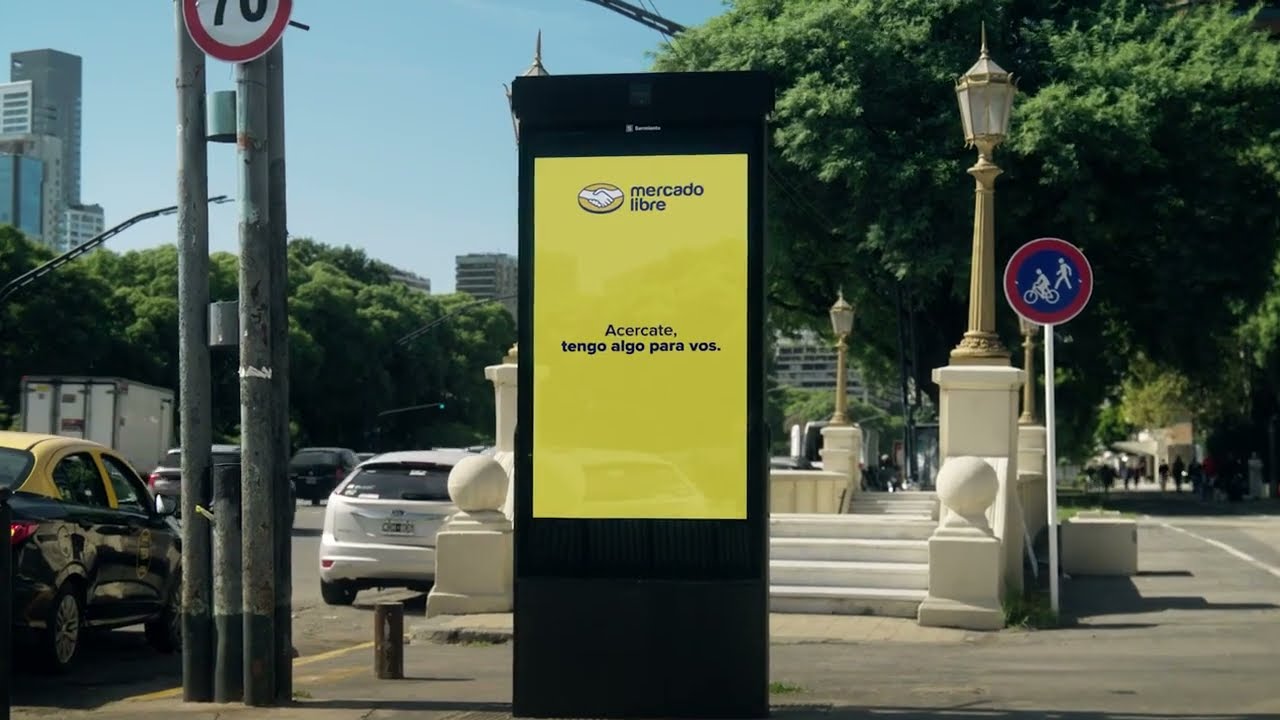
AI billboards identify pedestrian needs in real-time to offer instant, relevant product purchases.
Mercado Libre transformed static street billboards into AI-powered interactive displays that analyze passersby in real-time to recommend relevant products, bridging the gap between physical transit environments and instant digital e-commerce conversion.
Turning Public Streets Into Personal Storefronts
The Tech Behind the Real-Time Feed
To achieve this level of contextual relevance, GUT Buenos Aires integrated high-definition computer vision cameras with a proprietary AI engine. The system was trained to recognize specific visual cues—such as a person carrying a yoga mat, wearing a raincoat, or walking a dog—and instantly cross-reference those patterns with Mercado Libre’s massive inventory. Once a match was identified, the billboard would display a curated product suggestion alongside a dynamic QR code, allowing the pedestrian to complete a purchase in seconds.
Bridging the Offline-Online Divide
The campaign was designed to solve a persistent problem in outdoor advertising: the lack of attribution. By turning the billboard into a performance-marketing tool, the agency successfully tracked the entire conversion funnel from the moment of visual recognition to the final checkout. While the initial rollout in April 2026 was limited to select high-traffic hubs in Buenos Aires, the pilot served as a proof-of-concept for a scalable model that treats urban infrastructure as a living, breathing sales channel.
A Shift in Brand Philosophy
Valeria Bazzi, Senior Director of Branding and Communication at Mercado Libre, noted that the initiative fundamentally changed how the brand views the public highway. Instead of serving as a static broadcast medium, the billboard became an extension of the user’s shopping cart. Joaquín Campins, CCO of GUT Buenos Aires, emphasized that the goal was to provide utility rather than intrusion, ensuring that every message felt like a helpful nudge rather than a generic advertisement. By focusing on the immediate needs of the commuter, the campaign successfully transformed passive transit time into active, measurable engagement.
Creative Strategy Deconstructed
Company
Mercado Libre leveraged its massive product catalog and advanced machine learning capabilities to provide instant, context-aware shopping solutions.
Category
Retailers typically use static, one-size-fits-all outdoor advertising that ignores the specific context or immediate needs of the passing audience.
Customer
Commuters want convenience and relevance, often ignoring generic ads that fail to address their immediate, situational requirements.
Culture
The rise of AI-driven personalization and the demand for seamless, frictionless commerce experiences in public spaces drove this innovation.
Company
Mercado Libre leveraged its massive product catalog and advanced machine learning capabilities to provide instant, context-aware shopping solutions.
Category
Retailers typically use static, one-size-fits-all outdoor advertising that ignores the specific context or immediate needs of the passing audience.
Strategy:
Transform passive environmental touchpoints into active, personalized conversion funnels through real-time data integration.
Customer
Commuters want convenience and relevance, often ignoring generic ads that fail to address their immediate, situational requirements.
Culture
The rise of AI-driven personalization and the demand for seamless, frictionless commerce experiences in public spaces drove this innovation.
Strategy:
Transform passive environmental touchpoints into active, personalized conversion funnels through real-time data integration.
Strategy Technique
Make the Invisible Visible
It turns the invisible, fleeting moments of daily transit into visible, actionable shopping opportunities. By highlighting these overlooked micro-needs, the brand makes its vast catalog feel immediately useful and accessible.
Explore Technique
Creative Technique
Real-Time Relevance
The campaign uses computer vision to analyze the immediate environment and pedestrian context. This allows the billboards to serve hyper-personalized product recommendations that feel helpful rather than intrusive.
Explore Technique
Craft Breakdown
This campaign excels by merging smart technology with contextual copywriting, turning standard out-of-home advertising into a highly personalized, interactive utility.
The integration of real-time AI image recognition into physical outdoor billboards creates a seamless bridge between offline environments and mobile commerce.
The contextual, witty, and highly localized Spanish copy tailored to each specific passerby's situation makes the automated recommendations feel human and engaging.
“The magic of the campaign lies in the synergy between real-time computer vision technology and clever, contextual copywriting, making the automated ads feel surprisingly personal.”