Hertog Jan: Don't Drink Hertog Jan
Hertog Jan faced the challenge of dethroning Heineken's dominance in Dutch supermarkets. Despite superior craftsmanship, they struggled against the competitor's massive scale and sponsorship reach. They needed a strategy to pivot from volume-based competition to premium positioning, engaging beer enthusiasts by proving their product's aging potential and increasing brand value among discerning drinkers who valued quality over quantity.
Creative Idea
Instructed fans to store and age their beer instead of drinking it immediately.
Hertog Jan commanded fans not to drink their beer, instead offering digital and physical cellar slots to age the liquid like fine wine, transforming a mass-market beverage into a high-value collectible and successfully dethroning Heineken in Dutch supermarkets.
The Beer That Conquered Supermarkets by Staying in the Cellar
The Room Heineken Doesn't Have
The campaign centered on a physical and digital transformation of the brewery’s basement in Arcen. By positioning this space as "The Room Heineken Doesn't Have," the brand weaponized its smaller, craft-focused scale against its massive rival. This high-tech aging cellar allowed fans to claim 30,000 digitally owned slots to store and age their beer for up to six years. To maintain engagement over such a long period, Master Brewer Gerard van den Broek sent personalized digital updates to participants, tracking the evolving flavor profile of their specific bottles.
Weaponizing Abstinence for Market Share
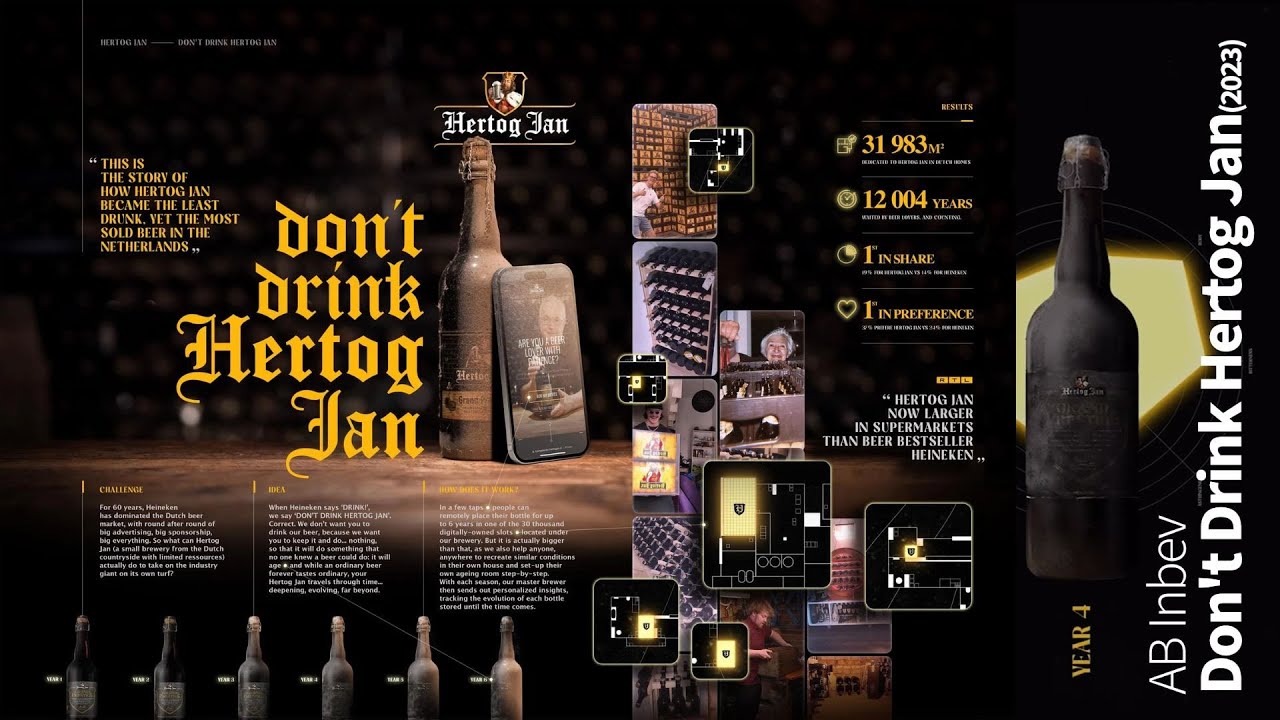 The "temptation through abstinence" strategy triggered a massive behavioral shift in the Netherlands, treating pilsner with the reverence typically reserved for fine wine. This psychological hook created a sales paradox: by telling consumers not to drink the beer, the brand encouraged them to buy in multiples - one to taste immediately and several more to archive. The results were historic for the Dutch market, as Hertog Jan officially surpassed Heineken in 2022 to become the #1 best-selling beer in Dutch supermarkets.
A Legacy of Craft and Controversy
While GUT Amsterdam led the recent global recognition, the campaign’s roots trace back to the "For the Love of Beer" platform established by The Valley in 2011. This long-term strategic consistency allowed the brand to eventually offer DIY home-aging kits, teaching fans how to recreate brewery conditions in their own cupboards. However, the campaign’s success at Cannes in 2024 sparked industry debate regarding agency attribution, as insiders noted the foundational role of previous partners in developing the brand's premium "aging" identity over the preceding decade.
Creative Strategy Deconstructed
Company
A historic brewery in Arcen with a physical basement and a reputation for high-quality, craft-oriented pilsner.
Category
Mass-market beer brands prioritize high-volume sales, immediate consumption, and generic lifestyle marketing to drive supermarket turnover.
Customer
Discerning drinkers wanted to feel like connoisseurs rather than just consumers, seeking products with depth, story, and long-term value.
Culture
The rise of slow movements and investment-grade collectibles made delayed gratification a status symbol for modern, sophisticated audiences.
Company
A historic brewery in Arcen with a physical basement and a reputation for high-quality, craft-oriented pilsner.
Category
Mass-market beer brands prioritize high-volume sales, immediate consumption, and generic lifestyle marketing to drive supermarket turnover.
Strategy:
Reframe beer consumption as a long-term investment in craftsmanship to outmaneuver high-volume competitors through perceived exclusivity.
Customer
Discerning drinkers wanted to feel like connoisseurs rather than just consumers, seeking products with depth, story, and long-term value.
Culture
The rise of slow movements and investment-grade collectibles made delayed gratification a status symbol for modern, sophisticated audiences.
Strategy:
Reframe beer consumption as a long-term investment in craftsmanship to outmaneuver high-volume competitors through perceived exclusivity.
Results
Hertog Jan achieved the #1 position in the Dutch beer market. The campaign resulted in 103,005 years of total wait time by customers. 30,000 bottles were stored in the brewery's digital cellar. Fans dedicated 31,983m² of space in their own homes to aging Hertog Jan. It became the most exchanged beer on Marktplaats (a Dutch marketplace). The brand reached 19.9% market share (surpassing Heineken's 14.2%) and achieved 37.2% in brand preference compared to Heineken's 24%.
19.9%
Market share (No. 1 in Netherlands)
103,005
Total years waited by consumers
37.2%
Brand preference score
Strategy Technique
Stake a Contrarian POV
In a category obsessed with volume and instant refreshment, Hertog Jan took the opposite stance. This bold positioning established the brand as a patient craftsman, making mass-market competitors look superficial and rushed.
Explore Technique
Creative Technique
Reverse Expectations
By ordering consumers to avoid the product's primary purpose, the brand created immediate intrigue. This counter-intuitive command effectively signaled superior quality that supposedly improves with time rather than expiring.
Explore Technique
Craft Breakdown
The campaign seamlessly merged physical brewery heritage with a sophisticated digital ownership platform to create a multi-year brand experience.
The Digital Cellar interface allowed real-time tracking of flavor profiles, turning a bottle into a tech-enabled asset.
Converting the Arcen brewery basement into a high-tech, digitally-accessible aging room bridged the gap between tradition and innovation.
The provocative 'Don't Drink' headline served as a powerful hook that challenged the entire category's consumption norms.
Integrating subscriptions and masterclasses evolved the brand from a simple product manufacturer into a premium service provider.
“The magic lies in how digital tracking gave tangible, long-term value to a physical product stored miles away from the owner.”