2024Plan InternationalNot-for-Profit & GovernmentCase video
Plan International: Good Night Gaza
Plan International Norway commissioned Bureau, Handverk, and Megafon to create a dual-language book of Palestinian folktales. The project aimed to preserve oral traditions at risk of loss while demonstrating the organization's active presence in conflict zones to the Norwegian public.
Creative Idea
A dual-front book physically unites two languages to preserve endangered oral Palestinian traditions.
Plan International preserved endangered Palestinian oral traditions by publishing a dual-language, bi-directional book that physically unites Norwegian and Arabic cultures, serving as both a cultural safeguard and tangible proof of the organization's frontline humanitarian presence.
Preserving Oral Histories Through Dual Language Craft
A Technical Feat of Typography
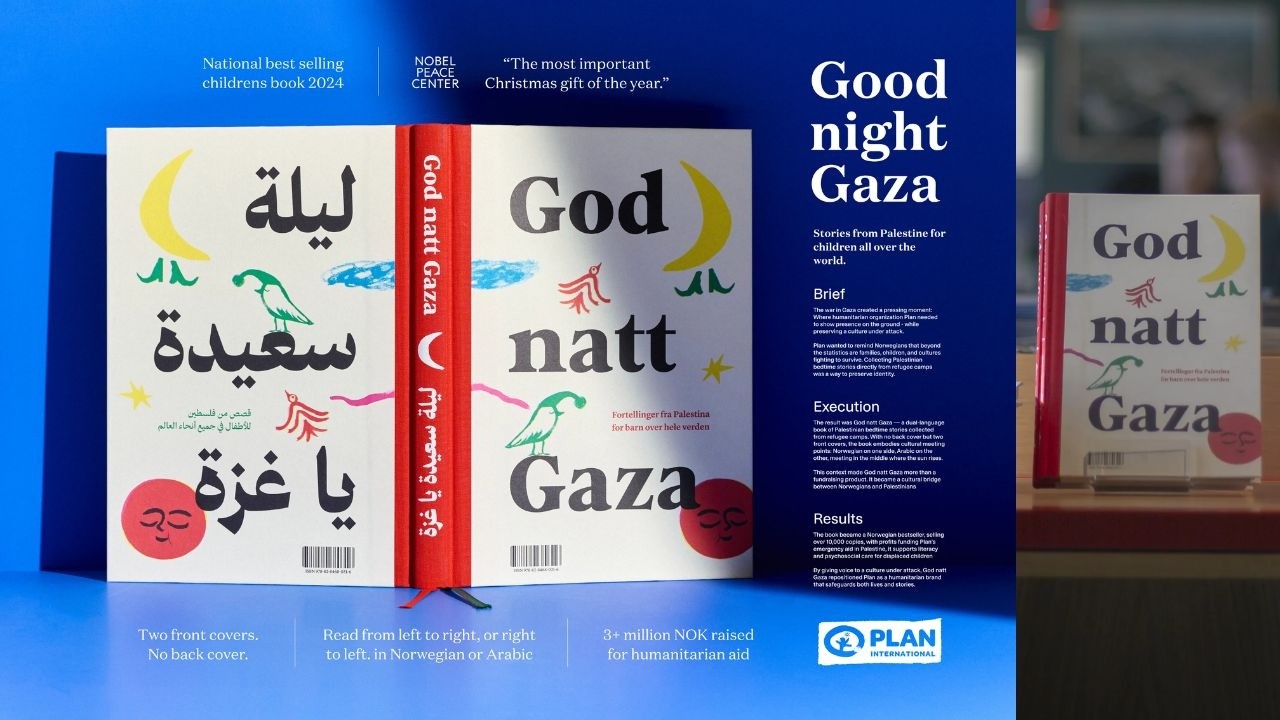
The project required a sophisticated approach to bi-scriptual design to ensure both languages held equal weight. Designers paired Lyon Text for the Norwegian script with Azahar Text for the Arabic, specifically chosen to harmonize with Latin letterforms. The book features a unique dual-front-cover structure with no back cover, bound by an exposed shirting spine. Two ribbon markers were included to guide readers from either side, meeting at a symbolic sunrise illustration in the center. The color palette - black, white, red, and green - was constructed using layered CMYK plates to mirror the Palestinian flag.
From Oral Tradition to National Bestseller
The book became an instant national bestseller in Norway, moving over 10,000 copies across four print editions. These sales generated significant financial support, contributing 2.8% of the organization's total emergency relief funding for the region at the time. Beyond the bookstore, the project gained institutional traction; the Nobel Peace Center endorsed it as a vital cultural contribution, and oversized 3x3 meter editions were displayed in transit hubs and libraries to facilitate public dialogue.
A Personal Perspective on Displacement
The illustrations were created by Zarina Saidova, an artist who arrived in Norway as a refugee and experienced displacement firsthand. Her work was instrumental in translating the oral stories into a visual medium. The text itself was carefully curated, with fairy tales retold in Norwegian by Oda Myran Winsnes and songs translated by Kari Iveland. The final Arabic text was preserved in the authentic Palestinian dialect, ensuring the book serves as a lasting cultural archive rather than a temporary fundraising tool.
4C Framework deconstruction
Company
Plan International leveraged its deep field access to collect and preserve oral stories directly from Palestinian refugee camps.
Category
Humanitarian NGOs typically rely on abstract imagery of aid delivery to demonstrate their impact and presence.
Customer
Norwegian audiences sought a deeper, more human connection to the crisis beyond traditional charity sponsorship models.
Culture
The urgent threat of cultural erasure in Gaza created a need for tangible, lasting preservation of oral traditions.
Company
Plan International leveraged its deep field access to collect and preserve oral stories directly from Palestinian refugee camps.
Category
Humanitarian NGOs typically rely on abstract imagery of aid delivery to demonstrate their impact and presence.
Strategy:
Transform abstract humanitarian aid into a tangible cultural artifact to build authentic, lasting emotional connection.
Customer
Norwegian audiences sought a deeper, more human connection to the crisis beyond traditional charity sponsorship models.
Culture
The urgent threat of cultural erasure in Gaza created a need for tangible, lasting preservation of oral traditions.
Strategy:
Transform abstract humanitarian aid into a tangible cultural artifact to build authentic, lasting emotional connection.
Results
The project sold 10,151+ (over 10,000) books, becoming a bestseller in Norway. All revenues went directly to Plan International's humanitarian relief work in the Gaza region. Readings were hosted nationwide across libraries, schools, and the Nobel Peace Center, where it was called 'The most important Christmas gift of the year.'
10,000+
books sold in Norway
100%
revenues to humanitarian aid
Strategy Technique
Make the Invisible Visible
The strategy shines a light on the overlooked oral culture of Palestinian refugees. By documenting these stories, the brand makes its humanitarian presence tangible and credible rather than abstract.
Explore Technique
Creative Technique
Borrow a Familiar Format
The campaign utilizes the familiar format of a children's bedtime storybook to bridge cultural divides. By adopting this trusted medium, the design makes complex humanitarian issues accessible and intimate for families in Norway.
Explore Technique
Craft Breakdown
The campaign excels through clever book design and editorial art direction, creating a dual-directional, dual-language object that physically connects two cultures while preserving oral heritage.
The reversible book structure designed to read left-to-right in Norwegian and right-to-left in Arabic ingeniously embodies cross-cultural connection.
Vibrant folk illustrations and expressive typography honor Palestinian storytelling tradition while appealing to children globally.
“The interaction between the structural book design, bilingual typography, and artistic illustrations creates a tangible symbol of cultural preservation and empathy.”