The Female Company: The Tampon Book
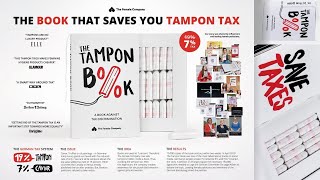
The Female Company sought a creative way to challenge Germany's unfair 19% 'luxury tax' on menstrual products, which made essentials more expensive than luxury items. They aimed to increase product sales, ignite public debate, and pressure lawmakers to revise the discriminatory tax system for their target German consumers.
Creative Idea
They packaged tampons as a book to exploit a tax loophole and protest gender inequality.
The Female Company packaged tampons as a book, taxed at 7% like books instead of 19% like luxury goods, to cleverly circumvent an unfair tax law and spark a national debate on gender inequality in taxation.
Hacking the Tax Code with 46 Pages
The 12 Percent Loophole
The production was a literal exercise in legal engineering. By embedding 15 organic tampons within a 46-page book, the product legally transitioned from a "luxury hygiene item" to "literature." This allowed The Female Company to sell the set at the lower 7% VAT rate, effectively using the law to protest the law. The book itself was not a hollow shell; it featured provocative stories about menstruation and period poverty, illustrated by Ana Curbelo and Alica Läuger. Curbelo’s bold, body-positive aesthetic was central to the campaign's visual identity, depicting women in relaxed, natural states to dismantle long-standing social taboos.
Zero Budget Viral Success
Despite a €0 media budget, the campaign achieved massive scale through strategic seeding. The agency, Scholz & Friends, sent 100 copies to influential members of the Bundestag and another 100 to feminist influencers. This sparked an organic firestorm that garnered 10.5 million views across social platforms. The momentum was further fueled when Facebook temporarily banned the campaign film for "explicit" content, a move that backfired by increasing the project's notoriety.
From Print to Parliament
The campaign’s impact moved beyond marketing into national legislation. A petition supported by the book garnered over 175,000 signatures, nearly triple the amount needed to force a parliamentary debate. While then-Finance Minister Olaf Scholz initially questioned if savings would reach consumers, the brand publicly pledged an immediate price drop. On January 1, 2020, the German government officially reclassified period products as necessities, permanently reducing the tax. This remains a benchmark for "creative activism," proving that a clever product design can successfully lobby for civil rights.
Creative Strategy Deconstructed
Company
The Female Company, an online shop for feminine hygiene products, had the agility and legal acumen to challenge an unfair tax system creatively.
Category
The feminine hygiene category typically sells products directly, accepting existing tax classifications without public challenge or creative subversion.
Customer
Consumers felt frustrated and unfairly burdened by the 'luxury tax' on essential menstrual products, seeing it as a symbol of gender inequality.
Culture
A growing cultural awareness of gender inequality and a desire for social justice provided fertile ground for a provocative, action-oriented protest.
Company
The Female Company, an online shop for feminine hygiene products, had the agility and legal acumen to challenge an unfair tax system creatively.
Category
The feminine hygiene category typically sells products directly, accepting existing tax classifications without public challenge or creative subversion.
Strategy:
Subvert an unfair system by leveraging its own rules to create a product that is solution and protest.
Customer
Consumers felt frustrated and unfairly burdened by the 'luxury tax' on essential menstrual products, seeing it as a symbol of gender inequality.
Culture
A growing cultural awareness of gender inequality and a desire for social justice provided fertile ground for a provocative, action-oriented protest.
Strategy:
Subvert an unfair system by leveraging its own rules to create a product that is solution and protest.
Results
The book sold out within a day. The second edition sold out within a week. It garnered widespread media attention across Germany. The campaign put the unfair tax system on the agenda of influencers and media. It was featured by Germany's largest TV networks. The message became a political message. Facebook temporarily banned the content. Leading female politicians and members of the German Parliament started sharing "The Tampon Book." The petition on Change.org got more than 150,000 signatures (157,223 signatures shown). As a result, the German Committee on Legal Affairs must officially debate the tampon tax.
1 day
time for first edition of 'The Tampon Book' to sell out
1 week
time for second edition of 'The Tampon Book' to sell out
157,223
signatures on Change.org petition
Strategy Technique
Build an Utility, Not an Ad
The campaign created a physical product - a book - that served as a legal loophole to reduce tampon tax. This utility directly addressed the problem, making the brand a tangible solution and a catalyst for change.
Explore Technique
Creative Technique
Turn Message into Product
The campaign literally turned its protest message - about unfair tampon taxation - into a physical product, a book. This allowed them to legally sell tampons at a lower tax rate while simultaneously raising awareness.
Explore Technique
Craft Breakdown
This campaign's craft is exceptional through its brilliant 'design,' manifesting a complex legal challenge into a tangible, provocatively designed product, amplified by sharp copywriting and distinctive art direction.
The 'Tampon Book' itself is a masterclass in product and packaging design, transforming a functional item into a protest tool that is both practical and symbolically powerful.
The text within the book and the campaign's messaging are incisive, witty, and bold, clearly articulating the issue while normalizing menstruation with engaging content.
“The campaign's magic emerges from the seamless synergy between the brilliant strategic Ideamaking, the innovative product Design, the provocative Copywriting, and the compelling Art Direction, which together transformed a legal loophole into a powerful political statement.”