2026NTTConsumer Services & B2BCase video
NTT: Waves of Will
NTT sought to showcase the human impact of its R&D capabilities and ultra-low latency IOWN network. They tasked Dentsu with creating a live demonstration that moved beyond basic medical utility. The goal was to show global audiences how cutting-edge technology can restore agency and artistic expression to individuals living with severe motor disabilities like ALS.
Creative Idea
A paralyzed ballerina performed a live dance using only her brainwaves to control an avatar.
NTT used advanced non-invasive EEG technology and high-speed IOWN infrastructure to translate a paralyzed ballerina's brainwaves into real-time digital choreography, enabling her to control a live mixed-reality performance using only her intentional thoughts.
When Thoughts Turn into Choreography on Stage
Brainwaves Take the Lead
To bypass the severe muscular degradation caused by advanced ALS, the team at NTT Human Informatics Laboratories joined forces with Dentsu Lab Tokyo and Dentsu Lab Amsterdam. Rather than relying on passive biological spikes or eye-gaze tracking, the team developed a custom non-invasive EEG brain-computer interface paired with a choice-grid UI.
Performer Breanna Olson, a former professional ballerina diagnosed with ALS in October 2023, trained to deliberately generate specific brainwave patterns. These intentional mental triggers were transmitted via NTT's high-speed, ultra-low-latency IOWN network infrastructure, directly cueing and manipulating a high-definition avatar projected into a live mixed-reality environment. The performance was facilitated by her brother Casey Herd, a former Principal Dancer at the Dutch National Ballet and founder of Ballet Rising.
Global Reach and Industry Impact
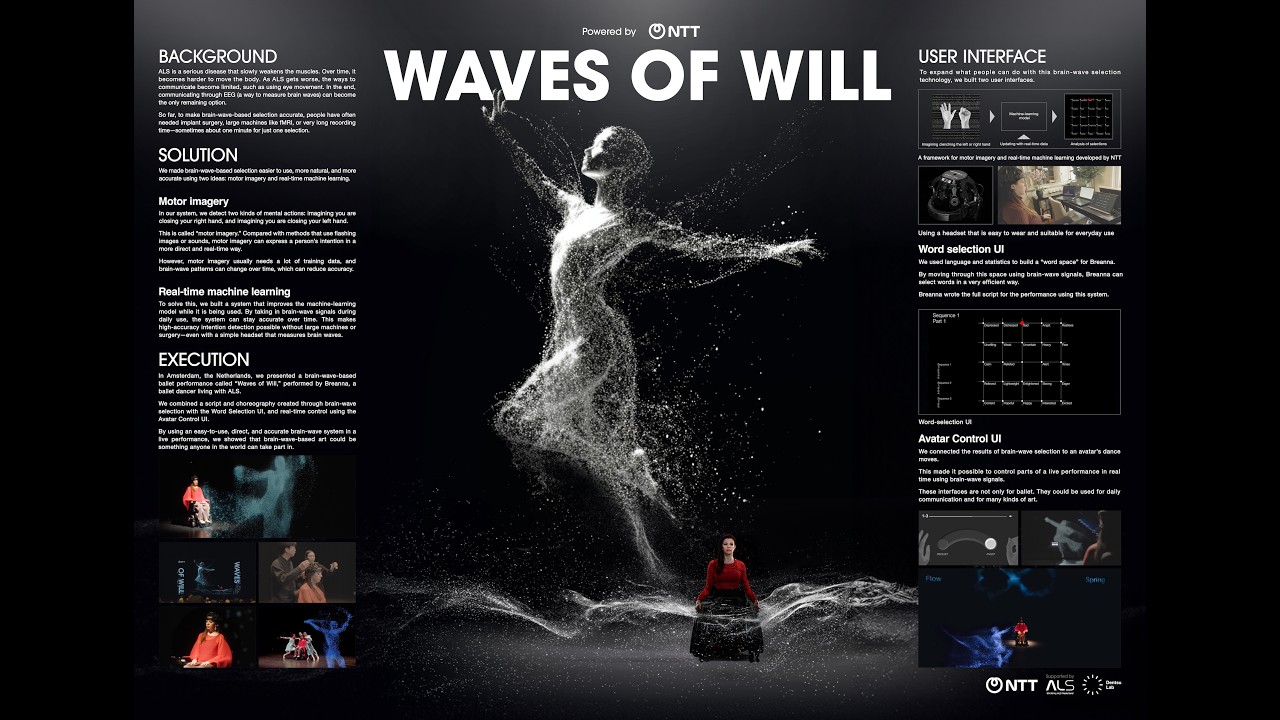 The project premiered live in Amsterdam on December 10, 2025, accompanied by film, special effects, and sound production from WOW Inc. Tokyo and Tracks & Fields Tokyo. A dedicated feature segment on BBC World News reached an audience of 400M+, driving a total 672M+ organic reach globally.
> "Technology without any human impact or an emotional layer is just a component stack... the fact that we were able to use this to actually impact someone's life in real time and enable her to dance again and express herself - that is what made it resonate so much." - Pascal Rotteveel, Global Executive Creative Director, Dentsu Lab
> "Working with NTT and Dentsu Lab, I am able to dance again. I have found a new language for creativity, one where my thoughts move, my ideas take shape, where I can keep expressing who I am." - Breanna Olson, Lead Performer
4C Framework deconstruction
Company
NTT offered ultra-low latency IOWN infrastructure and advanced EEG brainwave decoding models from its Human Informatics Laboratories.
Category
Assistive tech typically focuses on basic functional survival tasks, treating disability through a purely medical lens.
Customer
People with motor disabilities want to retain their creative agency and self-expression, not just manage physical limitations.
Culture
Growing public demand for inclusive innovation that uses advanced technology to empower individual human potential.
Company
NTT offered ultra-low latency IOWN infrastructure and advanced EEG brainwave decoding models from its Human Informatics Laboratories.
Category
Assistive tech typically focuses on basic functional survival tasks, treating disability through a purely medical lens.
Strategy:
Demonstrate NTT's human-centric technology by enabling a paralyzed dancer to perform live via brainwave control.
Customer
People with motor disabilities want to retain their creative agency and self-expression, not just manage physical limitations.
Culture
Growing public demand for inclusive innovation that uses advanced technology to empower individual human potential.
Strategy:
Demonstrate NTT's human-centric technology by enabling a paralyzed dancer to perform live via brainwave control.
Strategy Technique
Turn Brand Values Into Action
Instead of claiming that its IOWN network and human informatics research create human-centric technology, NTT proved it by restoring real-time artistic agency to a paralyzed dancer.
Explore Technique
Creative Technique
Cutting-edge Tech
The campaign relies on custom EEG hardware and machine learning to translate real-time motor imagery into live digital performance. Cutting-edge technology directly enables the core concept of brain-controlled creative expression.
Explore Technique
Craft Breakdown
This project excels through its real-time synthesis of non-invasive brainwave decoding and high-fidelity live digital stage design.
Machine learning models mapped complex motor imagery into intuitive live controls using low-latency processing.
The live stage setup translated neural signals into dynamic mixed-reality visual projections synchronized with music.
“The seamless combination of real-time brainwave interfaces and stage design created an emotionally powerful, authentic live performance.”