Creative Wear In vs Wear Out
Stop Killing Your Ads Before They're Famous
You’re bored. Your agency is bored. Your brand manager is desperately looking for a reason to win a Lion at Cannes. So, you kill the campaign that’s actually working to 'freshen things up.' Congratulations, you’ve just committed strategic arson. Marketers are the only people on earth who see their ads enough to hate them; your actual customers haven't even noticed you yet. By the time you feel like an ad is 'wearing out,' it’s usually just finally 'wearing in.' You’re lighting money on fire to outrun a boredom that only exists inside your marketing department's echo chamber.
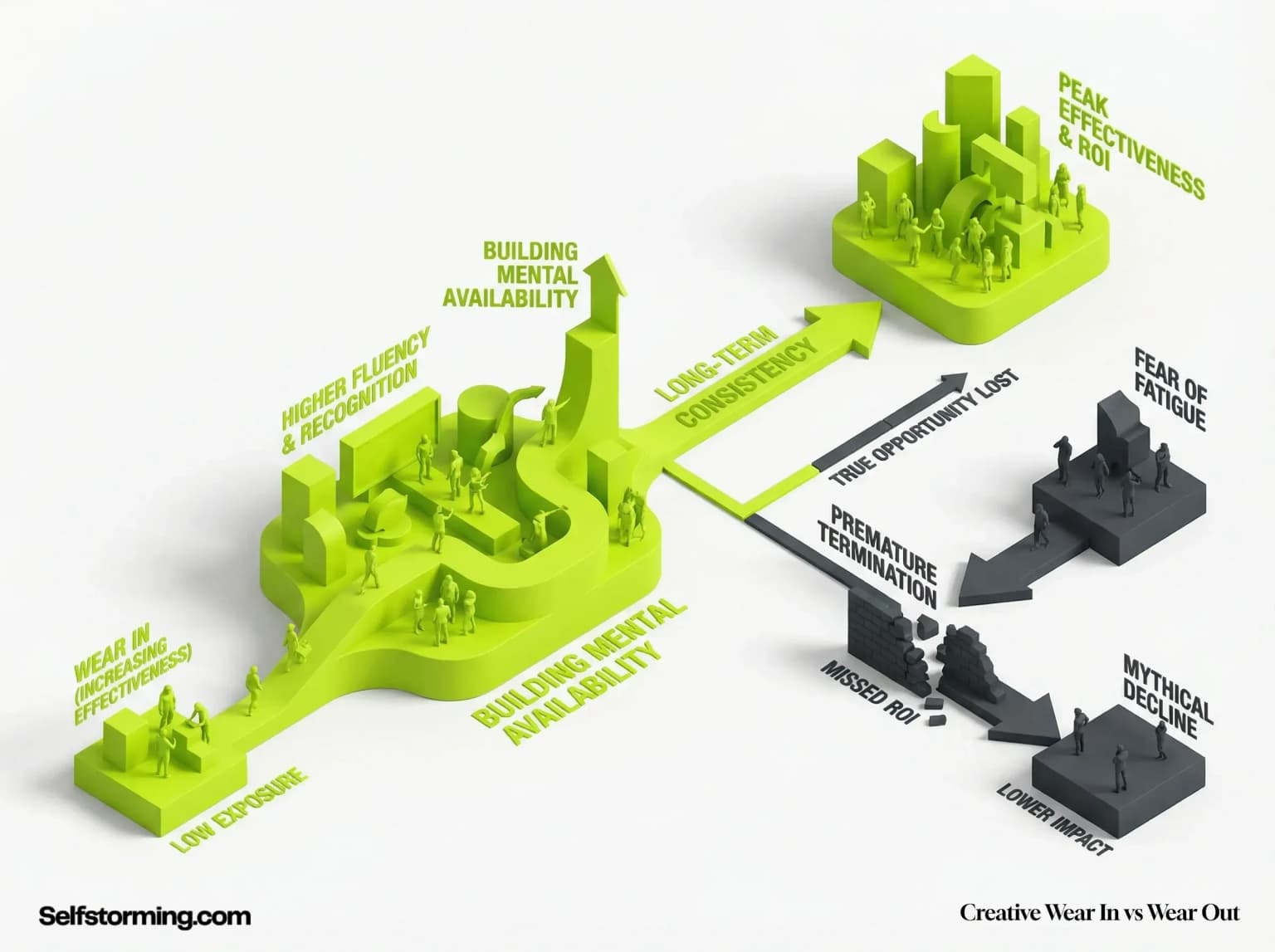
Creative Wear In vs Wear Out is a marketing principle stating that advertising effectiveness often increases with repeated exposure (Wear In) rather than declining (Wear Out). While marketers fear 'creative fatigue,' research from System1 and the IPA suggests that ads actually become more effective as they build 'processing fluency'—the ease with which a consumer recognizes and understands the message. Most campaigns are terminated by brand managers long before they reach their peak ROI. 'Wear Out' is largely a myth in broad-reach brand building; true fatigue is rare, whereas the benefits of long-term creative consistency—building mental availability and distinctive memory structures—are mathematically proven to drive superior business results over years, not just weeks.
CREATIVE WEAR IN VS WEAR OUT
“Advertising effectiveness typically scales as consumers develop cognitive fluency through repeated exposure, whereas the decline in performance due to over-saturation is vastly overestimated and rarely occurs before a campaign's potential is fully realized.”

Key Takeaways
- •Most ads are pulled before they reach their peak effectiveness and ROI.
- •Familiarity breeds processing fluency, which the brain interprets as brand preference.
- •Marketers overestimate creative fatigue because they see the ads 100x more than consumers.
- •Fluent devices like characters or slogans significantly accelerate the Wear In process.
- •Consistent creative over years builds stronger, more accessible mental brand structures.
Consequences Of Applying The Law
| Aspect | When Applied | When Not Applied |
|---|---|---|
| Creative Production & Budgeting | Production budgets are minimized by running high-quality assets for 12-24 months. Savings are reinvested into media reach, ensuring the creative has sufficient 'working' spend to reach peak effectiveness. | High 'non-working' spend occurs as brands constantly commission new creative. Assets are pulled before they pay back their production costs, leading to inefficient capital allocation and lower overall ROI. |
| Brand Distinctiveness & Assets | Creative elements become 'mental shortcuts.' Consistent exposure builds strong neural pathways, allowing light buyers to instantly identify the brand through distinctive cues and fluent patterns. | Constant creative pivoting causes brand fragmentation. Consumers fail to build a cohesive mental map of the brand, forcing them to re-evaluate the identity with every new execution, which increases cognitive friction. |
| Media Planning & Frequency | Media plans prioritize reach and allow for higher frequency. The strategy acknowledges that 'wear in' requires multiple exposures before the consumer moves from decoding the message to brand preference. | Frequency is capped too low or creative is rotated too early. Media spend is wasted on 'first-time' exposures that never reach the processing fluency threshold required to influence purchase behavior. |
| Performance Measurement | Success is measured over 6-18 month horizons. Analysis accounts for the 'latency effect' where the strongest sales impact occurs after the creative has become familiar to the audience. | Decisions are driven by short-term 'click-through' or 'early-view' metrics. Ads are prematurely killed due to a slight dip in engagement, which is often misidentified as 'wear out' rather than natural variance. |
| Consumer Cognitive Load | Leverages the 'Mere Exposure Effect.' As consumers recognize patterns, processing becomes pleasurable and effortless, which the brain subconsciously misattributes as a preference for the brand itself. | High cognitive load is maintained indefinitely. Each new ad requires the consumer to work to understand the context and message, preventing the transition from active decoding to automatic, fluent recognition. |
| Strategic Campaign Management | Marketing teams resist 'internal boredom.' They recognize that because they see the ads 100x more than the consumer, their own fatigue is not a proxy for market fatigue, maintaining the campaign for years. | Strategy is dictated by 'Marketing Boredom' or agency turnover. Campaigns are refreshed every quarter to satisfy internal desires for novelty, effectively restarting the brand's 'wear in' clock from zero every few months. |
Genesis & Scientific Origin
The concepts of Wear In and Wear Out emerged from longitudinal studies of advertising tracking data, most notably championed by the IPA (Institute of Practitioners in Advertising) and research firms like System1. While the industry has long obsessed over 'frequency' and 'fatigue,' the formalization of 'Wear In' as a strategic advantage was significantly advanced by Orlando Wood and the team at System1 in their 'Test of Time' research (2020), which challenged the prevailing wisdom that ads have a short shelf life. This work built upon the foundational principles of the Ehrenberg-Bass Institute regarding distinctive assets and the 'Long and Short of It' framework established by Les Binet and Peter Field.
“86% of high-performing ads maintain or increase their effectiveness over multiple years. (System1, 2020)”
The Mechanism: How & Why It Works
The mechanism behind Creative Wear In is rooted in cognitive psychology, specifically the 'Mere Exposure Effect' and 'Processing Fluency.' When a consumer is first exposed to a new creative execution, the cognitive load is high. They must decode the brand, the message, and the context. This is the 'Wear In' phase. As exposure repeats, the brain recognizes the creative patterns more quickly. This speed of recognition—fluency—is inherently pleasurable to the human brain and is frequently misattributed by the consumer as a preference for the brand itself.
Mathematically, this manifests as an S-curve of effectiveness. Initial exposures build the necessary memory structures (Encoding). Subsequent exposures reinforce these structures, making the brand more 'mentally available' during a buying situation. The 'Wear Out' phase—where an ad supposedly becomes annoying or ignored—is a function of 'Hedonic Adaptation,' but in mass-market advertising, the vast majority of the target audience never reaches the frequency threshold required for this to occur.
Furthermore, long-term creative consistency allows for the development of 'Fluent Devices'—recurring characters, scenarios, or melodies. These devices act as cognitive shortcuts. Instead of wasting the first 5 seconds of a 30-second spot trying to identify the brand, the audience knows immediately who is speaking, allowing the entire duration of the ad to be used for emotional reinforcement rather than basic identification. Marketers mistake their own high-frequency exposure (seeing the ad 500 times in production and reviews) for the consumer's experience (seeing it perhaps 3 times in a quarter). This 'False Consensus Effect' leads to the premature cancellation of high-performing assets.

Real-World Example:
Mars (Snickers)
Situation
In 2010, Snickers launched the 'You’re Not You When You’re Hungry' campaign. Despite immense pressure to 'refresh' the creative every year to keep up with digital trends and changing consumer sentiments, Mars maintained the core creative platform for over a decade.
Result
The campaign ran in over 80 countries and maintained incredible consistency in its 'Fluent Device' (the transformation of a hungry person into a celebrity/character). By resisting the urge to 'Wear Out' the creative, Mars saw a 15.9% increase in global sales in the first year alone and has sustained market-leading growth for over 10 years. The 'Wear In' effect allowed the slogan and scenario to become a cultural shorthand, drastically reducing the cost of mental availability compared to competitors who changed their slogans every 18 months.
Strategic Implementation Guide
Step 1
Stop measuring 'Creative Fatigue' via CTR. Click-through rates on digital platforms are a measure of immediate activation, not brand memory. A declining CTR often means you've exhausted the 'easy' buyers, not that the creative is dead.
Step 2
Adopt the 'Star Rating' or emotional testing. Use pre-testing to determine the long-term potential of an ad. If it tests well, commit to a multi-year flighting plan before a single frame is shot.
Step 3
Invest in a 'Fluent Device'. Create a recurring character, a specific visual style, or a sonic brand mark. These assets 'Wear In' faster and 'Wear Out' slower than generic lifestyle imagery.
Step 4
Separate Production from Media. Stop spending 50% of your budget on producing 10 different 'fresh' ads. Spend 10% on one great ad and 90% on ensuring people actually see it enough times to remember it.
Step 5
Ignore the 'Agency Itch'. Realize that your agency's business model often relies on production fees. When they tell you a campaign is 'stale,' ask for longitudinal brand-linkage data, not subjective 'vibe' assessments.
Step 6
Monitor Brand Linkage. The only metric that signals true Wear Out is a decline in Brand Linkage (the percentage of people who remember it was *your* brand). If Linkage is stable or rising, the ad is still Wearing In.
Step 7
Refresh the execution, not the idea. If you must change something, change the scenario but keep the Fluent Device. Think GEICO—different jokes, same Gecko.
Frequently Asked Questions
Doesn't high frequency on social media cause creative fatigue faster?
On platforms like Meta or TikTok, 'Creative Fatigue' is often a misnomer for 'Audience Saturation.' The algorithm has shown the ad to everyone likely to click. This isn't the creative 'wearing out' in terms of brand building; it's the performance algorithm hitting a ceiling. For brand building, the frequency required for true psychological 'Wear Out' is significantly higher than what most budgets can afford.
If ads get better over time, should we never change them?
You change them when the strategic objective shifts or when Brand Linkage begins to decay. However, 'The Test of Time' research shows that top-performing ads can run for a decade and still drive growth. You change when the data shows the memory structure is no longer serving the brand, not when the calendar hits January 1st.
How do we handle internal pressure to launch something 'new'?
Show the stakeholders the cost of 'Re-Encoding.' Every time you launch a new creative platform, you are essentially starting from zero in the consumer's mind. Use the analogy of a bank account: consistent creative is a compound interest investment; new creative is closing the account and starting over with a new bank every year.
Does this law apply to B2B marketing as well?
Even more so. B2B buying cycles are long, and the 'Light Buyer' problem is extreme. A B2B buyer might only be in the market for your service once every five years. If you change your creative every year, you've missed the chance to build a five-year 'Wear In' effect that ensures you're the first brand they think of when that window opens.
What is the difference between 'Wear Out' and 'Burn Out'?
Wear Out is a gradual decline in effectiveness due to familiarity. Burn Out is an acute negative reaction, usually caused by annoying creative or excessive frequency in a very short window (e.g., seeing the same unskippable pre-roll 10 times in one hour). Burn Out is a media planning failure; Wear Out is a creative myth.
Sources & Further Reading
Related Marketing Laws
Long and Short of It
Brand building and activation do different jobs and require different strategies.
60/40 Rule (Contextual)
Long-term brand investment typically outperforms short-term activation alone.
Short-Term ROI Bias
Short-term metrics undervalue long-term brand effects.
Brand Effects Compound
Long-term brand investment creates compounding returns over time.