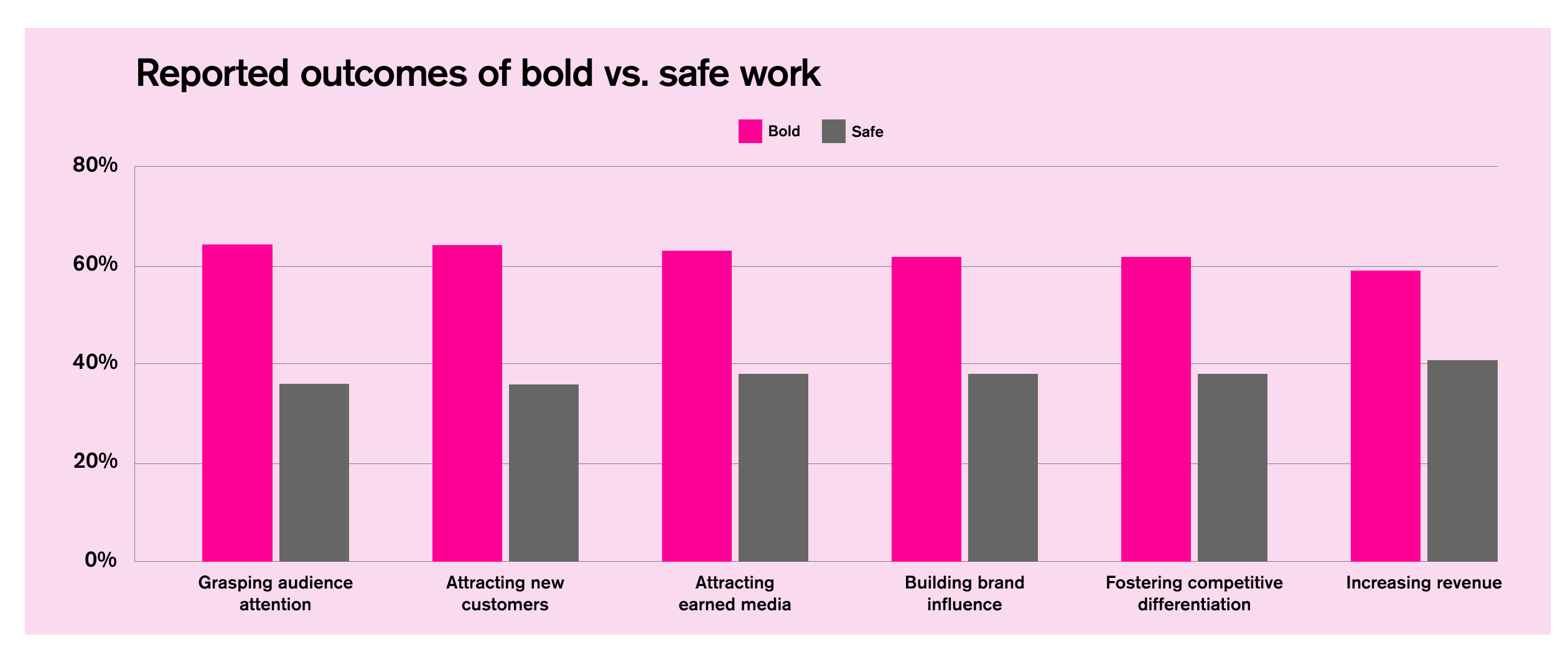
New Jellyfish x INSEAD research presented at Cannes Lions 2026: LLM and human ad judgments are completely uncorrelated. Here is what the models actually reward, and how to win both juries without killing the creative work.

There is a new advertising jury in town. It has perfect recall, an infinite attention span, it never gets bored during the case film, and it has never once cried at a Christmas ad.
It also increasingly decides which brands get recommended, compared and bought.
At Cannes Lions this year, WARC dedicated a whole session to this jury: "Can Creativity Win Models as well as Minds?", with Amy Rodgers (WARC Creative), Tom Roach (VP Brand Strategy at Jellyfish), David Dubois (Associate Professor of Marketing at INSEAD) and Natasha Wallace (Chief Solutions Officer at Jellyfish). They brought fresh research on how large language models judge advertising. The polite summary: not the way you do.
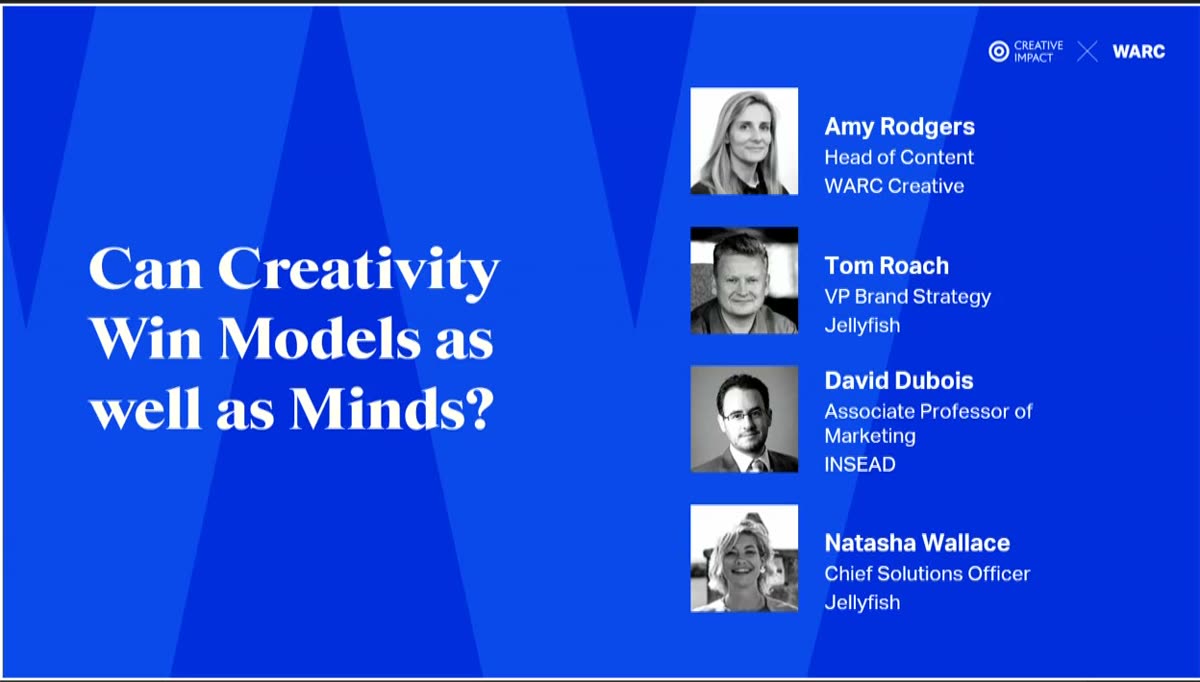
The session that asked the uncomfortable question. WARC Creative Impact Unpacked, Cannes Lions 2026.
Your media plan just grew a second audience
For years, AI in marketing meant efficiency: faster research, cheaper assets, personalisation at scale. Useful, occasionally sloppy, mostly a productivity story. The more interesting shift happens when AI stops being a tool you use and becomes an audience you perform for: the models that summarise categories, answer "what's the best running shoe for flat feet" and quietly shortlist three brands out of the entire internet.
Humans choose brands with their hearts. Models assemble answers with their heads, or whatever sits where a head would be. And you can't buy your way into that answer. There is no rate card for a recommendation.
Share of mind is not share of model
Earlier Jellyfish and INSEAD research on the US electric vehicle market makes the gap visible. Rivian scores high on AI brand awareness while regular consumers barely know it exists. Tesla dominates both. Jaguar and Lincoln live in human memory but underperform inside the models.
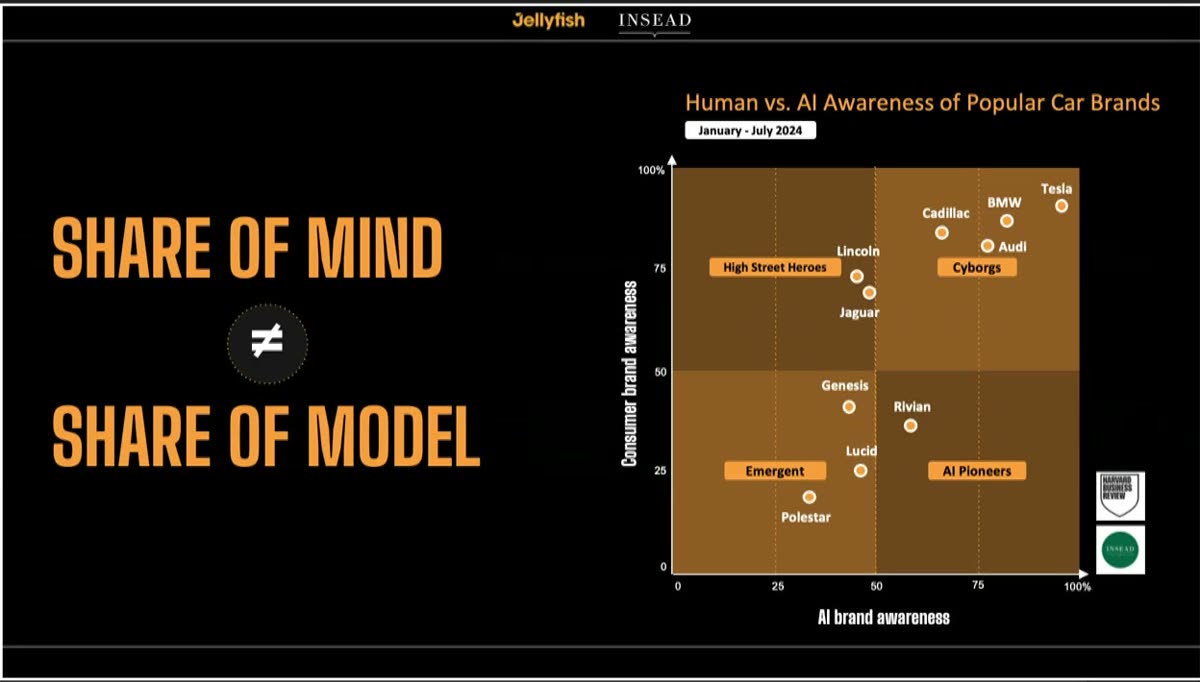
Human vs. AI awareness of car brands: the two audiences don't agree on who matters. Slide: Jellyfish x INSEAD.
If that sounds dystopian, Rodgers offered a calmer frame: this is just the next round of a game marketers have played twice already. First we learned to show up in search engines, then in social algorithms. Now we learn to show up in models. Same sport, new referee.
480 Cannes ads, one flat line
Here's the experiment that should keep your strategy director up at night. The team took 480 Cannes-entered ads with existing human effectiveness scores from WARC's dataset, then asked an LLM to judge the same work on the same scales.
The correlation between human scores and AI scores was close to zero. Not weakly positive. Not noisy. Flat.
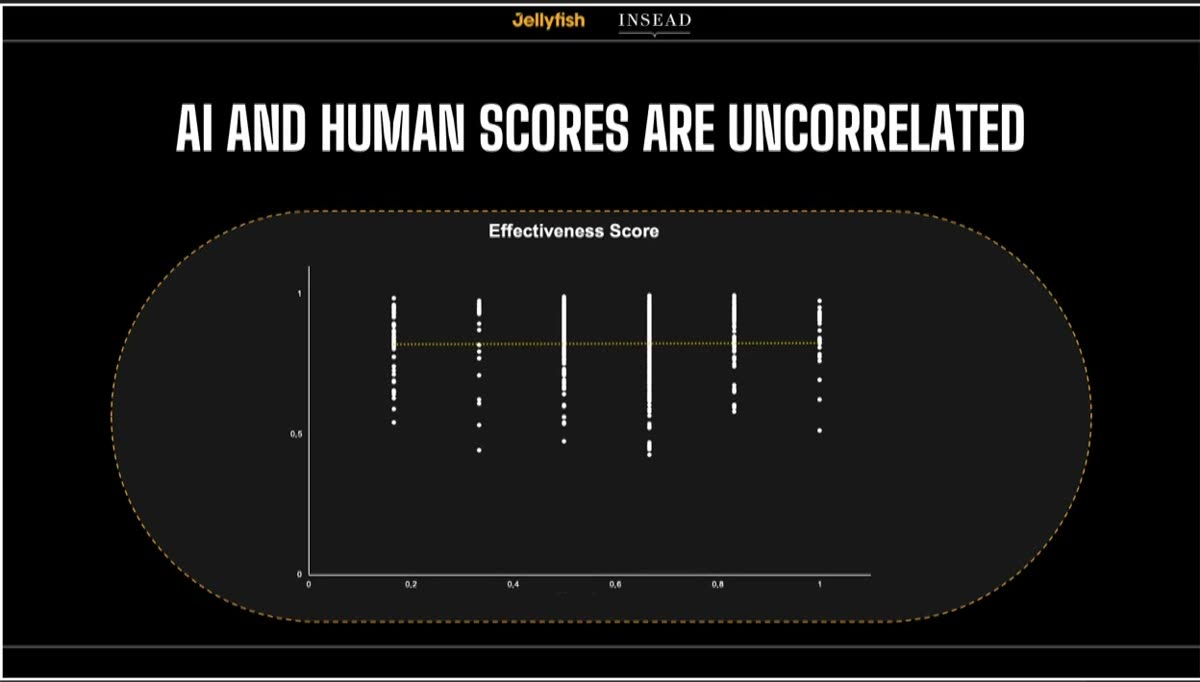
The flat line. 480 ads, two juries, zero agreement. Slide: Jellyfish x INSEAD.
Humans loved a Wendy's sustainability spot and India's #MaskIndia behavioural campaign. The models favoured a Bose product film and KitKat work built around a clean creative device. Qualitatively, no shared pattern. Two juries, two award shows.
Why: the machine reads the spec sheet
To move past vibes, the researchers had a second LLM code all 480 ads on 30+ structural parameters: duration, pacing, human presence, emotional intensity, story arc, CTA type and so on. Three findings fell out.
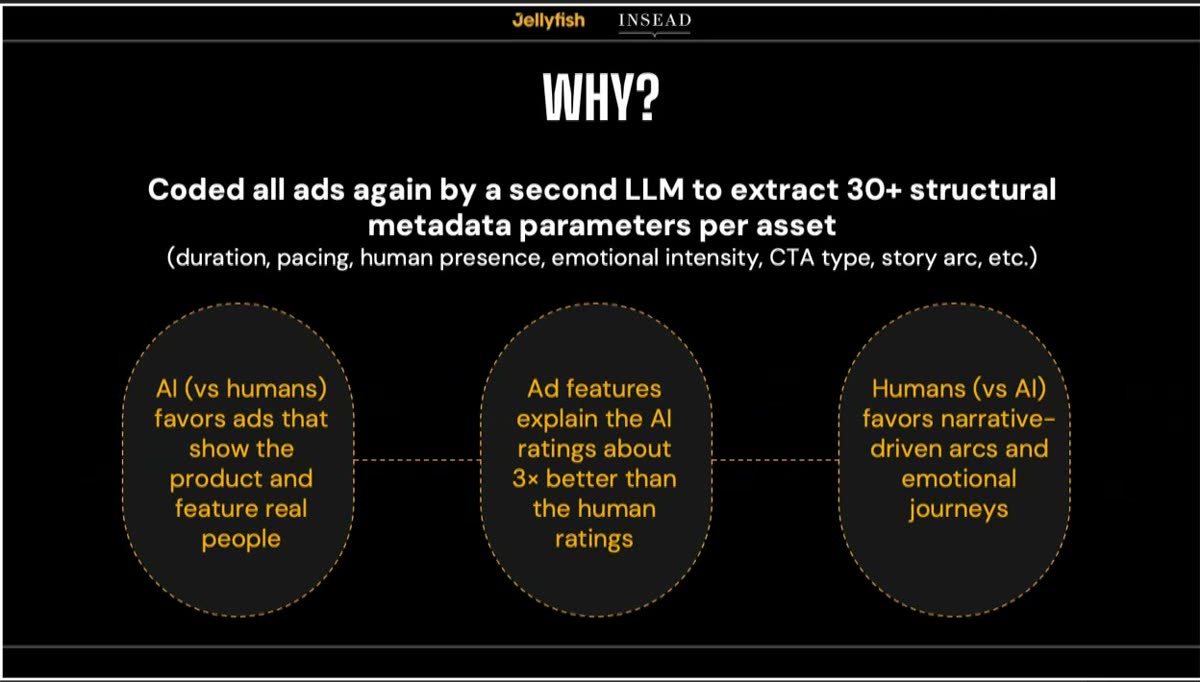
The three findings that explain the flat line. Slide: Jellyfish x INSEAD.
First, those structural features explain AI ratings about three times better than they explain human ratings. In other words, the model is systematic where humans are impressionistic. Second, AI favours ads that clearly show the product and feature real people, not celebrities. Third, humans favour narrative arcs and emotional journeys, which the model politely ignores.
Roach has a phrase for it: human perception is wide beam, model perception is narrow beam. People take in the gestalt, the story, the feeling, the gaps between the information. Models take in the information. All of it. They are the only audience member who actually reads the pack shot.
The wine test, and the ski that was too rigid
Dubois made it concrete with wine. In repeated experiments, humans consistently prefer slow-motion product videos: a 5.07 vs 4.77 lift in luxury perception over regular speed. It's immersive. You slow down, the wine gets more desirable.
Run the same two videos past an LLM and it prefers regular speed. His interpretation: the model analyses video slice by slice, and slow motion simply contains less information per second. What feels premium to you reads as low bandwidth to the machine.
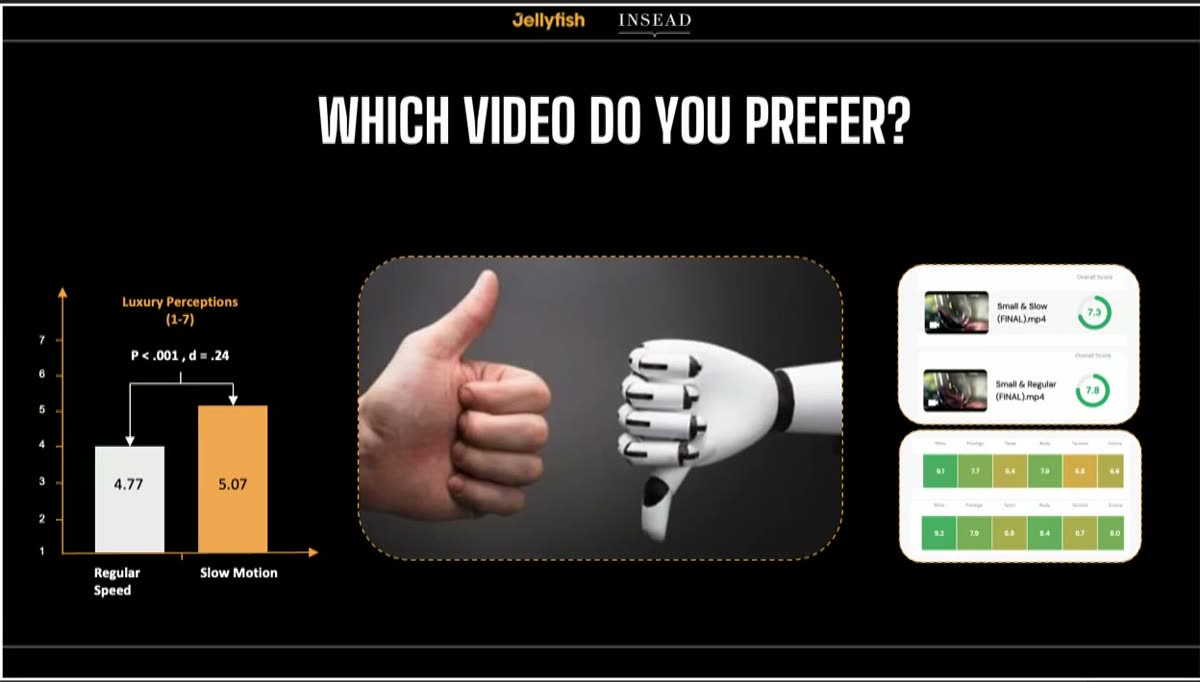
Humans vote slow motion, the model votes regular speed. Slide: Jellyfish x INSEAD.
Then there's the ski brand that proudly built its site around rigidity, the attribute every expert skier wants. Inside the models, rigidity surfaced as a negative and dragged the brand's visibility down. Dubois's theory: models are trained heavily on YouTube and Reddit, and how many expert skiers post on Reddit? To the internet at large, rigid just means stiff and unpleasant, so that's what the model learned.
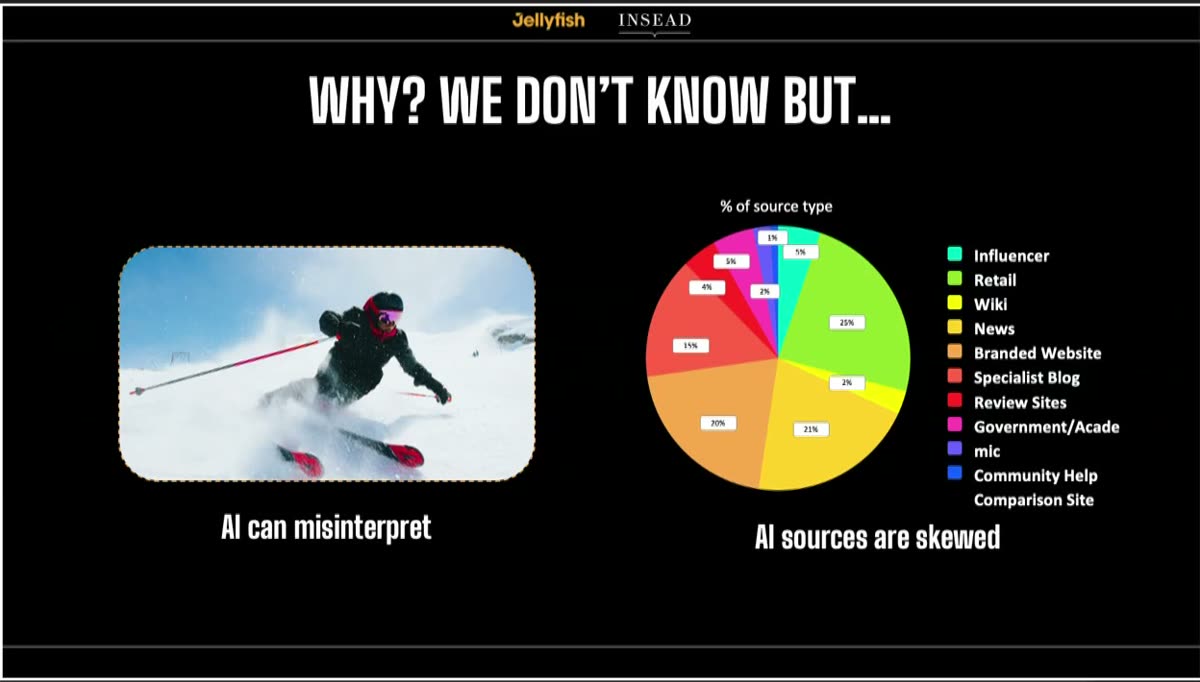
Your category language is being learned from sources you don't control. Slide: Jellyfish x INSEAD.
The part where brand people get to gloat
Now the good news, and it's genuinely good. Analysis by Charlie Oscar across 30 brands and six categories found that 63% of LLM visibility is driven by long-term brand equity. Marketing spend contributes 22%, citation volume 11%, influencer and PR reach 4%.
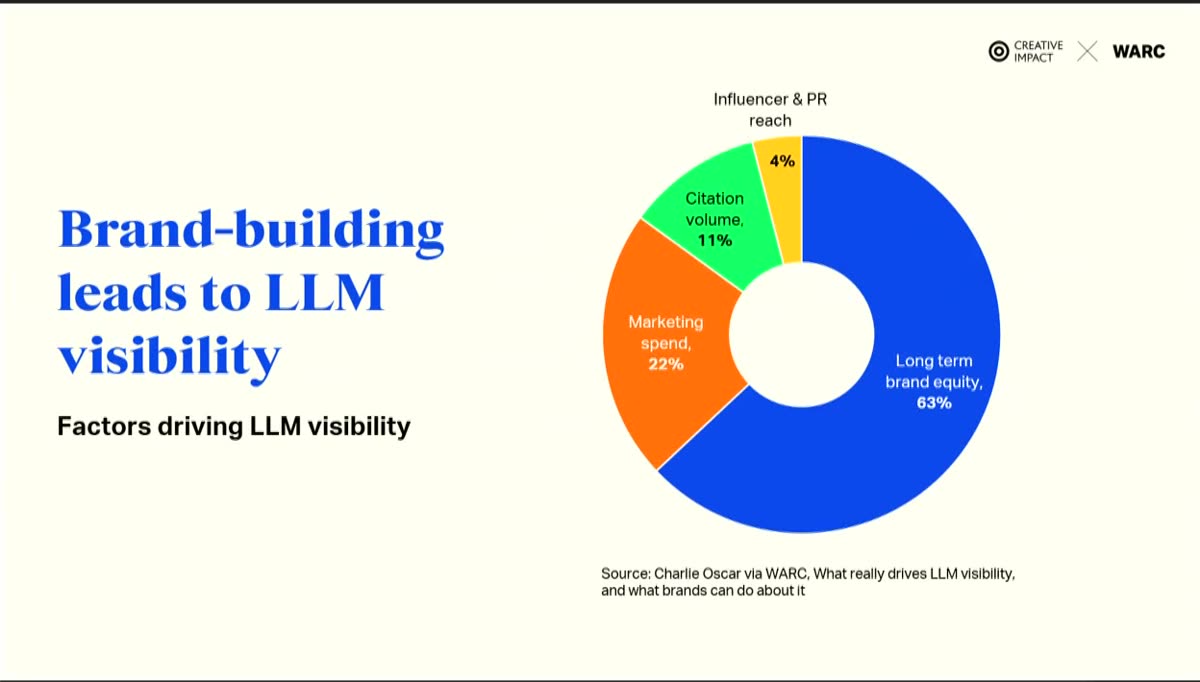
Brand building leads to LLM visibility. Source: Charlie Oscar via WARC.
Read that again: the single biggest driver of whether a model surfaces your brand is the unfashionable, slow, compounding work of building distinctive assets and consistent positioning over years. The machines, it turns out, are long-term brand people. Somewhere, a performance marketer just felt a cold draught.
So what do you actually do?
Wallace closed with the planning implications, which boil down to five moves:
Map the journey again. Work out where a model, not a person, makes the decision, and structure product-centric messaging for exactly those moments.
Be legible, don't be flat. Plain language, descriptive claims, functional tones where the model reads you. But keep the texture of the brand. You're building something a model can assemble into an answer in the moment, not a spec sheet with a logo.
Play for hierarchical dominance. Models look for consensus and rankings. Own an attribute, reinforce it everywhere, be distinct from your competitor. Dubois tells his MBA students: be first in a ranking, and if the ranking doesn't exist, create one.
Create for influence. No single source dominates what models cite, but in Jellyfish's Share of Model data, one in four cited sources is a YouTube video. What others say about you matters as much as what you say.
Stop guessing. Unlike human creativity, model receptivity is testable before launch. Models want direction where people want disruption, and you can check whether you're giving it to them.
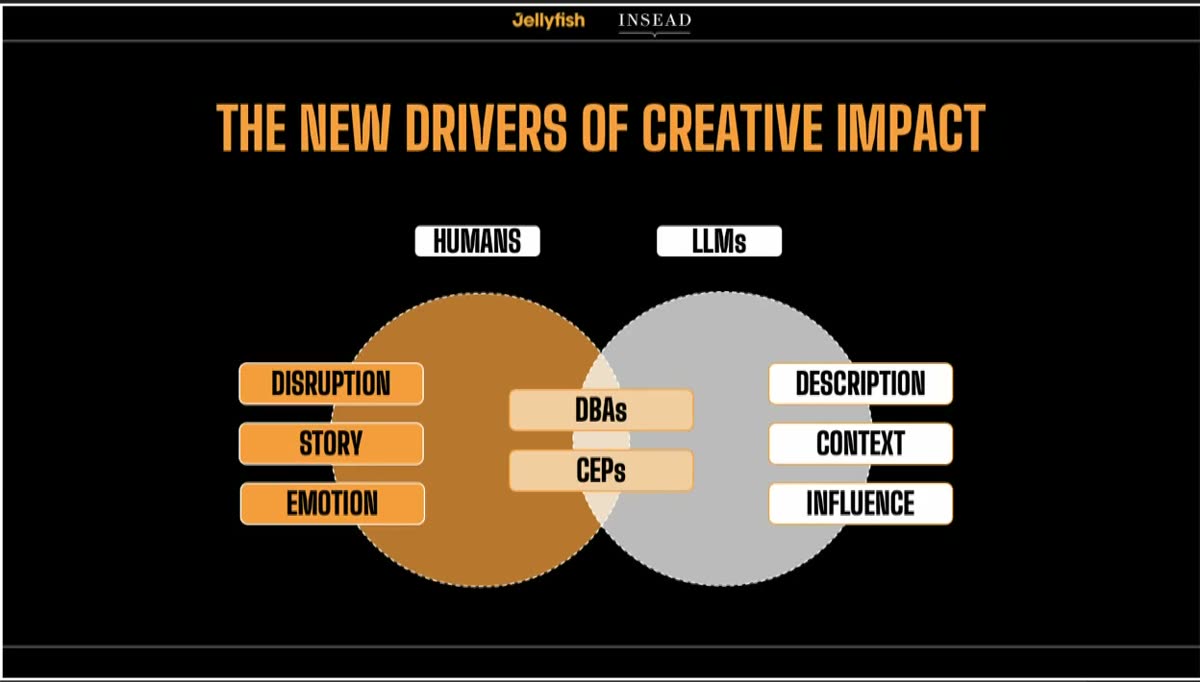
The overlap is where you win both juries: distinctive brand assets and category entry points. Slide: Jellyfish x INSEAD.
Note the overlap in that diagram. Distinctive brand assets and category entry points sit dead centre, valuable to both audiences. Brand still matters. If your brand is interchangeable with your competitor's in an evaluation, a model has no reason to pick you, and neither does a human.
Don't panic. Pixar solved this decades ago
A two-audience problem sounds terrifying until you remember advertising has seen them before. Pixar built an empire on films that work for kids and adults at the same time. Nobody suggested dropping the jokes for the parents.
Roach's warning is the one worth pinning above your desk: the real risk is over-correcting. If we stuff every ad with information because "that's what the models want", we'll repeat the first digital revolution's mistake, when everything became performance-driven direct response, and walk straight into a second crisis of creative effectiveness. The answer is bothist, not either-or.
So keep making work that gives people goosebumps. Just make sure that when the machine reads the transcript afterwards, it can tell what the product was, who it's for and why it wins. One audience falls in love. The other takes notes. You need both.
Source: "Can Creativity Win Models as well as Minds?", a WARC Creative Impact Unpacked session at Cannes Lions 2026, featuring Amy Rodgers (Head of Content, WARC Creative), Tom Roach (VP Brand Strategy, Jellyfish), David Dubois (Associate Professor of Marketing, INSEAD) and Natasha Wallace (Chief Solutions Officer, Jellyfish), presenting Jellyfish x INSEAD "Share of Model" research on 480 Cannes-entered ads. Screenshots from the session presentation, courtesy of WARC and the speakers.