Uber Eats: Build Your Own Super Bowl Commercial
Uber Eats tasked Special US with creating a Super Bowl campaign that moved beyond traditional broadcast spots. The goal was to increase app engagement and sales during the most competitive week of the year. The client needed a strategy to capture the attention of football fans who were increasingly distracted by multiple screens, aiming to turn passive viewers into active, ordering customers.
Creative Idea
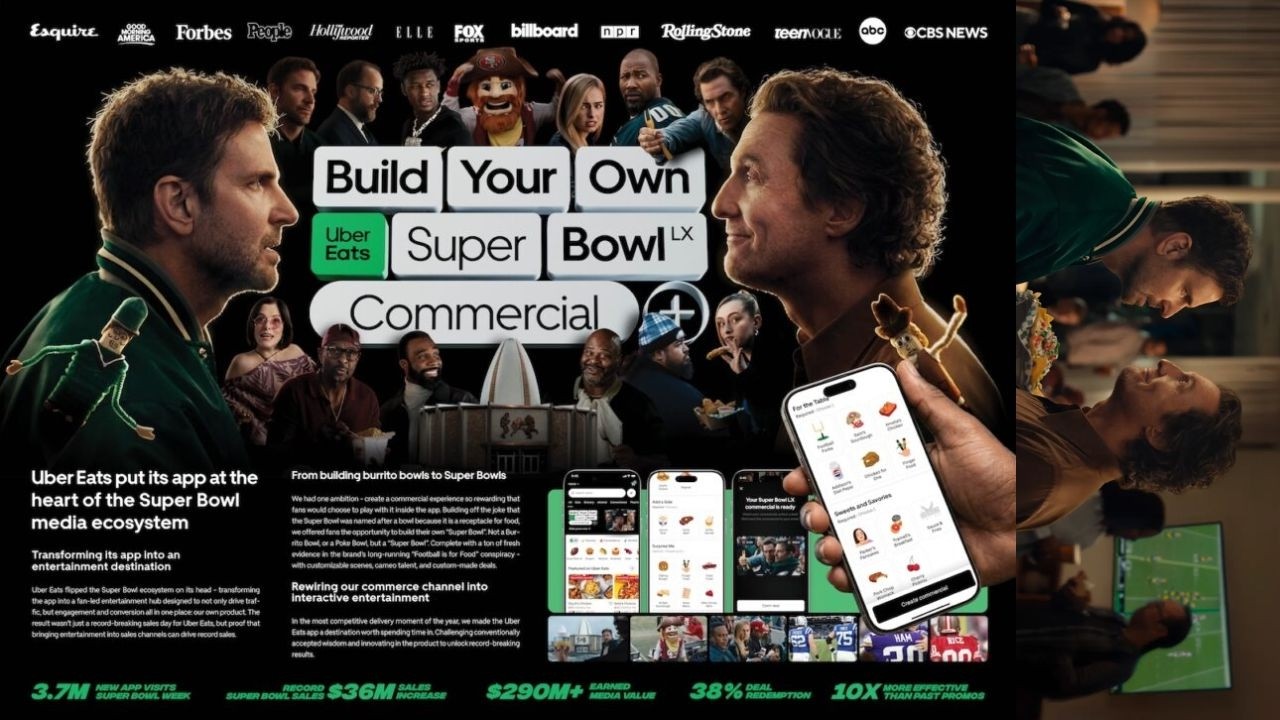
Fans built custom Super Bowl commercials within the app to unlock exclusive food deals.
Uber Eats turned its Super Bowl commercial into an interactive in-app experience, allowing fans to assemble custom ads from thousands of celebrity-led scenes, effectively transforming passive viewers into active participants and driving record-breaking sales through personalized entertainment.
Turning Passive Viewers Into Active Producers
A Massive Production Puzzle
To make the interactive builder feel seamless, Director Steve Rogers and the team at Biscuit Filmworks had to film an exhaustive library of modular scenes. The production required a complex, non-linear script structure where every celebrity cameo—from Matthew McConaughey to Jerry Rice—had to match in lighting, tone, and framing. This allowed the DEPT tech team to stitch together thousands of unique permutations in real-time, ensuring that no matter which clips a user selected, the final commercial felt like a cohesive, high-budget Super Bowl spot.
The Conspiracy Theory Engine
The campaign leaned heavily into the "football was invented to sell food" narrative, a multi-year platform that allowed the brand to act as a self-aware conspiracist. By casting Bradley Cooper as the skeptic to McConaughey’s wild theories, the agency created a narrative tension that encouraged users to keep building and sharing their own versions of the "truth." This meta-commentary on advertising itself helped the campaign achieve a 38% deal redemption rate, proving that when users are given the tools to play with the brand, they are significantly more likely to transact.
Scaling for Super Bowl Traffic
The technical infrastructure was designed to handle a massive surge in traffic, processing 3.7 million incremental app visits during the week of the game. By moving the creative experience directly into the Uber Eats app, the team bypassed traditional social media friction, keeping users within the ecosystem where they could immediately redeem their earned discounts. This strategy successfully converted casual viewers into customers, with 40% of participants being new or lapsed users who had not engaged with the platform recently.
Creative Strategy Deconstructed
Company
Uber Eats possessed a massive delivery infrastructure and a recurring, humorous brand platform centered on the conspiracy that football exists to sell food.
Category
Food delivery brands typically rely on static, high-budget celebrity commercials during the Super Bowl that offer no direct interaction for the viewer.
Customer
Viewers were tired of passive advertising and craved personalized, shareable content that allowed them to participate in the Super Bowl cultural conversation.
Culture
The rise of second-screen engagement and the demand for interactive, personalized digital experiences made this participatory approach highly resonant with modern football fans.
Company
Uber Eats possessed a massive delivery infrastructure and a recurring, humorous brand platform centered on the conspiracy that football exists to sell food.
Category
Food delivery brands typically rely on static, high-budget celebrity commercials during the Super Bowl that offer no direct interaction for the viewer.
Strategy:
Transform passive media consumption into active, utility-driven participation to maximize brand engagement and conversion.
Customer
Viewers were tired of passive advertising and craved personalized, shareable content that allowed them to participate in the Super Bowl cultural conversation.
Culture
The rise of second-screen engagement and the demand for interactive, personalized digital experiences made this participatory approach highly resonant with modern football fans.
Strategy:
Transform passive media consumption into active, utility-driven participation to maximize brand engagement and conversion.
Results
The campaign drove 3.7M new app visits during the most competitive week of the year. It delivered Uber Eats' best ever Super Bowl sales, smashing the previous record by over $36M. The activation also achieved a 10x higher deal redemption rate and record conversion.
3.7M
new app visits
+$36M
increase over previous sales record
10x
higher deal redemption
Strategy Technique
Build an Utility, Not an Ad
The campaign shifted from broadcasting a message to providing a functional tool that users wanted to interact with. It turned the advertising content itself into a product that delivered value through entertainment and commerce.
Explore Technique
Creative Technique
Gamification
By allowing users to select scenes and assemble their own commercials, the campaign turned a passive viewing experience into an interactive game. This mechanic directly incentivized engagement and repeat visits to the app.
Explore Technique
Craft Breakdown
This campaign excels by seamlessly integrating high-production celebrity content directly into an interactive mobile app experience. It successfully bridges the gap between passive entertainment and active consumer utility.
The seamless integration of a modular video generator within the native Uber Eats app interface is a massive technical and user-experience achievement.
The humorous conspiracy narrative is cleverly written and consistently maintained across all modular video variations.