Digital Iron Curtain
O2 Slovakia (agency: TRIAD Advertising) needed to remind Slovak citizens, especially younger generations, about the importance of the Velvet Revolution and the freedoms it secured. The brand aimed to connect its identity as a telecom provider with the values of freedom and open connectivity, increasing relevance on November 17th.
Creative Idea
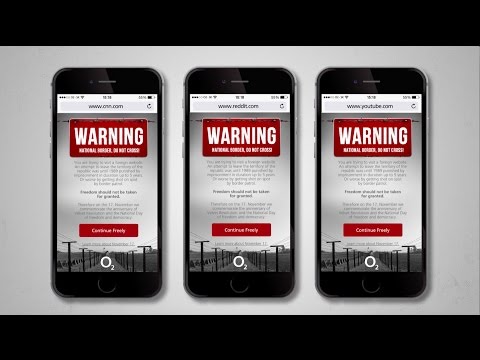
O2 blocked foreign websites and sent border warnings to simulate the Iron Curtain.
On November 17th, O2 created a "digital iron curtain" by blocking foreign websites, while sending SMS warnings to border-crossers about pre-1989 dangers. This powerfully reminded young people of the Velvet Revolution's importance, positioning O2 as a champion of freedom and open connectivity.
The Day O2 Intentionally Broke the Internet
Engineering a Digital Border
To pull off this simulation, TRIAD Advertising collaborated directly with O2's network engineers to manipulate the mobile network's DNS and gateway levels. This allowed for a real-time redirect that intercepted users the moment they attempted to access international domains like Google or Facebook. For the border component, the team piggy-backed on the existing roaming SMS system that automatically alerts customers when they cross into another country - injecting an additional message with a chilling warning about pre-1989 border dangers.
Tangible Freedom for Digital Natives
 The strategy focused on making the concept of freedom "tangible" for a generation that had never known restricted movement. Chief Creative Officer Martin Woska noted that by blocking the very service O2 sells, the brand proved its commitment to democratic values. The risk of "breaking" the product paid off; despite the intrusive nature of the blocking, the campaign achieved a 98% positive sentiment. It reached 1.7 million people - nearly one-third of the entire Slovak population - in just 24 hours.
A Benchmark for Brand Bravery
The campaign generated over 1 million "border crossings" (clicks to bypass the warning page) and became the top trending topic on Slovak social media. Beyond the metrics, it served as a massive educational tool, praised by historians for its ability to translate the 1989 revolution into a language "digital natives" understood. It remains a definitive case study in Brand Bravery, proving that a telecom provider can gain significant brand preference by temporarily denying the very connectivity it exists to provide.
Creative Strategy Deconstructed
Company
O2, as a telecom provider, credibly controlled internet access and communication, enabling the "digital iron curtain" simulation.
Category
Telecoms typically promote seamless connectivity and modern services, rarely restricting access or evoking historical political themes.
Customer
Many young people lacked understanding of the Velvet Revolution's significance and the freedoms it brought, taking them for granted.
Culture
The national holiday of November 17th, commemorating the Velvet Revolution, provided a potent and relevant cultural backdrop for the message.
Company
O2, as a telecom provider, credibly controlled internet access and communication, enabling the "digital iron curtain" simulation.
Category
Telecoms typically promote seamless connectivity and modern services, rarely restricting access or evoking historical political themes.
Strategy:
Use O2's network control to re-educate youth on freedom's cost via a cultural anniversary.
Customer
Many young people lacked understanding of the Velvet Revolution's significance and the freedoms it brought, taking them for granted.
Culture
The national holiday of November 17th, commemorating the Velvet Revolution, provided a potent and relevant cultural backdrop for the message.
Strategy:
Use O2's network control to re-educate youth on freedom's cost via a cultural anniversary.
Results
On November 17, 2016, 400,000 Slovaks (which is 65% of the young adult Slovak population) were withheld at the digital Iron Curtain. The campaign became a huge topic, with media and public discussions praising it as an "astonishing way to remind people about freedom" and "really strong! Especially in the times of Trump, Kotleba and Putin!" Four months after the campaign, for the first time in 30 years, the Slovak court rehabilitated a victim of the Iron Curtain (Harmut Tautz), establishing a precedent.
400,000
Slovaks withheld at digital Iron Curtain
65%
of young adult Slovak population reached
30 years
first time court rehabilitated victim in
Strategy Technique
Create Contrast
The campaign starkly contrasted modern internet freedom with a simulated past of restricted access. By creating this "before" scenario, it powerfully highlighted the value of current liberties.
Explore Technique
Creative Technique
Dramatize the Problem
The campaign physically simulated the lack of freedom by blocking internet access and sending border warnings. This directly dramatized the historical problem of the Iron Curtain for a modern audience.
Explore Technique
Craft Breakdown
This campaign's craft is exceptional in its use of historical context and innovative digital intervention to deliver a profound message, primarily elevated by its strong concept and art direction.
The core idea of creating a 'digital Iron Curtain' to remind people of the past and the value of freedom is exceptionally clever, timely, and impactful, demonstrating deep strategic insight into a societal problem.
The visual contrast between historical black-and-white footage/photos and the clean, modern O2 branding, along with the consistent use of red as a symbolic warning and highlighting color, is powerfully executed.
The narrative effectively frames a complex historical event, highlights a modern problem of historical amnesia, and positions O2's solution as a meaningful intervention, creating a compelling and educational arc.
The technical execution of the digital border block, the customized warning page, and the geo-fenced SMS messages showcases innovative use of technology to deliver a conceptual message in a real-world context.