Poise: Drops of Hope
Kimberly - Clark challenged FCB New York to revitalize the Poise brand by addressing the deep - seated stigma of incontinence. They aimed to deepen brand purpose by supporting women in rural health deserts who lack OB - GYN access. The goal was to drive category growth and brand love through a meaningful innovation that provided tangible health value beyond traditional advertising for underserved populations.
Creative Idea
Poise turned incontinence pads into mail - in diagnostic kits for women in healthcare deserts.
Poise re-engineered its incontinence pads into at-home diagnostic tools, allowing women in rural healthcare deserts to mail in samples for biomarker testing, transforming a stigmatized product into a life-saving medical interface for underserved communities.
Turning Bladder Leakage Into A Medical Lifeline
From Shameful Necessity to Scientific Tool
The technical breakthrough of the campaign centered on a collaboration with Panome Bio in St. Louis. Together, they developed a proprietary method to extract dried urine from the super - absorbent polymers inside standard Poise pads. This innovation allowed the product to function as a mail - in diagnostic interface capable of detecting thousands of biomarkers. The results provided rural women with critical data on perimenopause, UTIs, kidney disease, and even bladder cancer, effectively bypassing the need for an immediate physical clinic visit.
Documentary Realism in Health Deserts
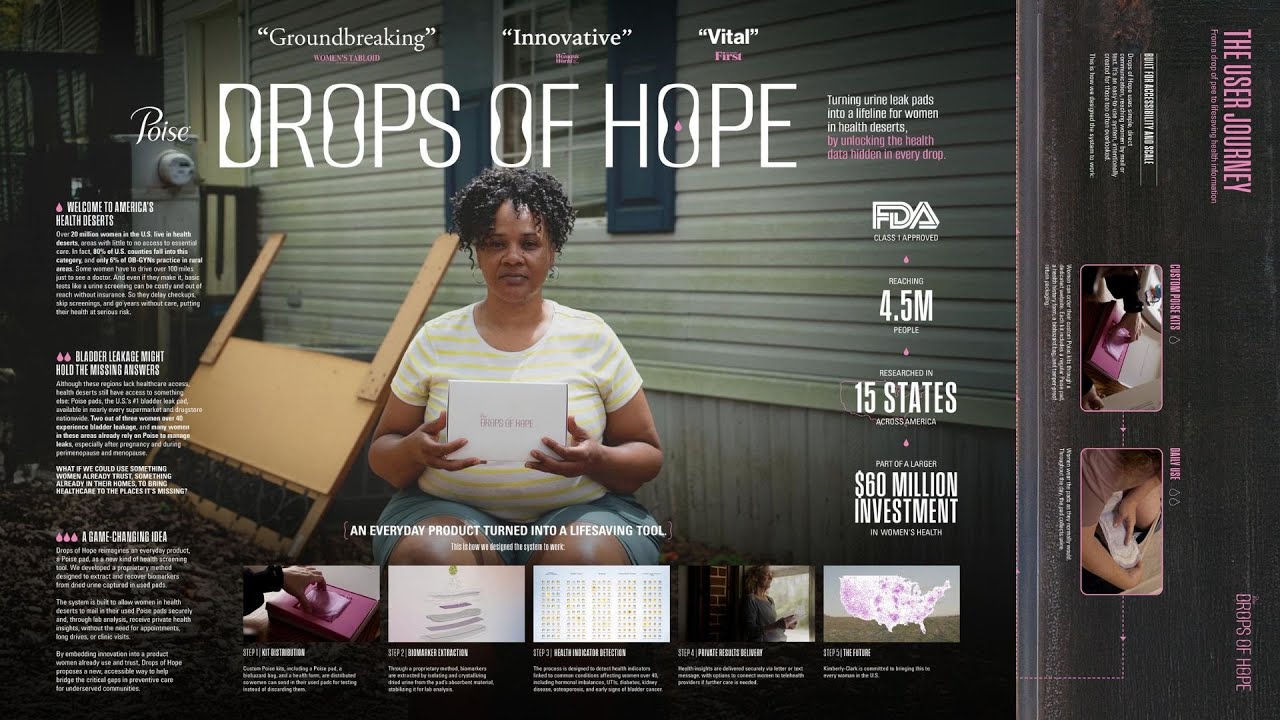 To capture the gravity of the situation, FCB New York partnered with Oscar - nominated director Sara Nesson. Eschewing traditional actors or celebrities, the production team traveled to remote regions where 80% of U.S. counties lack adequate healthcare and only 6% of OB - GYNs practice. The flagship film, "Welcome to America’s Health Deserts," featured real women who had not seen a physician in over a decade. One participant poignantly noted that the initiative made her feel that her "bladder leakage could finally be a positive thing."
Four Months to Change the Category
Despite the scientific complexity and logistical hurdles of launching a medical diagnostic service, the entire project was conceptualized and executed in just four months. This rapid turnaround, led by Kimberly - Clark’s Luiz Sanches and Katie Moran, paid off commercially. The campaign drove high - single - digit category growth in the Adult Care segment for Q2 2025 and contributed to a 5% YoY rise in Kimberly - Clark’s stock price. Industry analysts now cite the project as a benchmark for Creative Business Transformation, proving that an agency can solve infrastructure gaps through product re - engineering.
Creative Strategy Deconstructed
Company
Poise possessed a high-volume absorbent product and the scientific partnerships to extract biomarkers from dried urine samples.
Category
The incontinence category typically focuses on discreet protection and odor control, ignoring the deeper health implications of bladder leakage.
Customer
Women in rural health deserts feel neglected by the medical system and embarrassed by a condition they cannot easily treat.
Culture
Growing awareness of systemic healthcare inequality in America created a demand for accessible, decentralized diagnostic solutions for women.
Company
Poise possessed a high-volume absorbent product and the scientific partnerships to extract biomarkers from dried urine samples.
Category
The incontinence category typically focuses on discreet protection and odor control, ignoring the deeper health implications of bladder leakage.
Strategy:
Repurpose pads as diagnostic interfaces to bridge the gap between rural women and essential gynecological care.
Customer
Women in rural health deserts feel neglected by the medical system and embarrassed by a condition they cannot easily treat.
Culture
Growing awareness of systemic healthcare inequality in America created a demand for accessible, decentralized diagnostic solutions for women.
Strategy:
Repurpose pads as diagnostic interfaces to bridge the gap between rural women and essential gynecological care.
Results
The 'Drops of Hope' campaign achieved significant reach and impact. It was researched in 15 states across America and reached 4.5 million people. The initiative is part of a larger $60 million investment in women's health by Kimberly-Clark, with plans to expand the technology to other products. The diagnostic method is FDA Class 1 Approved, ensuring its reliability and safety. The campaign received praise from media outlets, being described as 'Innovative' by Women's Tabloid and 'Groundbreaking' by Woman's Day. The project successfully demonstrated a new way to provide essential health screenings to underserved populations, potentially saving lives by detecting serious conditions early.
4.5M
people reached
15
states researched
$60M
investment in women's health
Strategy Technique
Build an Utility, Not an Ad
Instead of just advertising brand purpose, Poise created a physical solution for the 80% of U.S. counties lacking OB-GYN access. The product itself became the medium for delivering essential healthcare.
Explore Technique
Creative Technique
Unexpected Utility
It converts a passive, single-use absorbent product into a proactive medical device. This shift turns a source of personal shame into a functional tool for health empowerment and diagnostic access.
Explore Technique
Craft Breakdown
The campaign seamlessly integrates advanced biotechnology with empathetic documentary storytelling to solve a systemic logistics problem.
Partnering with Panome Bio to extract biomarkers from pad fibers turned a commodity into a medical device.
Director Sara Nesson used intimate, raw visuals to humanize the medical isolation felt by women in rural areas.
Mapping U.S. healthcare deserts allowed the brand to target the innovation where it was most urgently needed.
Reframing leakage as a source of vital health data successfully dismantled long - standing category stigmas.
“The fusion of biotech innovation and cinematic human stories transformed a technical breakthrough into an emotional movement.”