Change the Ref: Statiums
Change the Ref tasked Alma Miami with creating a high-impact campaign to address gun violence ahead of the FIFA World Cup. The goal was to mobilize voters in key states by making the scale of gun deaths feel personal and urgent. The client needed a strategy that would cut through the excitement of the tournament to drive civic engagement and political pressure.
Creative Idea
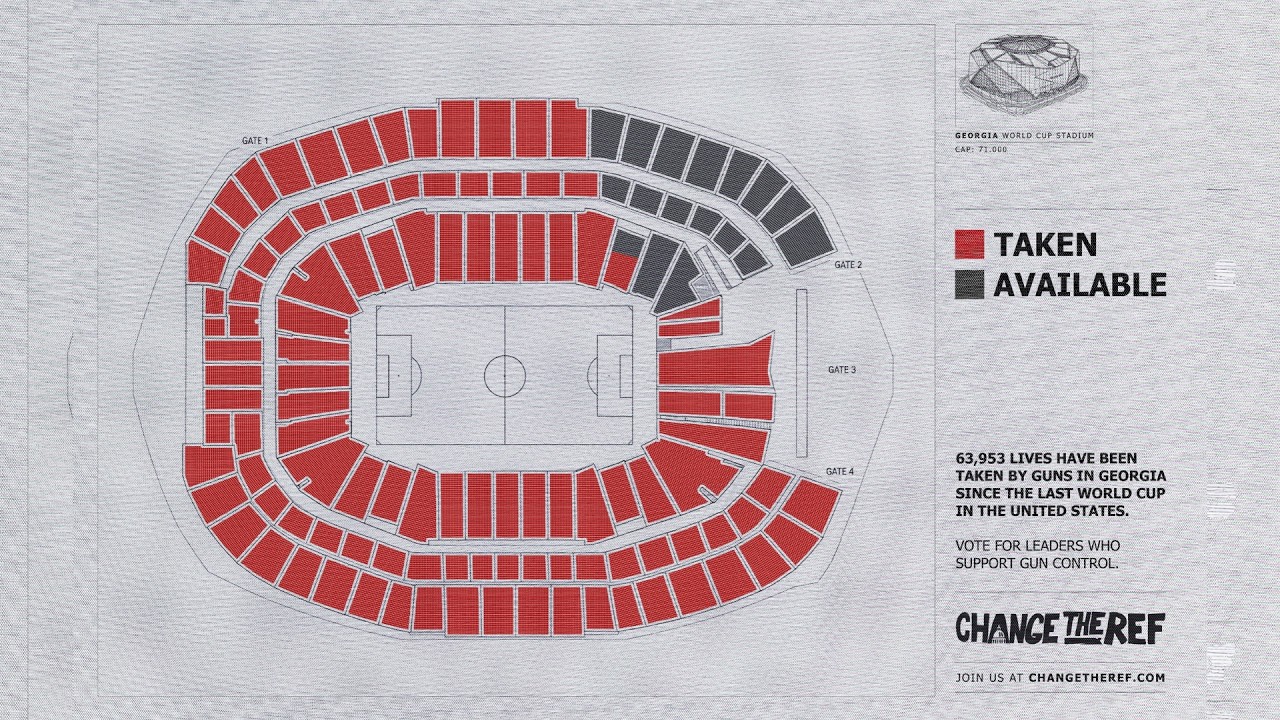
Mapped gun death statistics onto stadium seating charts to visualize the human cost.
By mapping gun violence casualty data onto World Cup stadium seating charts, the campaign transformed abstract, overwhelming statistics into a tangible, visceral reality, reframing the act of voting as a necessary step to reclaim public spaces from gun violence.
Visualizing The Human Cost Of Violence
Turning Data Into A Stadium Spectacle
The production process relied on meticulous data mapping to ensure the visual impact was both accurate and haunting. By utilizing real stadium blueprints, the team at Alma Miami and Omnicom Studios transformed cold statistics into a visceral experience. Each seat in the digital and print renderings was assigned to a victim of gun violence, effectively turning the architecture of celebration into a memorial. This approach allowed the campaign to bypass traditional advertising noise by embedding itself directly into the context of the FIFA World Cup, turning the excitement of the tournament into a platform for civic urgency.
A Strategic Call To Action
The campaign was specifically timed to bridge the gap between the return of the World Cup to the United States and the critical midterm elections. By focusing on Georgia, Missouri, and Pennsylvania, the agency targeted states where swing-voter populations and legislative debates on gun safety were most intense. The creative team framed the act of voting as a form of patriotism, summarized by the rallying cry: "Fill the ballots. Not the stadiums." This narrative shift was designed to move the conversation from passive observation to active participation.
Navigating Media Restrictions
Rather than viewing the strict advertising regulations surrounding major sporting events as a hurdle, the agency used them as a catalyst for innovation. The team employed mobile, context-aware media to reach fans at the exact moment their passion for the sport was at its peak. This strategy ensured that the campaign felt like a natural, albeit jarring, part of the fan experience rather than an intrusive interruption. By connecting the universal language of sports with the harsh reality of gun violence, the campaign successfully forced a national dialogue during a period of high-visibility celebration.
Creative Strategy Deconstructed
Company
Change the Ref leveraged its credibility as a victim-led advocacy group to demand accountability through data-backed, high-impact visual storytelling.
Category
Non-profits often rely on abstract statistics or emotional testimonials that frequently fail to cut through the noise of major sporting events.
Customer
Sports fans wanted to celebrate the World Cup, but the campaign tapped into their underlying anxiety about safety in public spaces.
Culture
The return of the FIFA World Cup to the U.S. provided a massive, high-visibility platform to contrast celebration with national tragedy.
Company
Change the Ref leveraged its credibility as a victim-led advocacy group to demand accountability through data-backed, high-impact visual storytelling.
Category
Non-profits often rely on abstract statistics or emotional testimonials that frequently fail to cut through the noise of major sporting events.
Strategy:
Translate abstract societal crises into familiar cultural frameworks to force immediate, tangible public accountability.
Customer
Sports fans wanted to celebrate the World Cup, but the campaign tapped into their underlying anxiety about safety in public spaces.
Culture
The return of the FIFA World Cup to the U.S. provided a massive, high-visibility platform to contrast celebration with national tragedy.
Strategy:
Translate abstract societal crises into familiar cultural frameworks to force immediate, tangible public accountability.
Results
The campaign mapped state-level gun violence mortality data since 1994 onto World Cup stadium seating charts to visualize the scale of gun deaths. Specific metrics displayed include 63,953 lives lost to gun violence in Georgia, 53,386 lives in Pennsylvania, and 57,629 lives in Missouri since the 1994 World Cup. The activation reached fans directly at U.S. National Team friendlies, street poster placements, backpack digital screens, print newspapers, and online sports media outlets prior to elections.
63,953
gun deaths mapped in Georgia
57,629
gun deaths mapped in Missouri
53,386
gun deaths mapped in Pennsylvania
Strategy Technique
Turn Data Into Drama
By mapping casualty numbers onto familiar stadium layouts, the campaign forces an emotional connection to cold statistics. It turns dry data into a shocking, relatable visual narrative that demands immediate civic action.
Explore Technique
Creative Technique
Dramatize the Problem
The campaign visualizes the staggering scale of gun violence by literally filling stadium seats with data points. This makes an invisible, abstract crisis feel physically overwhelming and impossible to ignore.
Explore Technique
Craft Breakdown
This campaign's exceptional execution relies on brilliant graphic design and data visualization, repurposing familiar stadium seating charts into a chilling metric of human loss.
Transforming abstract death toll statistics into intuitive, unmistakable red-seat stadium diagrams creates an immediate emotional impact.
Mapping 30+ years of state-level gun mortality data onto exact stadium capacities makes an incomprehensible statistic tangibly real.