Ville de Paris: Terms and Conditions of Being a Girl
The Ville de Paris sought to address the persistent gender inequality in France. They tasked BETC Paris with creating a campaign that would move beyond performative rhetoric to spark a national conversation. The goal was to highlight the daily, systemic barriers women face, ultimately driving tangible civic action and policy visibility for women's contributions to history.
Creative Idea
Framed systemic gender inequality as a mandatory, unconsented legal contract for all women.
The campaign exposed the systemic inequality women face by framing societal biases as hidden legal 'terms and conditions.' It used the French motto as a canvas to force a national conversation about the gap between equality in theory and reality.
The Fine Print Behind French Equality
Engineering the Asterisk
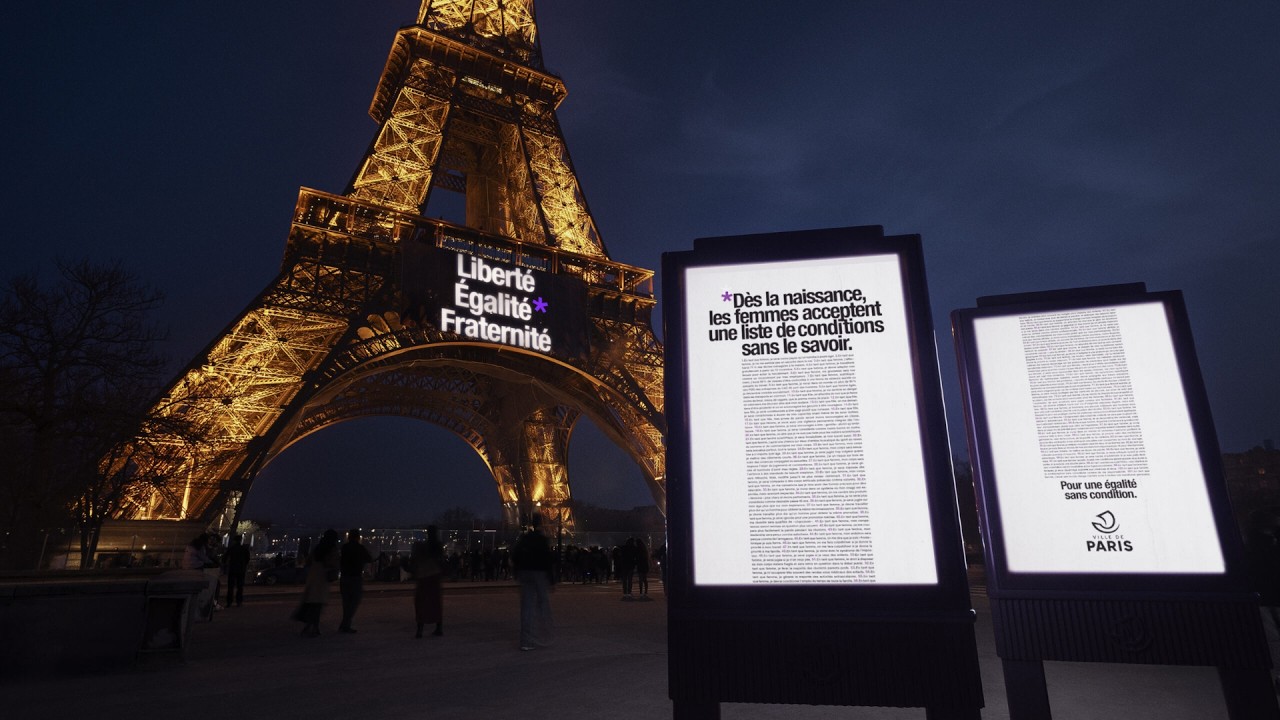
The campaign utilized a high-stakes technical execution to transform the Eiffel Tower into a living document. By darkening the monument and projecting the modified motto, the production team created a stark visual contrast that forced the public to confront the asterisk as a symbol of systemic exclusion. This was not merely a projection but a deliberate act of urban intervention that required precise synchronization with the city of Paris to ensure the message remained legible against the iconic iron lattice.
Rewriting Scientific History
Beyond the visual stunt, the campaign achieved a permanent shift in the Parisian landscape. Mayor Anne Hidalgo spearheaded the initiative to carve the names of 72 female scientists into the base of the Eiffel Tower. This move directly addressed the historical erasure of women in academia, providing a physical, lasting counterpart to the 72 male scientists already honored on the structure. By integrating these names, the project moved from a temporary media moment to a permanent revision of French cultural heritage.
The Anatomy of Inequality
The creative team at BETC Paris curated a list of 101 specific societal conditions that define the female experience in France. These clauses were designed to be uncomfortable, highlighting systemic issues such as the gender pay gap - which effectively forces women to work for free starting November 10th - and the fact that women still shoulder 71% of domestic chores. By framing these statistics as legalistic terms and conditions, the agency successfully shifted the conversation from abstract advocacy to a tangible, documentable list of grievances that demand institutional reform.
Creative Strategy Deconstructed
Company
As the governing body of Paris, the city had the authority to modify public monuments and lead national civic discourse.
Category
Government campaigns often rely on performative, vague slogans about equality that fail to address specific, lived systemic barriers.
Customer
Women felt frustrated by the disconnect between the national promise of equality and their daily experiences of discrimination and danger.
Culture
The campaign leveraged International Women's Day to pivot from empty celebration toward a demand for concrete, measurable systemic change.
Company
As the governing body of Paris, the city had the authority to modify public monuments and lead national civic discourse.
Category
Government campaigns often rely on performative, vague slogans about equality that fail to address specific, lived systemic barriers.
Strategy:
Expose the hypocrisy of institutional values by framing systemic inequality as an unconsented legal contract.
Customer
Women felt frustrated by the disconnect between the national promise of equality and their daily experiences of discrimination and danger.
Culture
The campaign leveraged International Women's Day to pivot from empty celebration toward a demand for concrete, measurable systemic change.
Strategy:
Expose the hypocrisy of institutional values by framing systemic inequality as an unconsented legal contract.
Results
The campaign successfully turned a symbol into a national conversation, receiving coverage from major media outlets such as Le Monde, franceinfo:, Libération, Le Figaro, Le Parisien, and TF1. A significant outcome of the campaign was the announcement that the names of 72 female scientists will be written on the Eiffel Tower, correcting the previous historical omission of women.
72
female scientists' names added to the Eiffel Tower
Strategy Technique
Attack a Cultural Blind Spot
The campaign targeted the complacency surrounding the French motto, forcing the public to acknowledge that systemic gender inequality persists despite official claims of equality.
Explore Technique
Creative Technique
Borrow a Familiar Format
By adopting the universally recognized, yet ignored, format of legal terms and conditions, the campaign turned abstract social issues into a tangible, unavoidable contract that women are forced to sign at birth.
Explore Technique
Craft Breakdown
This campaign's craft is elevated by its powerful copywriting and bold experiential design, which physically hacks a national symbol to provoke a conversation about gender inequality.
The physical projection of the asterisk onto iconic Parisian monuments, including the Eiffel Tower, transformed public spaces into a canvas for social commentary.
The framing of gender inequality as non-consensual 'terms and conditions' accepted at birth is a brilliant and biting conceptual hook.
The strategic rollout from localized projections to a massive takeover of the Eiffel Tower, timed with International Women's Day, maximized visibility and impact.
The clean, minimalist aesthetic of the 'terms and conditions' document and the stark purple asterisk created a highly recognizable visual identity.
“The synergy between the provocative copywriting of the 'terms and conditions' and the bold experiential projections on national monuments is what made the campaign undeniably powerful.”