Armed Forces of Ukraine: The Healing Stage
The Armed Forces of Ukraine and Saatchi & Saatchi Ukraine needed to address the mental health crisis among veterans who avoided clinical therapy due to stigma. The goal was to create a scalable, effective rehabilitation model that would encourage participation, foster social reintegration, and improve the psychological well-being of thousands of wounded soldiers across the country.
Creative Idea
The campaign turned theatre stages into therapy centers to bypass veteran stigma.
The campaign transformed theatres into a nationwide mental health network, using narrative therapy disguised as performance art to bypass the stigma of clinical treatment and help traumatized veterans process their war experiences through storytelling.
The Trojan Horse of Narrative Therapy
Beyond the Clinical Stigma
The campaign was built on the insight that traditional clinical settings often trigger defensive reactions in soldiers. By rebranding therapy as a Theatre of Veterans, the agency successfully bypassed the psychological barriers associated with medical intervention. This approach allowed participants to process trauma through the act of creation rather than the act of being "treated." The initiative was supported by the German Federal Ministry for Economic Cooperation and Development (BMZ) and implemented via GIZ, ensuring the project had the structural backing to evolve into a permanent, nationwide mental health network.
Engineering Performance for the Wounded
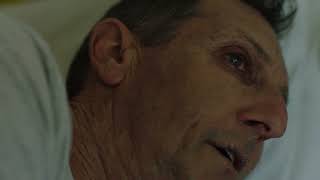
Production required significant technical and logistical adaptations to accommodate severe physical injuries. For blind veteran Andrii Onopriienko, who lost his sight in Avdiivka, the entire script and stage directions were recorded as audio files, allowing him to memorize his performance through sound. For double-amputees, choreographers like Olha Semioshkina redesigned movement patterns to emphasize upper-body expression and wheelchair-based positioning. These adjustments ensured that the artistic integrity of the productions remained high, treating the veterans as professional performers rather than patients.
Bridging the Civilian Divide
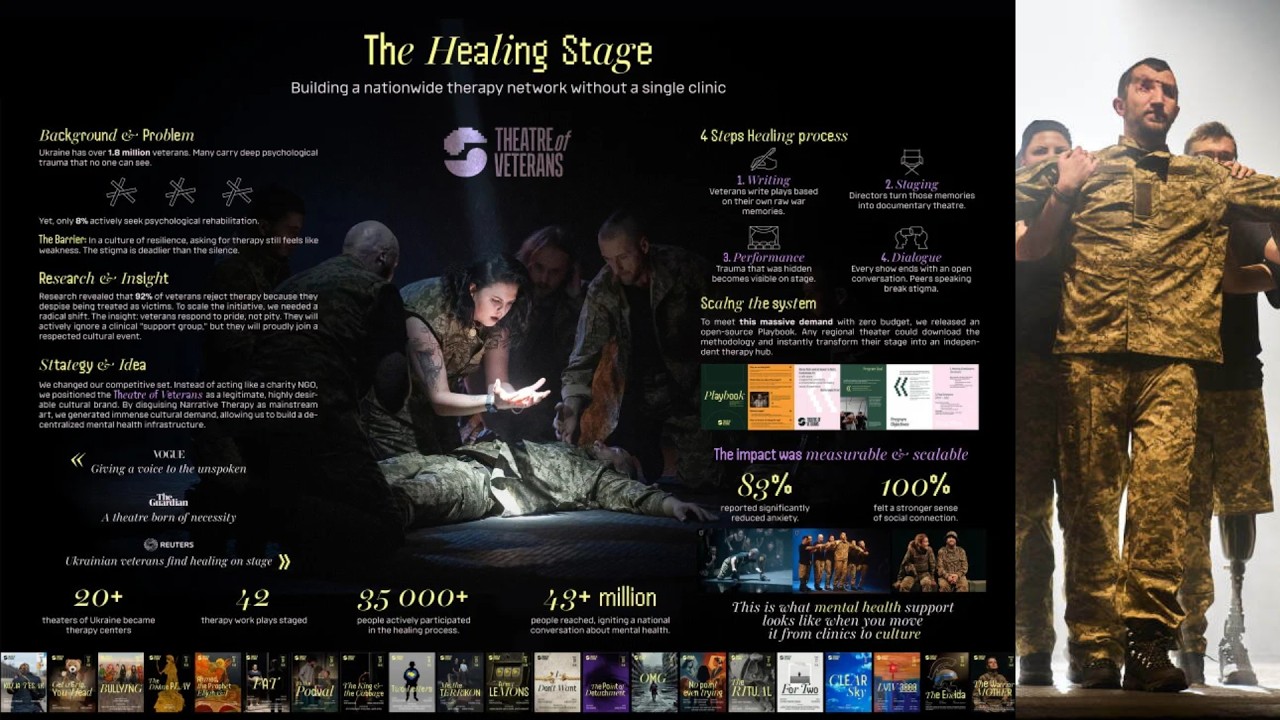
The project culminated in high-profile performances at historic venues like the Maria Zankovetska Theatre. These events were not merely plays; they functioned as a bridge between military and civilian life. Every performance concluded with an open discussion between the veteran-actors and the audience, which proved essential for social reintegration. By moving from the private struggle of PTSD to the public forum of the stage, the campaign transformed individual trauma into a collective experience, fostering deep social cohesion in a country where 93% of the population reported war-related stress.
Creative Strategy Deconstructed
Company
The Armed Forces leveraged their authority to legitimize arts-based therapy as a valid form of veteran rehabilitation.
Category
Mental health initiatives typically rely on clinical, sterile environments that veterans often reject due to perceived weakness.
Customer
Veterans sought community and purpose but resisted traditional therapy, fearing the stigma of being labeled as mentally fragile.
Culture
The widespread need for post-war reintegration made cultural institutions a powerful, neutral ground for healing trauma.
Company
The Armed Forces leveraged their authority to legitimize arts-based therapy as a valid form of veteran rehabilitation.
Category
Mental health initiatives typically rely on clinical, sterile environments that veterans often reject due to perceived weakness.
Strategy:
Shift the context of care from clinical isolation to cultural participation to bypass psychological resistance.
Customer
Veterans sought community and purpose but resisted traditional therapy, fearing the stigma of being labeled as mentally fragile.
Culture
The widespread need for post-war reintegration made cultural institutions a powerful, neutral ground for healing trauma.
Strategy:
Shift the context of care from clinical isolation to cultural participation to bypass psychological resistance.
Results
The campaign achieved significant measurable impact: 71% of participants reported reduced depression, 83% reported reduced anxiety, 67% reported reduced aggression, and 100% felt a stronger sense of social connection. The initiative scaled nationwide through an open-source playbook, leading to the program starting in more than 20 Ukrainian theatres. 42 original works were staged, and 35,000 people became part of the healing process as audience members. The campaign sparked a national conversation about mental health, reaching 43 million people and earning coverage in major global publications including Reuters, Vogue, and The Guardian.
43M
people reached
35,000
people became part of the healing process
100%
of participants felt a stronger sense of social connection
Strategy Technique
Find the Missing Conversation
The campaign identified that veterans were avoiding clinical therapy due to stigma. By moving the conversation from the clinic to the stage, they unlocked a new, accessible space for mental health support.
Explore Technique
Creative Technique
Borrow a Familiar Format
By adopting the format of professional theatre, the campaign bypassed the stigma associated with clinical therapy. This allowed veterans to engage in healing through a culturally respected medium rather than a medical one.
Explore Technique
Craft Breakdown
This campaign's craft is elevated by its brilliant experiential design, transforming traditional cultural institutions into accessible mental health sanctuaries, and its powerful copywriting that reframes vulnerability as an act of bravery.
The campaign masterfully repurposes physical theatres into therapeutic spaces, creating a scalable, nationwide framework for collective healing.
The script beautifully reframes the stigma of therapy, describing it as 'healing trauma from an act of bravery with another act of bravery.'
The visual contrast between dark, isolating personal spaces and the warm, spotlighted community of the stage visually reinforces the journey of recovery.
The creation of a clean, highly functional, open-source 'Playbook' design ensures the campaign's methodology is easily adoptable by other institutions.
“The magic of the campaign lies in how experiential design and narrative therapy copywriting work hand-in-hand to turn a private struggle into a shared, destigmatizing cultural event.”