Chorogusan: The Life-Saving Receipt
Chorogusan tasked Dminusone with increasing vaccination rates among migrant children in South Korea. The client faced a significant challenge where language barriers prevented families from accessing free medical services. The goal was to reach these families directly within their own communities and ensure they received essential health information, ultimately improving vaccination compliance and advocating for equal healthcare rights for migrant-background children.
Creative Idea
Grocery receipts were turned into multilingual health alerts for migrant parents.
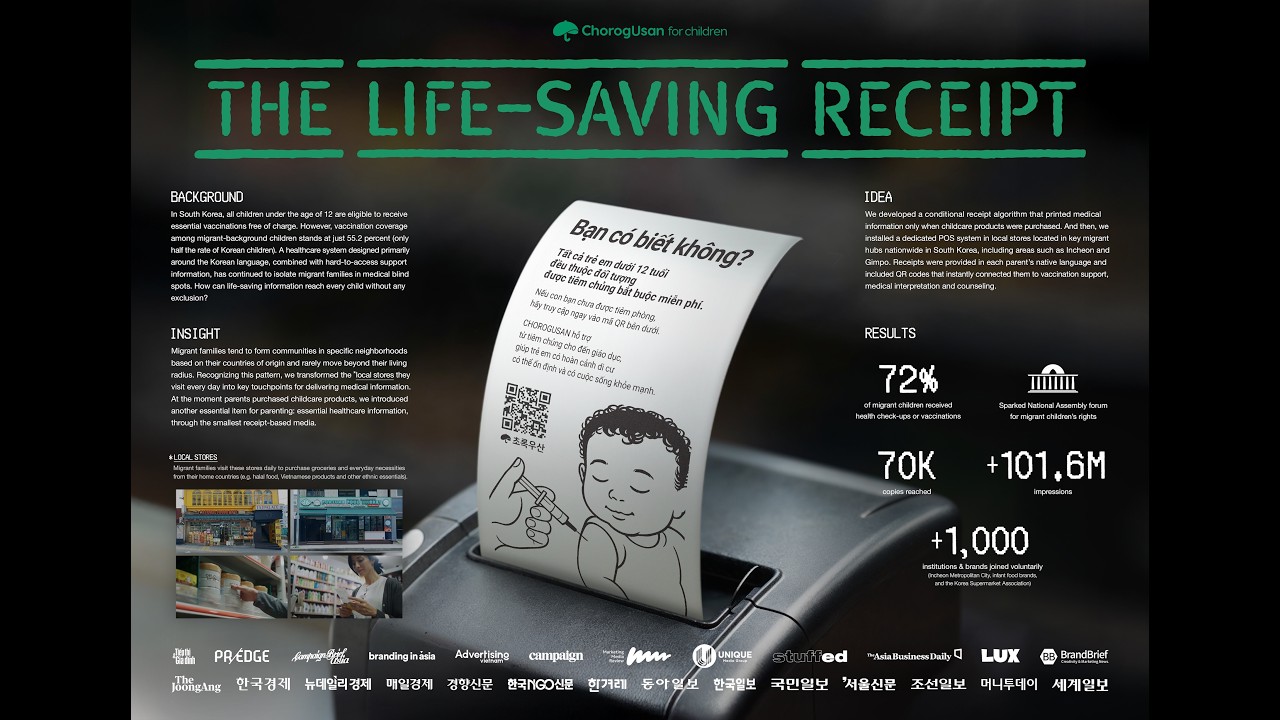
Chorogusan transformed standard grocery store receipts into multilingual health alerts for migrant families. By printing vaccination information in their native languages at the point of purchase, the campaign bypassed systemic language barriers to ensure children received essential medical care.
Turning Grocery Receipts Into Medical Lifelines
Engineering a Zero-Cost Solution
The technical backbone of the campaign relied on a custom conditional receipt algorithm designed to function without new hardware. Dminusone focused on software integration, embedding the code directly into existing POS terminals at local grocery stores. This approach bypassed the need for store owners to purchase expensive equipment, ensuring the system was both scalable and sustainable. By targeting stores that stock imported goods and halal food, the agency effectively reached migrant families within their own trusted living radius, turning a mundane transaction into a critical health intervention.
Quantifiable Health Outcomes
The campaign achieved a significant shift in public health engagement. Before the intervention, the vaccination rate for migrant-background children was just 55.2%, compared to 96.4% for native Korean children. Following the implementation of the receipt-based alerts, the vaccination completion rate among targeted families climbed to 72%. Beyond these individual health gains, the initiative reached 70,000 migrant families and generated over 101.6 million impressions globally, proving that hyper-local media channels can solve systemic barriers.
From Local Hubs to National Policy
The project’s success transcended its initial scope, eventually triggering an official policy forum at Korea’s National Assembly. By demonstrating that the primary barrier to healthcare was linguistic rather than financial, the campaign forced a broader conversation about equitable access. The initiative garnered support from over 1,000 partner institutions and welfare organizations. As noted by the ADFEST 2026 Jury President, the campaign was a masterclass in "Media Precision with a Heart," proving that hijacking an existing, trusted touchpoint is often more effective than attempting to force new behaviors or digital adoption on vulnerable populations.
Creative Strategy Deconstructed
Company
Chorogusan leveraged its deep-rooted history in children's welfare to implement a software-based solution for local grocery store POS systems.
Category
Welfare organizations typically rely on traditional outreach, pamphlets, or digital campaigns that often fail to reach marginalized, non-native speaking populations.
Customer
Migrant parents wanted to protect their children but felt excluded by a healthcare system that only communicated in Korean.
Culture
The growing visibility of migrant communities in South Korea necessitated a more inclusive approach to public health and social equity.
Company
Chorogusan leveraged its deep-rooted history in children's welfare to implement a software-based solution for local grocery store POS systems.
Category
Welfare organizations typically rely on traditional outreach, pamphlets, or digital campaigns that often fail to reach marginalized, non-native speaking populations.
Strategy:
Bridge systemic gaps by embedding critical information into existing, trusted daily consumer touchpoints.
Customer
Migrant parents wanted to protect their children but felt excluded by a healthcare system that only communicated in Korean.
Culture
The growing visibility of migrant communities in South Korea necessitated a more inclusive approach to public health and social equity.
Strategy:
Bridge systemic gaps by embedding critical information into existing, trusted daily consumer touchpoints.
Results
The campaign printed 70K copies of the life-saving receipts. 72% of migrant children who had not previously received health check-ups or vaccinations were able to access them. Over 1,000 institutions and brands joined the initiative voluntarily, expanding the medical information access infrastructure. The campaign generated over 101.6M impressions, received international media coverage in the children's countries of origin, and sparked a National Assembly forum addressing equal rights for migrant children.
72%
of previously unvaccinated migrant children accessed care
70K
life-saving receipts printed
+101.6M
impressions generated
Strategy Technique
Make the Invisible Visible
The campaign identified the hidden, systemic exclusion of migrant children from healthcare due to language barriers. By shining a light on this overlooked population, it forced a necessary conversation about equal access to medical rights.
Explore Technique
Creative Technique
Unexpected Utility
The campaign repurposed a mundane, everyday object—the grocery receipt—into a functional tool for public health. It provided critical information at the exact moment and location where migrant parents were already shopping for their children.
Explore Technique
Craft Breakdown
This campaign's craft is elevated by its brilliant integration of technology and media planning, turning a mundane transactional medium into a life-saving communication channel.
The campaign brilliantly identifies local international grocery stores as the precise, trusted touchpoints to reach an otherwise isolated demographic.
Developing a conditional receipt-printing algorithm based on baby-product purchases is a highly targeted, low-cost, and frictionless tech execution.
The copy on the receipts and the video's narrative text are clear, direct, and culturally translated to build trust and drive action.
The receipt layout and friendly child illustrations make potentially intimidating medical information feel accessible and welcoming.
“The magic of this campaign lies in how media planning and technology work together, transforming a standard point-of-sale receipt printer into a highly targeted, multilingual media channel.”