2024Nagasaki CityNot-for-Profit & GovernmentCase video
Nagasaki City: Play the Preservation
Nagasaki City faced a severe funding crisis for the maintenance of the Gunkanjima World Heritage site. They needed a sustainable, long-term financial model to replace traditional, unreliable donation-based funding. Dentsu was tasked with engaging younger, global audiences and creating a scalable system that would ensure the site's preservation for future generations without relying solely on public grants.
Creative Idea
Transformed 3D heritage data into a playable Fortnite map that funds real-world site conservation.
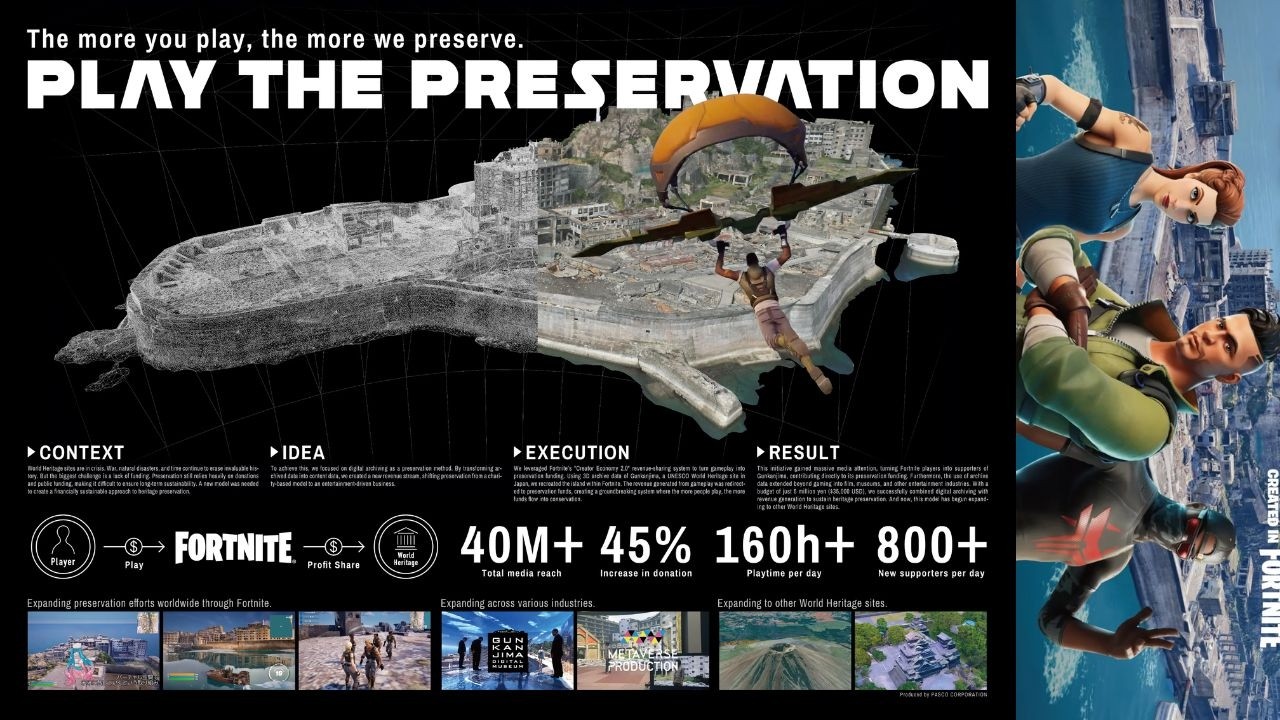
To solve the funding crisis for the Gunkanjima World Heritage site, the campaign transformed static 3D archival data into an interactive Fortnite experience, turning player engagement into a sustainable revenue stream that directly funds real-world preservation efforts.
Turning Digital Data Into Physical Preservation
Scanning the Forbidden Zone
Over 90% of Gunkanjima is strictly off-limits to the public due to the extreme risk of structural collapse caused by salt exposure and typhoons. To capture the island, the team deployed specialized drones and photogrammetry to map every detail, including interior staircases and roof gardens. This high-polygon raw data was then optimized for the Unreal Editor for Fortnite (UEFN) to ensure the digital twin remained historically accurate while functioning within a real-time gaming environment.
A New Economic Model
The project launched in 2024 to mark the 50th anniversary of the coal mine closure. By leveraging Epic Games' Creator Economy 2.0, the team established a system where 100% of engagement payouts are funneled directly into the Hashima (Gunkanjima) Preservation & Maintenance Fund. This initiative achieved 45% of its annual donation target in just 10 days. With a lean budget of 5 million yen, the campaign generated over 40 million in media reach and maintains an average of 160 hours of gameplay per day.
Beyond the Screen
The project serves as a scalable blueprint for global heritage sites. Beyond the Fortnite map - which features 13 educational checkpoints and multiplayer hide-and-seek - the 3D data pipeline has been utilized for commercial films, digital museum exhibits, and VR/XR experiences. As noted by the Dentsu HERITAGE DATABANK team, the goal is to shift the perception of preservation from a rigid, charity-dependent cost into a self-sustaining business model. By transforming archival data into interactive content, the project successfully engaged younger audiences, resulting in over 800 new supporters daily and a 47% increase in public interest regarding the site.
4C Framework deconstruction
Company
Nagasaki City possessed high-resolution 3D archival data of the restricted Gunkanjima island, providing a unique digital asset for interactive development.
Category
Heritage preservation typically relies on passive, unsustainable donation models and public funding, often failing to engage younger, digital-native generations.
Customer
Millennials and Gen Z seek experiential, socially responsible engagement rather than traditional charitable giving, preferring to contribute through active participation.
Culture
The rise of the creator economy and the popularity of immersive gaming platforms like Fortnite provided a scalable, global infrastructure for monetization.
Company
Nagasaki City possessed high-resolution 3D archival data of the restricted Gunkanjima island, providing a unique digital asset for interactive development.
Category
Heritage preservation typically relies on passive, unsustainable donation models and public funding, often failing to engage younger, digital-native generations.
Strategy:
Convert passive cultural preservation into an active, self-sustaining digital entertainment business model.
Customer
Millennials and Gen Z seek experiential, socially responsible engagement rather than traditional charitable giving, preferring to contribute through active participation.
Culture
The rise of the creator economy and the popularity of immersive gaming platforms like Fortnite provided a scalable, global infrastructure for monetization.
Strategy:
Convert passive cultural preservation into an active, self-sustaining digital entertainment business model.
Results
The campaign generated massive reach and quantifiable funding for heritage site conservation: 40M+ total media reach, 160h+ playtime per day, a 45% increase in donations, and 800+ new supporters per day. The model successfully turned passive digital archiving into active revenue generation through Fortnite's Creator Economy 2.0.
40M+
total media reach
45%
increase in donation
800+
new supporters per day
Strategy Technique
Build an Utility, Not an Ad
Instead of running a traditional donation campaign, the agency built a functional revenue-generating platform. This transformed the preservation model from a charity-dependent expense into a self-sustaining business ecosystem.
Explore Technique
Creative Technique
Gamification
The campaign turns the act of playing a video game into a direct contribution to heritage conservation. By integrating the site into Fortnite, it makes preservation an active, engaging, and measurable process for a younger audience.
Explore Technique
Craft Breakdown
This campaign excels through groundbreaking 3D digital photogrammetry scanning and interactive gaming integration, converting static archival data into an active financial engine for physical world preservation.
High-resolution, architecturally exact 3D scanning and digital modeling of Gunkanjima allowed a complex historical island to be flawlessly recreated inside Unreal Engine for Fortnite.
Leveraging Epic Games' Creator Economy 2.0 revenue-sharing system created an unprecedented financial model connecting digital playtime to physical conservation funds.
“The genius lies in combining high-end 3D architectural archiving with web3/creator-economy gaming mechanics to transform passive historical documentation into an active revenue engine.”