2025Wildlife Conservation SocietyNot-for-Profit & GovernmentCase video
Wildlife Conservation Society: The Petition Papers
The Wildlife Conservation Society tasked McKinney with driving public signatures to secure National Marine Sanctuary status for the Hudson Canyon. The goal was to reach New York seafood consumers who were largely unaware of the canyon's ecological vulnerability. The client needed a high-impact, low-cost strategy to convert everyday fish purchases into direct, measurable advocacy for federal protection.
Creative Idea
Transformed fish market butcher paper into a functional, art-inspired petition for ocean conservation.
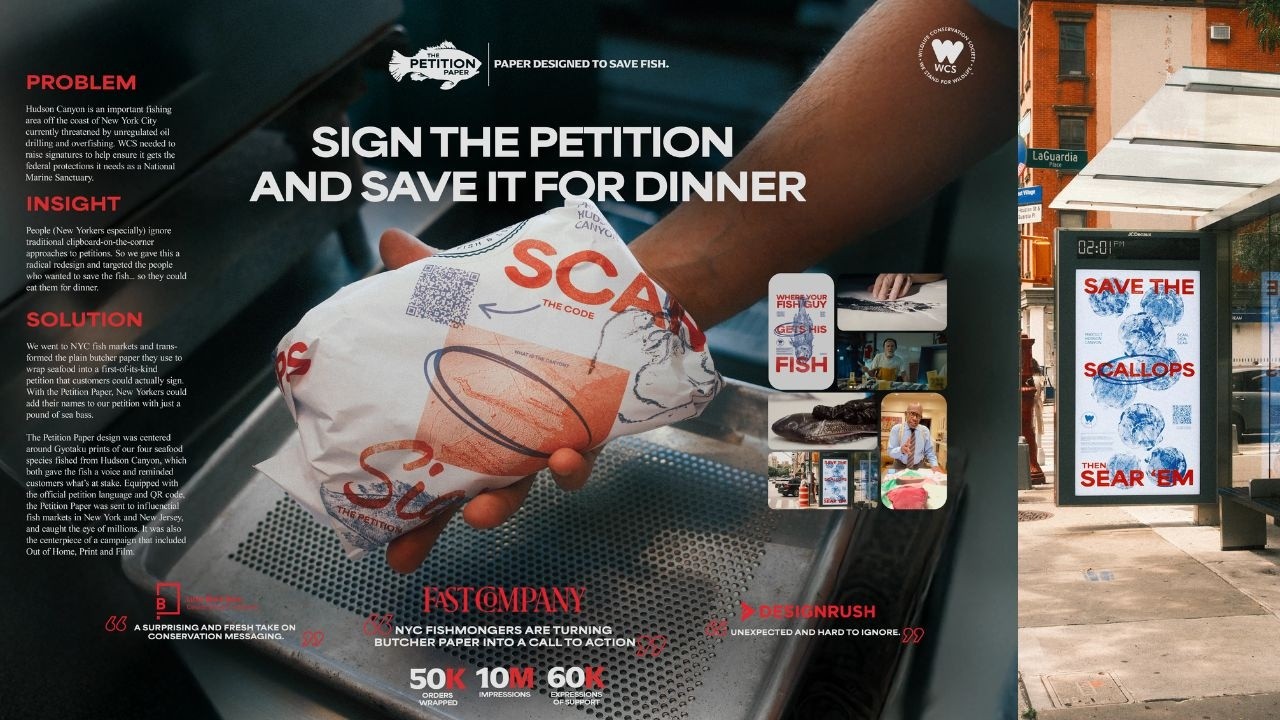
WCS transformed everyday fish market butcher paper into an active petition using traditional Gyotaku art. By placing the call to action directly on the packaging of the fish being protected, they turned the act of consumption into an advocacy moment.
Turning Fish Wrappers Into Political Advocacy
Inspired by Ancient Japanese Art
To ensure the campaign resonated with the aesthetic of authentic fish markets, the creative team utilized Gyotaku, a traditional Japanese artform that involves printing real fish with ink to record a catch. Designers collaborated with CYLNDR Studios to create vector renderings based on actual fish caught in local waters. These illustrations were paired with typography and graphic elements modeled after the nostalgic, gritty aesthetic of Old New York fish markets, bridging the gap between historical craft and modern environmental activism.
Meeting Consumers at the Counter
The strategy focused on a specific, high-intent audience: seafood buyers in New York and New Jersey. By integrating the petition into the physical packaging used by fishmongers, the agency bypassed traditional digital clutter. Omid Amidi, Co-Chief Creative Officer at McKinney, noted that the goal was to place the information into people's hands at the exact moment they were consuming the very resource under threat. This ambient approach transformed a standard retail transaction into a tangible advocacy moment, effectively leveraging the fish counter as a high-relevance media channel.
A Gritty Call to Action
Beyond the print materials, the campaign featured a digital film centered on a monologue from a local fisherman. The narrative emphasized the personal stakes of the Hudson Canyon protection effort, featuring the stark warning: "You don't wanna bite the body of water that feeds you." This raw, human-centric storytelling complemented the analog nature of the petition paper, reinforcing the connection between local coastal communities and the federal legislative push to secure National Marine Sanctuary status for the canyon.
4C Framework deconstruction
Company
WCS leveraged its scientific authority and conservation mission to advocate for the protection of the Hudson Canyon ecosystem.
Category
Conservation groups typically rely on traditional digital ads or generic physical signage to solicit signatures for environmental petitions.
Customer
Seafood consumers were unaware of the threats to the Hudson Canyon and needed a frictionless way to support ocean health.
Culture
The rise of sustainable consumption and interest in local food sourcing made shoppers receptive to messages about ocean health.
Company
WCS leveraged its scientific authority and conservation mission to advocate for the protection of the Hudson Canyon ecosystem.
Category
Conservation groups typically rely on traditional digital ads or generic physical signage to solicit signatures for environmental petitions.
Strategy:
Integrate advocacy into the physical consumption experience to turn passive shoppers into active environmental participants.
Customer
Seafood consumers were unaware of the threats to the Hudson Canyon and needed a frictionless way to support ocean health.
Culture
The rise of sustainable consumption and interest in local food sourcing made shoppers receptive to messages about ocean health.
Strategy:
Integrate advocacy into the physical consumption experience to turn passive shoppers into active environmental participants.
Results
The Petition Paper campaign yielded impressive public engagement and media reach: - Achieved 60,000 expressions of support / signatures (more than double the initial goal of 25,000) - Over 10 million total impressions across media platforms - Over 50,000 fish market orders wrapped in the Petition Paper - Featured across major news outlets, social media influencers, and press including Fast Company, Little Black Book, and Shots.
60,000
expressions of support
10M
total impressions
50,000
seafood orders wrapped
Strategy Technique
Build an Utility, Not an Ad
By embedding the petition into the necessary packaging of fish markets, the campaign became a functional utility for the consumer. It solved the problem of reaching people by integrating advocacy into their existing purchasing habits.
Explore Technique
Creative Technique
Turn Message into Product
The campaign literally turned the butcher paper used to wrap fish into the petition itself. This transformed a standard functional object into a powerful advocacy tool at the point of consumption.
Explore Technique
Craft Breakdown
The campaign excels through magnificent physical print craft—reviving the ancient Japanese technique of Gyotaku—and exquisite graphic design that seamlessly turns butcher paper into an interactive, high-impact media channel.
The layout of the butcher paper beautifully balances classic Gyotaku prints with modern typography, QR code placement, and clear calls-to-action.
The entire campaign maintains a coherent visual language from hand-inked fish scales to urban poster takeovers and high-contrast red and blue palettes.
Transforming ordinary seafood packaging into a direct petition channel creates an unexpected, tactile touchpoint at the exact moment of consumer engagement.
Clever, concise wordplay like 'SCAN. SIGN. SEAR.' effectively links culinary enjoyment directly to ocean conservation.
“The synergy between traditional Japanese print craft and clever functional graphic design turns routine food packaging into an urgent, scalable activist tool.”