PESTLE
Analysis: Reading the Forces Nobody in Your Company Controls
PESTLE is the strategy slide everybody has made and almost nobody has used. Six boxes - Political, Economic, Social, Technological, Legal, Environmental - each filled with bullet points like "inflation", "digitalisation" and "growing sustainability awareness". It looks thorough. It changes nothing, because a list of things that are true about the world is not the same as knowing which of them will change your next three years.
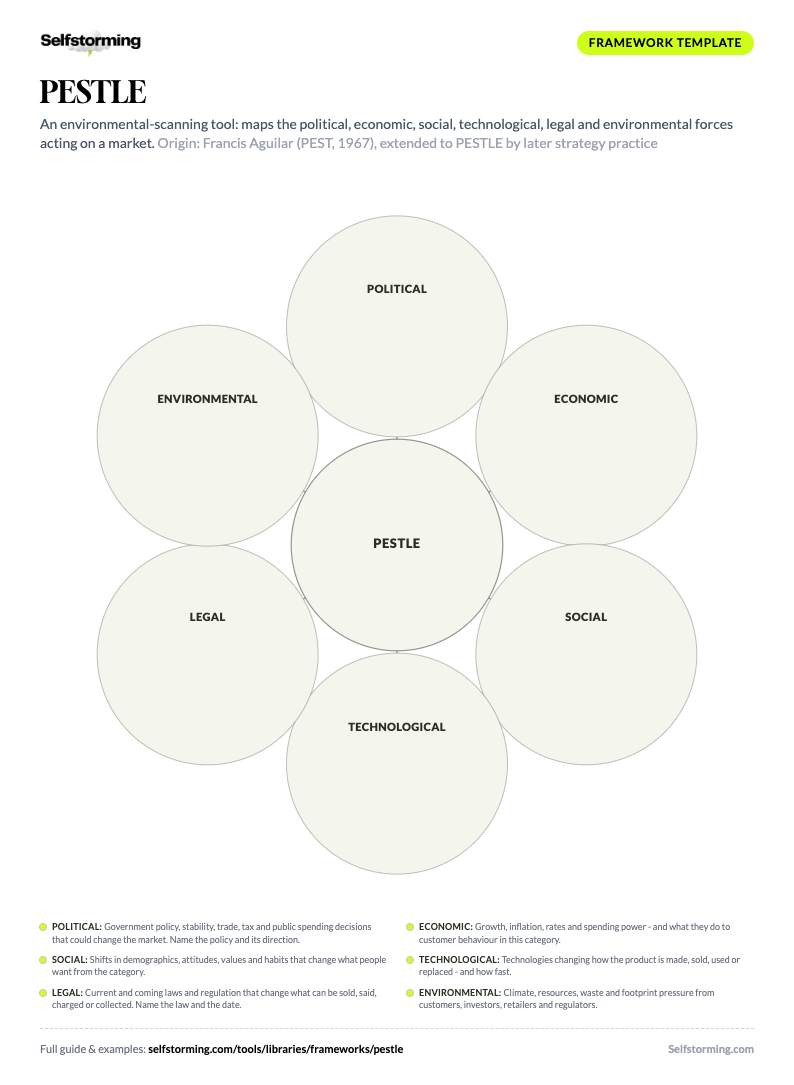
Print it. Fill it in.
The PESTLE as a printable A4 worksheet - write straight into the framework, on paper or in any PDF app.
Download the PDF templateKnowledge Worth Paying For
A working library of brand strategy frameworks - with worked examples on real brands, sources, and decision criteria. Not vibes.
One good deck covers the subscription. The rest is profit.
Six external factors that shape a market: Political (policy, stability, trade, tax), Economic (growth, inflation, rates, spending power), Social (demographics, attitudes, habits), Technological (new tech, platforms, speed of change), Legal (current and coming regulation) and Environmental (climate, resources, waste, footprint pressure). The rule that separates a useful PESTLE from wallpaper: for every force, write what it means for your business and how big the impact is, then pick the few forces that should change the plan. A grid with no priorities is research, not strategy.
Back Market
Refurbished electronics marketplace (France, founded 2014)A business where all six factors push in the same direction. Policy and law in France and the EU are making repair and reuse normal, new phones keep getting pricier, technology has plateaued enough that an older phone is fine, and the environmental case is easy to explain. The interesting part is how directly the brand turned the Social factor - unease with "fast tech" - into its advertising.

Oatly
Oat drink brand (Sweden, scaled internationally in the 2010s) - illustrative analysisAn illustrative PESTLE built from public facts about the category. It shows a business where the Legal factor is unusually concrete - an EU court ruling on what plant-based products may be called - and where the Social and Environmental factors are the growth engine. The Economic factor is the honest threat: a premium product in a cost-of-living squeeze.
Too Good To Go
Surplus-food marketplace app (Denmark, founded 2016) - illustrative analysisAn illustrative PESTLE for a platform business that exists because of external forces. Food waste moved from a back-office cost to a public and political topic, smartphones made last-minute selling easy, and a French law made throwing away edible food a legal problem for supermarkets. It shows how Political and Legal factors can create a market, not just constrain one.
Back Market, Oatly, Too Good To Go - filled in, line by line. Unlock to read them.
Back Market (Refurbished electronics marketplace (France, founded 2014))
A business where all six factors push in the same direction. Policy and law in France and the EU are making repair and reuse normal, new phones keep getting pricier, technology has plateaued enough that an older phone is fine, and the environmental case is easy to explain. The interesting part is how directly the brand turned the Social factor - unease with "fast tech" - into its advertising.
Political: EU and French policy pushing for longer-lasting, repairable electronics.
Economic: New flagship phones keep getting pricier while household budgets stay tight.
Social: Growing unease with "fast tech" and upgrading every year for a better camera.
Technological: Phones are good enough for years; each new model adds less a buyer would miss.
Legal: France's repairability index (2021) and the EU right-to-repair directive (2024).
Environmental: E-waste, and most of a phone's footprint coming from making it.
Oatly (Oat drink brand (Sweden, scaled internationally in the 2010s) - illustrative analysis)
An illustrative PESTLE built from public facts about the category. It shows a business where the Legal factor is unusually concrete - an EU court ruling on what plant-based products may be called - and where the Social and Environmental factors are the growth engine. The Economic factor is the honest threat: a premium product in a cost-of-living squeeze.
Political: EU farm policy and dairy support that keep cow's milk cheap on the shelf.
Economic: Oat drink costs more than dairy - a premium harder to defend as grocery bills rise.
Social: More flexitarians cutting dairy for health, animal welfare or climate reasons.
Technological: Enzyme process that turns oats into a drink that foams for baristas.
Legal: EU court ruling (2017): plant-based products cannot be sold as "milk".
Environmental: Rising pressure on dairy's emissions and interest in climate labelling.
Too Good To Go (Surplus-food marketplace app (Denmark, founded 2016) - illustrative analysis)
An illustrative PESTLE for a platform business that exists because of external forces. Food waste moved from a back-office cost to a public and political topic, smartphones made last-minute selling easy, and a French law made throwing away edible food a legal problem for supermarkets. It shows how Political and Legal factors can create a market, not just constrain one.
Political: Governments setting food-waste reduction targets for retail and hospitality.
Economic: Cost-of-living squeeze makes cheap surplus meals more attractive.
Social: Wasting food has become something people feel guilty about.
Technological: Location-based apps make last-minute surplus easy to list and sell.
Legal: France's 2016 law bans supermarkets from destroying unsold edible food.
Environmental: Food waste's share of emissions puts it on climate agendas.
1. Political
Which government decisions, policies or political shifts could change demand, costs or the rules of competition in our market?
Political forces cover what governments decide and how stable they are: policy direction, trade deals and tariffs, taxation, subsidies and public spending, elections and political stability. Political factors often arrive before the Legal ones - a policy debate today becomes a regulation in two years - so this is where you spot change early.
Good answer: EU and French governments are pushing for longer-lasting, repairable electronics. (Back Market.) A clear direction of policy that makes the refurbished-phone business more mainstream every year, long before any single law is passed.
Wrong answer: "Political uncertainty." True of every market on Earth and useless for planning. Name the policy, the institution and the direction, or leave the box empty.
2. Economic
How will growth, inflation, interest rates, exchange rates and spending power change what our customers buy and what it costs us to serve them?
Economic forces shape both sides of the business: how much customers can and will spend, and what it costs you to make and sell. Look at income and price trends in your specific category, not just headline GDP. The useful question is always behavioural - do customers trade down, delay, switch channel or pay more for certainty?
Good answer: New flagship phones keep getting more expensive while household budgets stay tight. (Back Market.) The price gap between new and refurbished becomes the reason to switch, not just a discount.
Wrong answer: "Inflation is high." A headline, not an implication. Write what inflation does to your customers in your category - which products they cut, which they protect - or the box is decoration.
3. Social
Which shifts in demographics, attitudes, values and everyday habits are changing what people want from our category?
Social forces are changes in people: age structure, household types, health attitudes, values, media habits, what is considered normal or embarrassing. They move slowly and then suddenly. For marketers this is often the richest factor, because a social shift that meets an unmet need is where many brand insights come from.
Good answer: Growing unease with "fast tech" - replacing a phone every year for a slightly better camera. (Back Market.) A cultural tension a brand can take a side on, which is exactly what its advertising does.
Wrong answer: "Consumers are becoming more sustainability-conscious." Said in every PESTLE since 2010 and rarely checked against what people actually buy. Back it with behaviour data, or describe the tension honestly - many people say one thing and buy another.
4. Technological
Which technologies are changing how our product is made, sold, used or replaced - and how fast?
Technological forces include new products and platforms, automation, changes in cost curves, and shifts in how customers discover and buy. The key questions are speed and direction: does this technology make your product better, cheaper, easier to copy, or unnecessary? Include the technology your customers use, not only the technology you use.
Good answer: Phones are now good enough for years, and each new model adds less that a buyer would miss. (Back Market.) A technology plateau turns a two-year-old phone from "outdated" into "perfectly fine".
Wrong answer: "AI and digitalisation." A label, not a force. Name the specific technology and the specific way it changes your market - who it helps, who it hurts, by when.
5. Legal
Which laws and regulations - current or coming - change what we may sell, say, charge or collect?
Legal forces are the rules that already apply or are on the way: consumer protection, advertising and labelling rules, data protection, employment law, competition law, product standards. Separate them from Political by asking whether something is already law or still a policy debate. Legal factors are the easiest to verify and the most expensive to ignore.
Good answer: France's repairability index (2021) and the EU right-to-repair directive (2024). (Back Market.) Specific, dated, verifiable rules that make repair and reuse part of the market's legal framework.
Wrong answer: "Regulatory changes." Which law, in which country, from which date? A Legal box without citations is a guess, and a guess about regulation is how companies end up rebranding in a hurry.
6. Environmental
How do climate, resources, waste and environmental pressure from customers, investors and regulators affect our product and operations?
Environmental forces cover physical change (climate, weather, resource scarcity) and the pressure to reduce your footprint from customers, investors, retailers and regulators. For many categories this has moved from a reputation topic to a cost and access topic: packaging rules, carbon reporting, sourcing requirements. Be specific about where the pressure comes from.
Good answer: E-waste, and the fact that most of a phone's footprint comes from making it. (Back Market.) An environmental fact that turns "keep using an existing device" into the lower-impact choice.
Wrong answer: "Climate change." Real and enormous, and on its own it says nothing about your business. Write the mechanism: a packaging law, a retailer requirement, a supply risk, a shift in what customers will pay for.
Decide your starting point: You do not need a week of desk research before the first draft. On Selfstorming you can run a Research Session to pull category news, regulation and competitor moves with sources, then use the steps below to turn that material into a prioritised PESTLE. Treat any first draft, from a report or from AI, as a list of hypotheses to check.
Set the scope: Write down which market, which countries and which time horizon you are scanning - for example "plant-based dairy, Germany and the UK, next three years". A PESTLE without a scope collects everything and decides nothing.
Scan each factor with sources: For every factor, list the forces you can back with evidence - legislation, official statistics, industry data, customer research. Write the source next to each force. If a force has no source, mark it as a hypothesis and check it before it reaches a decision.
Translate every force into an implication: Next to each force, write one sentence on what it means for your business: "so what?". "Rising rates" becomes "our customers delay big-ticket purchases, so our sales cycle gets longer". Forces with no implication come out of the grid.
Rate likelihood and impact: Score each implication for how likely it is and how much it would change revenue, costs or positioning. Plot them on a simple 2x2. The high-likelihood, high-impact corner is your shortlist.
Mark opportunity or threat: Forces usually cut both ways - a new regulation is a cost for you and a barrier for weaker competitors. Write down both sides, then decide which one you will act on.
Choose the three to five forces that change the plan: Turn the shortlist into actions with an owner and a date: a product change, a price move, a message, a market you enter or leave. Feed the same forces into the Opportunities and Threats of your SWOT.
Put a review date on it: Set a date to revisit the PESTLE, at least yearly and sooner in fast-moving categories. Keep a short "watch list" of forces that are not urgent yet but could move quickly - the next election, a draft regulation, an emerging technology.
Best for: Scanning the external environment before a strategy, a market entry, a big launch or annual planning - when you need to know which outside forces will move your market. / Assessing your own capabilities, your competitors' moves or your brand. PESTLE only looks at forces no single company controls.
Output: A six-factor scan with sourced forces, a "so what?" for each, likelihood and impact scores, and a short list of forces that change the plan. / A strategy, a positioning or a competitor map. PESTLE gives you the context those decisions need, not the decisions.
Time to complete: A first draft in a few hours with good research; a solid version in a few days, including sources and a prioritisation workshop. / Ten minutes of filling boxes from memory. That version is quick and almost always generic.
vs SWOT: Use PESTLE to find and evidence the external forces acting on your market. It is the research step. / SWOT combines internal strengths and weaknesses with external opportunities and threats. Run PESTLE first and feed its top forces into the O and T boxes.
vs Porter's Five Forces: Use PESTLE for the macro environment - policy, economy, society, technology, law, environment. / Porter's Five Forces looks at the industry level - rivals, buyers, suppliers, substitutes, new entrants - and how profitable the market is. Use both for a full external picture.
vs TAM SAM SOM: Use PESTLE to understand which forces are growing or shrinking a market. / TAM SAM SOM puts numbers on the market's size and your obtainable share. PESTLE explains why those numbers will change.
PESTLE grew out of PEST, which Harvard Business School professor Francis Aguilar introduced in his 1967 book Scanning the Business Environment as a way for managers to watch the outside forces that shape strategy. Aguilar's original order was ETPS - Economic, Technical, Political, Social - and later writers rearranged the letters into PEST and STEP. As regulation and sustainability moved up the boardroom agenda, practitioners added Legal and Environmental, giving PESTLE and PESTEL, and longer variants such as STEEPLE (adding Ethical). There is no single author of the six-factor version; it is the shared toolkit of strategy teams, MBA courses and consultancies.
The common critique of PESTLE is not that it is wrong but that it is easy to do badly. Because the six categories are broad, teams fill them with statements that are true for every company - "economic uncertainty", "digitalisation", "growing environmental awareness" - and the result informs no decision. Academics have also pointed out that PESTLE is descriptive: it lists forces but has no built-in method for prioritising them or connecting them to the company's position, which is why it needs a SWOT, a scenario exercise or a likelihood-impact matrix on top. Finally, it is a snapshot in a fast-moving world. Used as a living, sourced and prioritised scan, it is one of the most practical strategy tools there is. Used as a deck appendix, it is six boxes of weather.
What is PESTLE analysis?
PESTLE analysis is a framework for scanning the outside forces that can help or hurt a business: Political, Economic, Social, Technological, Legal and Environmental. It looks at the macro environment - the things no single company controls, from interest rates to new regulation - so a strategy is built on the world as it is changing, not as it was when the last plan was written. It grew out of Francis Aguilar's 1967 PEST model, with Legal and Environmental added later.
What are the six factors in PESTLE?
Political: government policy, stability, trade and tax decisions, public funding. Economic: growth, inflation, interest rates, exchange rates, consumer spending power. Social: demographics, attitudes, lifestyles, values and habits. Technological: new technology, automation, platforms and the speed of change in your category. Legal: laws and regulation that already apply or are coming - consumer, employment, data, advertising, product rules. Environmental: climate, resources, waste and the pressure from customers and regulators to reduce your footprint.
What is the difference between PEST, PESTLE and PESTEL?
PEST is the original four-factor version (Political, Economic, Social, Technological). PESTLE and PESTEL are the same six factors - PEST plus Legal and Environmental - written in a different order. There are longer variants too, such as STEEPLE, which adds Ethical. Use PEST for a quick scan, PESTLE when regulation and sustainability matter to your category, which today is most categories.
How do you do a PESTLE analysis?
Define the scope first: which market, which country, which time horizon. Then list the forces under each of the six factors, using sources rather than opinions - official statistics, legislation, industry reports, customer research. For each force, write what it means for your business specifically, mark whether it is an opportunity or a threat, and rate how likely and how big its impact is. Finish by picking the three to five forces that should actually change your plan. A PESTLE that ends as a full grid with no priorities has not done its job.
What is the difference between PESTLE and SWOT?
PESTLE looks only outside the company, at forces nobody in the business controls. SWOT looks both inside (strengths, weaknesses) and outside (opportunities, threats). The two work best together: run PESTLE first to find the external forces that matter, then use them as the evidence for the Opportunities and Threats boxes of a SWOT. A SWOT built without a PESTLE tends to have thin, generic external boxes.
What is a PESTLE analysis example?
Back Market, the refurbished electronics marketplace, is a clean example. Political and legal forces (France's repairability index and the EU right-to-repair directive), economic pressure (new flagship phones getting more expensive), social unease with upgrading every year, and the environmental cost of manufacturing new devices all push in the same direction - towards buying refurbished. This page has three worked examples, including Oatly and Too Good To Go.
How often should you update a PESTLE analysis?
Treat PESTLE as a living document, not a one-off slide. Review it at least once a year as part of planning, and again whenever something big moves - an election, a new regulation, a price shock, a technology shift in your category. Fast-moving categories such as fintech, food or anything touched by AI may need a quarterly check on the Legal and Technological factors.
Is PESTLE analysis useful for marketing?
Yes, if you use it to make decisions rather than to fill a deck. For marketers, PESTLE explains why demand is shifting (Social, Economic), what you will not be allowed to say or do (Legal), and which cultural tensions a brand could credibly take a side on (Social, Environmental). It is also a good brief-writing tool: a strong insight often sits where a big external force meets a specific customer habit.
An environmental-scanning tool: maps the political, economic, social, technological, legal and environmental forces acting on a market.
All 50 frameworks, ready to use.
The PDF book with worked examples and printable templates, the editable PowerPoint and an MD file for your AI. €39.90, or free with a yearly plan.
See the ebook packUsed properly, PESTLE is a scanning tool for the forces outside your company that nobody inside it controls: government decisions, the economy, shifting attitudes, new technology, regulation and the environment. The job is not to fill six boxes. The job is to find the two or three forces that will move your market whether you like it or not, and decide what you will do about them before your competitors do. This page walks through the six factors, how to turn a scan into priorities, how PESTLE feeds a SWOT, and worked examples from Back Market, Oatly and Too Good To Go.
Related Frameworks
Playing to Win
Five linked choices, top to bottom: Winning Aspiration (what winning looks like, for whom), Where to Play (the specific market, segment, geo
OKRs
One Objective (qualitative, ambitious, memorable - the hill worth taking) plus three Key Results (numeric, measurable, with zero grey area -
SWOT Analysis
Four boxes, two axes: Strengths and Weaknesses are internal and controllable, Opportunities and Threats are external and mostly not. Left si
Eisenhower Matrix
Score every task on two axes: important (does it matter to your goals?) and urgent (does it need attention now?). That gives four boxes. Do