Salesforce and MrBeast turned a 30-second Super Bowl spot into a 276,000-player scavenger hunt that ran live on Salesforce's own infrastructure. The ad did not describe the product. It was the product, under load, in public.
In December, MrBeast posted a tweet asking if any brand wanted to sponsor a Super Bowl idea he had. Marc Benioff, the CEO of Salesforce, replied yes. Twenty-seven days later they aired it. That is roughly the time it takes most enterprise software companies to schedule the kickoff meeting about the briefing document for the campaign nobody will remember.
What they built is called The Million Dollar Puzzle, and it is one of those rare ideas that gets better the longer you stare at it. It just picked up a D&AD Wood Pencil. It deserves more than that, but D&AD has always been stingy with the metal.
The boring problem nobody could solve
Enterprise software has an emotional range of about zero. You cannot make a person feel anything about a cloud org or a data pipeline. The category default is to film a confident executive walking through a glass office while a voiceover promises transformation. It works on no one, including the executive.
Salesforce had the classic enterprise dilemma: the thing they are actually good at - moving enormous amounts of data without falling over - is invisible. You cannot show reliability. Reliability is the absence of disaster, and you cannot put the absence of something in a 30-second spot.
So they did the only honest thing. Instead of telling 100 million viewers their infrastructure scales, they invited those viewers to come break it.
The ad was not about the product. It was the product.
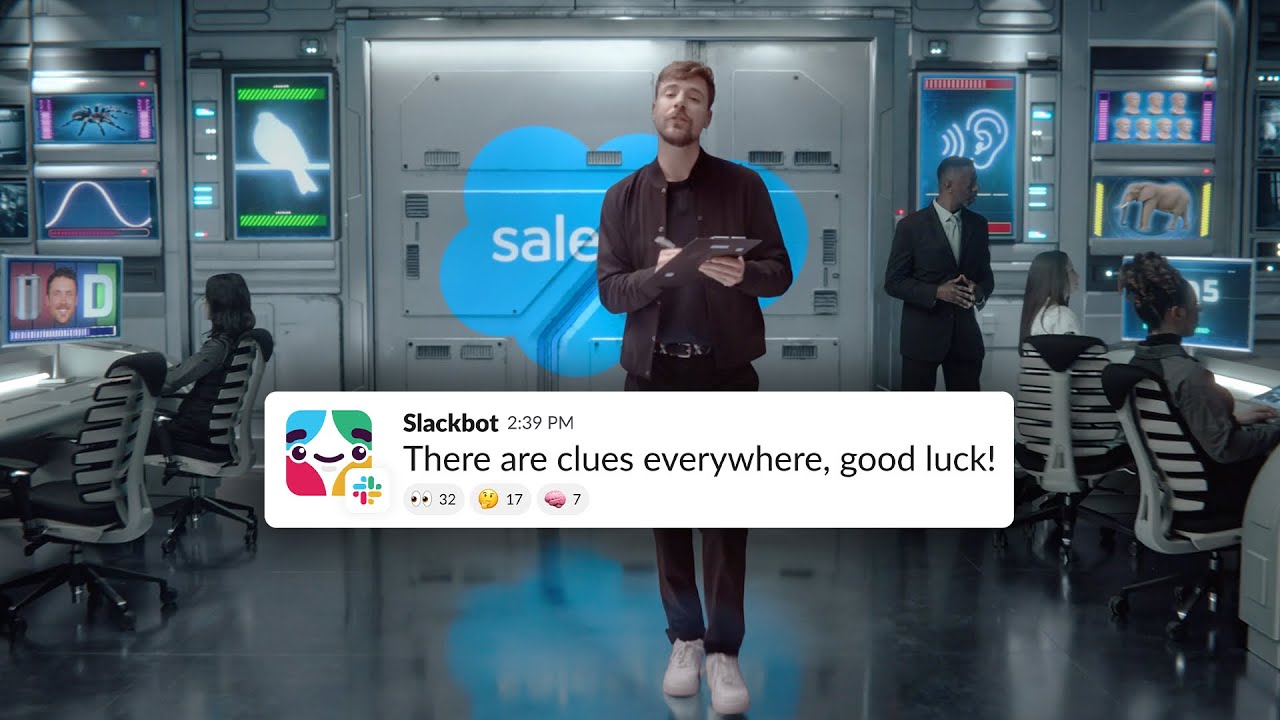
Here is the move, and it is genuinely clever. The Super Bowl spot, built around Slack's Slackbot, hid 25 clues in 30 seconds and ended on a QR code. Scan it and you entered an eight-week global scavenger hunt with a million dollars waiting for the first person to finish.
The puzzles were designed by Lone Shark Games, the people behind Wired's journalist manhunt and Cards Against Humanity's treasure hunt. Clues were scattered across old MrBeast videos, websites, Reddit threads and the physical world. A custom Slackbot ran the whole conversation.
Now read the numbers, because the numbers are the actual ad:
276,000 players over eight weeks, 60 million total visitors
78 distinct Salesforce orgs handling traffic in real time
200,000 requests per minute at peak
2.7 million individual Slackbot conversations
100+ AI-managed puzzles, all running live
Every one of those requests was Salesforce's infrastructure doing the one thing they could never film: holding. The game was not a metaphor for the product. The game was the product, under genuine load, in front of everyone, with the receipts published afterwards in a documentary that pulled 419 million views.
They turned a sales claim into a live demo and let the public run the QA.
What the two giants actually traded
This is the part people miss when they say “big creator plus big brand equals big campaign.” That maths is usually wrong. Most celebrity-brand mashups are two famous things standing next to each other hoping the fame compounds. It rarely does. It usually just splits the credit.
This one worked because each side brought the thing the other physically could not buy.
MrBeast brought attention and a built-in appetite for elaborate games. His audience does not watch an ad and leave. They play. He brought 276,000 people who genuinely wanted to spend eight weeks solving riddles, which is the single hardest input in marketing to manufacture.
Salesforce brought the plumbing. You can hand MrBeast's audience a global real-time game, but someone has to keep 200,000 requests a minute from collapsing into a 404. MrBeast cannot build that. Salesforce can, because it is that.
So the collaboration was not two logos sharing a frame. It was a creator who needed industrial-grade infrastructure meeting a company that needed a reason for anyone to care about its industrial-grade infrastructure. Each one was the other's missing half. That is the rare version of a partnership, and it is why it scaled instead of just trended.
The craft underneath the spectacle
It would have been easy to cut corners on the 30 seconds itself, given the stunt was carrying the idea. They did the opposite. Wally Pfister, the cinematographer behind Inception, co-directed. Beast Studios and Caviar handled execution. The clue-packed spot rewarded the people who freeze-framed it, which is precisely the audience you want leaning in before the hunt even starts.
The principle here has a name we use a lot in the campaign library: build a utility, not an ad. Give people something to do, not something to watch. DoorDash did a version of it by turning every Super Bowl spot into one giant promo code. The Million Dollar Puzzle pushed the same instinct to its logical extreme: the doing and the proving were the same act.
What to actually take from this
You probably do not have a Super Bowl slot, a million-dollar prize, or MrBeast on speed dial. Fine. The transferable idea is cheaper than all of that.
Stop describing your product's best quality and find a way to make people experience it. If your thing is fast, make them race it. If your thing is reliable, dare them to break it. If your thing is clever, hide something and let them find it. The most persuasive ad is the one where the claim and the demonstration are indistinguishable, because then there is nothing left to disbelieve.
Salesforce did not say “trust our scale.” They let a quarter of a million strangers test it for eight weeks and filmed the result. That is not a campaign. That is an alibi with a budget.
Dig into the full breakdown of The Million Dollar Puzzle and the strategy behind it in the Selfstorming campaign library, then go find the thing about your product you have only ever been brave enough to claim.